
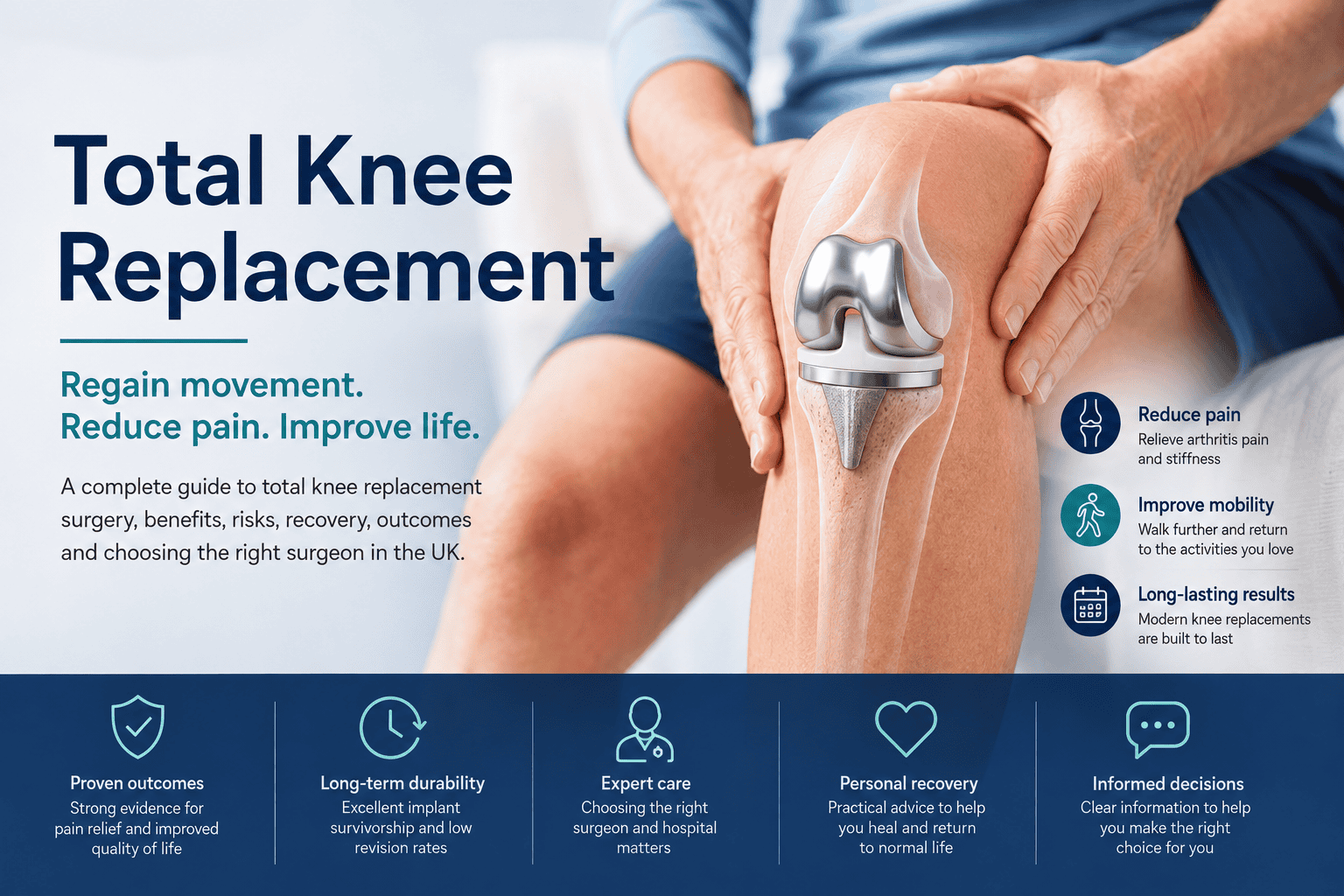
Total knee replacement, sometimes called a full knee replacement, is an established operation for people with severe knee arthritis whose pain, stiffness and loss of function are significantly affecting their quality of life.
For appropriately selected patients, knee replacement can provide substantial and lasting improvements in pain, mobility and quality of life. Most patients are satisfied with their result, and modern knee replacements have excellent long-term survivorship.
But having a successful operation involves more than replacing the damaged joint.
Before deciding to have a total knee replacement, you may want to understand whether you really need surgery, what the operation can realistically achieve, how long an artificial knee is likely to last, what the risks are, what recovery involves, whether robotic surgery offers an advantage, and how to choose the right surgeon.
This guide brings together the clinical evidence and the practical questions patients commonly have when considering knee replacement surgery.
At a glance: what can you expect from a total knee replacement?
Total knee replacement — the key facts
Pain: Most appropriately selected patients experience substantial pain relief.
Function: Knee function and quality of life generally improve significantly after surgery.
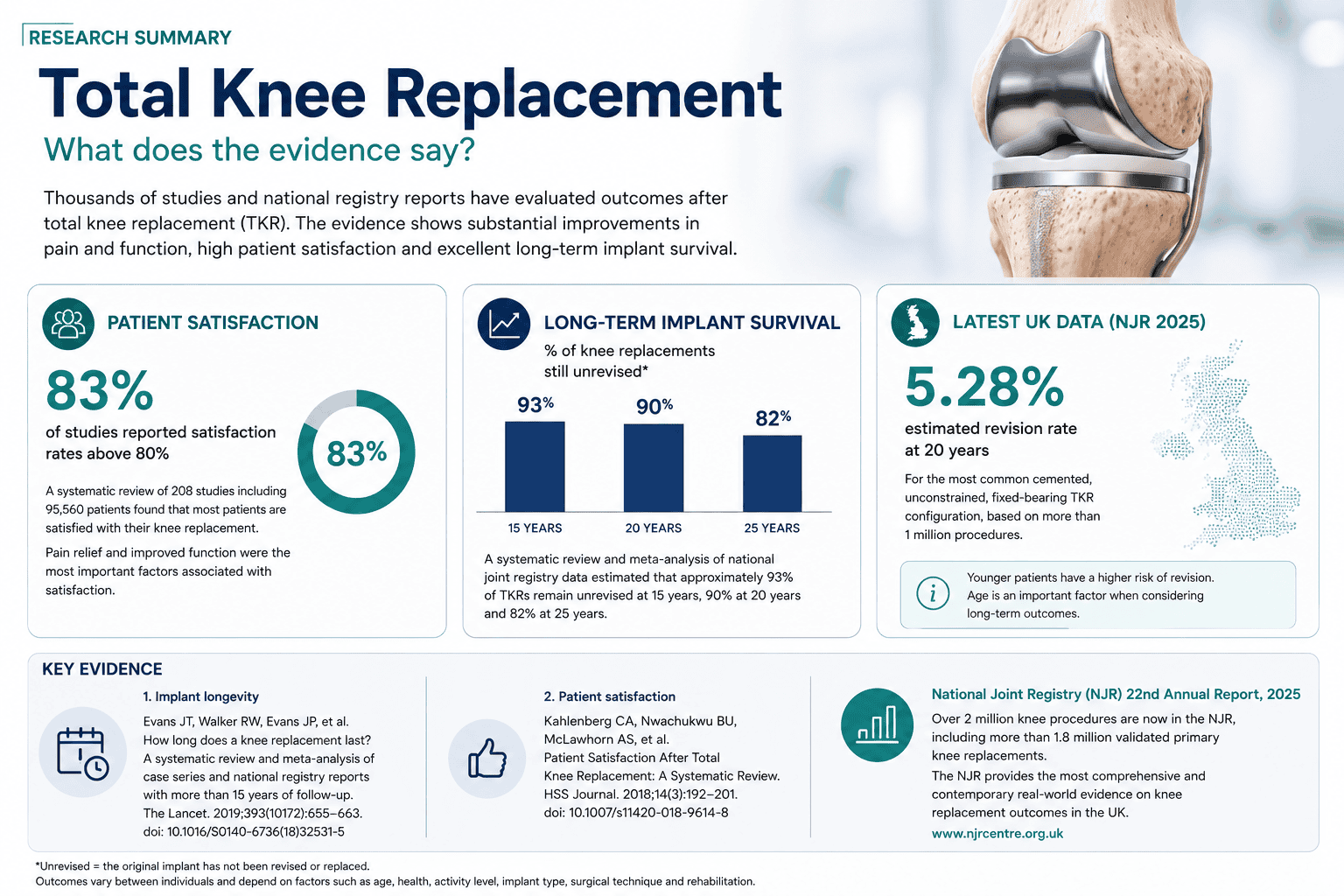
Satisfaction: A systematic review of 208 studies involving 95,560 patients found that 83% of studies reported satisfaction rates above 80%. Pain relief and postoperative function were important determinants of satisfaction. (PubMed Central (PMC))
Longevity: A major systematic review of national registry data found approximately 93% of knee replacements remained unrevised at 15 years, 90% at 20 years and 82% at 25 years. (PubMed Central (PMC))
UK data: The latest National Joint Registry reports a 5.28% estimated revision rate at 20 years for the most common cemented, unconstrained, fixed-bearing total knee replacement configuration, based on more than one million procedures. (NCBI)
Reality: A knee replacement can transform pain and function, but it does not necessarily recreate a completely normal knee. Some patients experience persistent pain, stiffness, difficulty kneeling or other symptoms.
What is a total knee replacement?
A total knee replacement, or TKR, is an operation in which the damaged surfaces of the knee joint are replaced with artificial components.
The knee has three main compartments:
- the medial compartment on the inside;
- the lateral compartment on the outside;
- and the patellofemoral compartment between the kneecap and thigh bone.
During a total knee replacement, the damaged surfaces of the femur and tibia are prepared and replaced with artificial components. The underside of the kneecap may also be resurfaced.
The precise surgical technique, implant design and fixation method vary between patients and surgeons.
Despite the name, a total knee replacement does not mean that every structure in the knee is removed and replaced. Much of the surrounding bone and soft tissue remains.
Is a full knee replacement the same as a total knee replacement?
Yes.
Total knee replacement is the standard medical term. Some patients use phrases such as full knee replacement, complete knee replacement or simply knee replacement.
On this website, we use the medically recognised term total knee replacement, while recognising the terminology patients use when searching for information.
Do I need a total knee replacement?
This is perhaps the most important question to ask before thinking about the operation itself.
An X-ray showing severe arthritis does not, by itself, mean that you need a knee replacement.
NICE recommends considering referral for joint replacement when symptoms such as pain, stiffness, reduced function or progressive deformity are substantially affecting quality of life and non-surgical management is ineffective or unsuitable. NICE also advises against using a numerical score of disease severity as the sole basis for referral.
Your decision may therefore depend on:
- how much pain you experience;
- how far you can walk;
- whether you can climb stairs;
- whether you can sleep comfortably;
- whether you can work;
- whether you can exercise;
- whether you can pursue hobbies;
- whether your knee prevents you doing things that matter to you;
- and whether other treatments have provided sufficient relief.
The important question isn’t simply:
“How bad does my X-ray look?”
It is:
“How much is my knee affecting my life, and have other reasonable treatments stopped being effective?”
When is the right time to have a knee replacement?
There is no single age or pain score at which everyone should have a knee replacement.
Some people wait until their symptoms become severe and everyday activities are difficult. Others choose surgery earlier because their knee is preventing them from working, travelling, exercising or enjoying life.
The decision involves balancing:
How much are you suffering now?
against:
What are the benefits and risks of having surgery now rather than later?
Age is relevant, particularly because younger patients have more years in which an implant could potentially require revision. The latest NJR data show that revision risk following primary TKR is substantially higher in younger age groups. (NCBI)
That does not mean that younger patients should automatically delay surgery.
It means the decision deserves an individual discussion.
Who is suitable for total knee replacement?
Total knee replacement is most commonly performed for people with advanced symptomatic osteoarthritis.
It may also be considered for other forms of severe joint damage, including some inflammatory arthritis and damage following previous injury.
Your assessment will consider:
- your symptoms;
- examination;
- X-rays and sometimes other imaging;
- knee alignment;
- movement;
- stability;
- the condition of the joint;
- your general health;
- previous treatments;
- and what you want to achieve from surgery.
Factors such as obesity, smoking, diabetes and other medical conditions can affect surgical risk and recovery, but they do not automatically mean that knee replacement is inappropriate.
What are the benefits of total knee replacement?
The primary objective is to reduce pain and improve function.
Successful surgery can allow patients to:
- walk further;
- climb stairs more easily;
- sleep better;
- return to exercise;
- resume hobbies;
- return to work;
- travel;
- and regain independence.
The research consistently demonstrates improvements in pain, function and quality of life after total knee replacement.
Patient satisfaction is also generally high. A systematic review covering 208 studies and 95,560 patients found that 83% of studies reported satisfaction above 80%, although the authors highlighted considerable variation in how satisfaction was measured.
How successful is total knee replacement?
There isn’t one statistic that defines success.
A knee replacement can be considered successful because it:
- relieves pain;
- improves walking;
- improves quality of life;
- enables a patient to return to work;
- enables them to return to sport;
- or simply allows them to perform everyday activities again.
The research suggests that most patients experience substantial improvement.
However, successful surgery does not necessarily mean a completely normal-feeling knee.
This is an important distinction to understand before surgery.
Will my knee feel normal after a knee replacement?
Not necessarily.
A replacement can remove the arthritic surfaces responsible for much of your pain, but it does not recreate the original anatomy and sensation of your natural knee.
Some patients notice:
- clicking;
- altered sensation around the scar;
- stiffness;
- difficulty kneeling;
- a feeling that the knee is different;
- or occasional discomfort.
These symptoms do not necessarily mean that the replacement has failed.
Your expectations before surgery therefore matter.
A useful question to ask yourself is:
What do I actually want my new knee to allow me to do?
For one person, success may mean walking the dog without pain.
For another, it may mean returning to golf, cycling, travelling or work.
Being clear about your priorities can help you and your surgeon decide whether your expectations are realistic.
How satisfied are patients after total knee replacement?
Most patients are satisfied, but not everyone is.
The systematic review by Kahlenberg and colleagues examined 208 studies involving 95,560 patients. Eighty-three percent of the studies reported satisfaction above 80%. Postoperative functional outcome and pain relief were among the most important determinants of satisfaction. (PubMed Central (PMC))
However, the authors also pointed out an important limitation: satisfaction was measured differently between studies, and only a minority used validated satisfaction instruments.
So it would be misleading to tell an individual patient:
“You have an 80% chance of being satisfied.”
The evidence is better interpreted as showing that the large majority of patients report a positive outcome, while a significant minority do not achieve everything they hoped for.
Can you still have pain after a knee replacement?
Yes.
Most patients experience substantial improvement, but persistent pain can occur.
Pain during the early weeks after surgery is expected. The more important question is why pain persists or returns later.
Possible causes include:
- normal recovery;
- stiffness;
- soft-tissue irritation;
- infection;
- loosening;
- instability;
- problems around the kneecap;
- nerve-related pain;
- or another condition affecting the leg.
Persistent or worsening pain should be assessed rather than simply assumed to be part of having an artificial joint.
Read our guide to Knee Replacement Risks & Complications →
How long does a knee replacement last?
This is one of the most important questions patients ask.
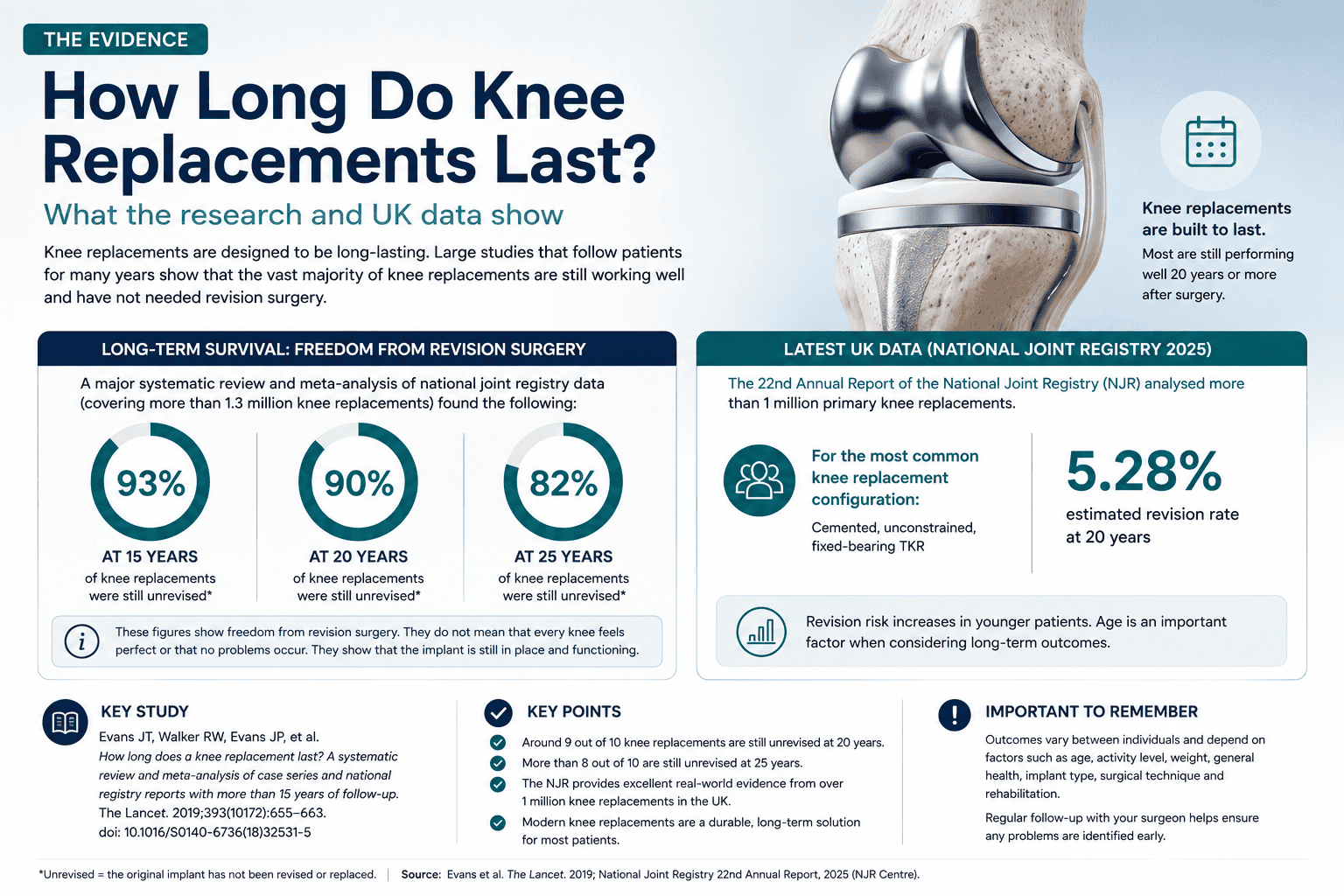
A major systematic review and meta-analysis published in The Lancet examined national joint-registry data and estimated that approximately:
- 93% of total knee replacements remained unrevised at 15 years
- 90% remained unrevised at 20 years
- 82% remained unrevised at 25 years.
These figures describe freedom from revision surgery.
They do not mean that every knee feels exactly the same at 20 or 25 years.
What does the latest UK evidence show?
The National Joint Registry provides much more recent UK-specific information.
For the most common configuration — a cemented, unconstrained, fixed-bearing total knee replacement — the NJR reports an estimated cumulative revision rate of 5.28% at 20 years, based on more than one million procedures. (NCBI)
The NJR describes these results as excellent, while also emphasising that revision risk varies according to factors including age, sex and implant configuration.
What causes a knee replacement to fail?
Most knee replacements do not require revision.
When revision is necessary, possible reasons include:
- infection;
- loosening;
- instability;
- pain;
- fracture;
- wear;
- stiffness;
- malalignment;
- problems involving the kneecap;
- or other mechanical complications.
The NJR records a range of indications for revision, including infection, aseptic loosening, pain, instability, stiffness, fracture and implant wear.
An important point for patients is that revision surgery is not automatically the next step whenever a knee hurts.
The cause needs to be established first.
Does age affect how long a knee replacement lasts?
Yes.
The latest NJR data show a substantially higher probability of revision in younger patients following primary TKR.
There is an obvious reason for part of this difference.
A person receiving a knee replacement at 55 potentially has several additional decades in which the implant could eventually wear, loosen or require revision compared with someone receiving one at 80.
This is one reason why age should form part of the discussion, rather than being treated as an automatic reason either to proceed or to delay surgery.
Which knee replacement implant is best?
There isn’t a single implant that is best for every patient.
Patients may encounter different:
- implant manufacturers;
- designs;
- bearing surfaces;
- fixation methods;
- levels of constraint;
- and component combinations.
The latest NJR report demonstrates why implant configuration matters. It provides detailed outcomes according to fixation, constraint and bearing type rather than treating all knee replacements as identical. (NCBI)
The most common TKR configuration in the UK remains a cemented, unconstrained, fixed-bearing implant, accounting for approximately 68% of TKRs in the NJR data.
A useful question for your surgeon
“Why have you chosen this particular implant for me, and how much experience do you have using it?”
You don’t necessarily need the newest or most technologically elaborate implant.
You need an implant and surgical approach that your surgeon considers appropriate for your knee.
Cemented vs uncemented knee replacement
Knee implants can be fixed using bone cement, without cement, or using a combination of techniques.
Cemented knee replacement
The components are fixed using bone cement.
Uncemented knee replacement
The implant is designed to allow bone to grow onto or into its surface.
Hybrid replacement
Different components use different fixation methods.
In the UK, cemented fixation remains dominant. More than 90% of primary knee replacements in the NJR are all-cemented, with uncemented or hybrid procedures accounting for 6.6% in 2024.
This is a good example of why “newer” does not automatically mean “better.”
Your surgeon should be able to explain why a particular fixation method is appropriate for you.
What about robotic total knee replacement?
Robotic-assisted knee replacement has become increasingly visible to patients considering private surgery.
Robotic systems can assist with:
- preoperative planning;
- measurements;
- implant positioning;
- bone preparation;
- and intraoperative decision-making.
But robotic surgery should not be confused with a robot independently performing your operation.
The surgeon remains responsible for the operation and the clinical decisions.
The important patient question is therefore not simply:
“Does this hospital use a robot?”
but:
“Does robotic assistance offer a meaningful advantage for my particular operation?”
The evidence to date is more nuanced than some marketing suggests. Improvements in alignment and positioning do not automatically translate into better long-term patient outcomes.
For that reason, we would recommend asking your surgeon what evidence they believe supports using robotic assistance in your case.
Read our complete guide to Robotic Knee Replacement →
Does the kneecap need resurfacing?
The kneecap, or patella, is one of the areas where surgical practice has historically varied.
Patellar resurfacing involves replacing the damaged underside of the kneecap with an artificial component.
NICE recommends offering patellar resurfacing to people undergoing primary elective total knee replacement. NICE also notes that the clinical evidence comparing resurfacing, no resurfacing and selective resurfacing has limitations, although its economic analysis supported resurfacing because of reduced hospital readmissions. (Nice UK)
This is therefore another reasonable question to ask your surgeon:
“Will you resurface my kneecap, and why?”
How important is surgeon experience?
The surgeon performing your knee replacement is an important part of the decision.
The latest NJR data provide some useful context.
Over the three years covered by the report, consultant surgeons performed a median of 135 knee procedures. The majority of primary TKR procedures were performed by surgeons doing more than 49 cases per year, while approximately half were performed by surgeons doing more than 97 per year.
That doesn’t mean that a particular annual number makes someone a “good” surgeon.
But it does demonstrate that experience varies considerably.
Questions worth asking
- How many total knee replacements do you perform each year?
- How many have you performed over the last three years?
- What proportion of your practice is knee replacement?
- Which implants do you commonly use?
- What are your revision rates?
- What happens if I develop a complication?
- Who looks after me after discharge?
- Who would perform revision surgery if I needed it?
Read our guide to Choosing a Knee Replacement Surgeon →
Preparing for total knee replacement
The operation itself is only one part of the journey.
Before surgery, you may want to consider:
Exercise
Improving strength and fitness before surgery can help you prepare for rehabilitation.
Weight
If appropriate, weight management may improve health and reduce some surgical risks.
Smoking
Stopping smoking before surgery may reduce complications.
Medical conditions
Conditions such as diabetes, heart disease and respiratory disease should be appropriately assessed and managed.
Medication
Your surgical team should review your medications, particularly anticoagulants and medicines affecting diabetes or blood pressure.
Home preparation
Think about:
- stairs;
- chairs;
- toilet arrangements;
- showering;
- transport;
- shopping;
- food;
- pets;
- and who will help you during the first few days.
What happens on the day of surgery?
Although individual hospitals differ, the process usually involves:
- Admission and preoperative assessment
- Anaesthetic assessment
- Anaesthesia
- The knee replacement operation
- Recovery from anaesthesia
- Pain management
- Getting up and walking
- Physiotherapy
- Discharge planning
Modern knee replacement pathways increasingly aim to get patients moving soon after surgery.
Total knee replacement recovery
Recovery is a process rather than a single event.
The first few days
You can expect:
- pain and swelling;
- physiotherapy;
- walking with assistance;
- exercises;
- and gradual increases in independence.
The first few weeks
Walking generally becomes easier, although swelling, stiffness and tiredness can remain significant.
Around 6–12 weeks
Many patients are becoming substantially more mobile and independent.
Three to six months
Strength, confidence and function can continue improving.
Beyond six months
Some patients continue to notice improvements for considerably longer.
There is no universal recovery timetable. Age, fitness, preoperative function, health, surgery and rehabilitation all influence recovery.
Read our detailed Knee Replacement Recovery guide →
When can I drive after knee replacement?
There is no single safe date that applies to everyone.
Your ability to drive depends on factors including:
- pain;
- medication;
- reaction time;
- strength;
- mobility;
- which knee was operated on;
- and whether you can safely control the vehicle.
You should follow your surgical team’s advice and only return to driving when you are safely able to control the vehicle and meet your legal and insurance requirements.
When can I return to work?
Return to work varies considerably.
A systematic review and meta-analysis found a pooled return-to-work rate of 65%, with a mean return time of approximately 13 weeks, although results varied substantially between studies. Return-to-work rates increased over time, reaching approximately 90% at one year in the studies providing time-point data.
Your job makes a major difference.
A desk-based job is very different from:
- construction;
- nursing;
- warehouse work;
- driving;
- teaching;
- or a job involving prolonged standing.
Can I exercise after knee replacement?
Exercise is an important part of maintaining the benefits of your knee replacement.
Common activities include:
- walking;
- cycling;
- swimming;
- gym-based strengthening;
- golf;
- and other lower-impact activities.
Your physiotherapist or surgeon can advise you about when and how to progress.
Can I return to sport?
For many patients, yes.
A systematic review and meta-analysis found a pooled return-to-sport rate of approximately 82% after total knee arthroplasty. Return was substantially more common for lower-intensity activities than high-intensity sports. (PubMed)
Activities such as walking, cycling, swimming and golf are generally more compatible with a knee replacement than high-impact activities.
The important point is:
Returning to activity is a goal of rehabilitation, but your individual surgeon should advise you about higher-impact sports.
Can I kneel after a knee replacement?
You may be able to, but kneeling can remain difficult or uncomfortable after total knee replacement.
This is important because some patients interpret difficulty kneeling as evidence that something has gone wrong.
It doesn’t necessarily mean that.
If kneeling is particularly important to you because of your work, hobbies or lifestyle, tell your surgeon before surgery.
Can I travel after knee replacement?
Travel is usually possible after recovery, but timing depends on:
- mobility;
- wound healing;
- pain;
- blood-clot risk;
- length of journey;
- and your individual medical circumstances.
Long-haul travel deserves particular discussion because prolonged immobility can increase the risk of venous thromboembolism.
Ask your surgical team when they consider travel appropriate for you.
Can I have both knees replaced?
If both knees are severely affected, there are several possible approaches.
You may have:
- one knee replaced first and the second later;
- or, in selected patients, both knees replaced during the same period.
The appropriate approach depends on:
- age;
- general health;
- fitness;
- anaesthetic risk;
- severity of both knees;
- home support;
- and the surgeon’s assessment.
What happens if I’m not happy with my knee replacement?
Persistent symptoms do not automatically mean that the replacement has failed.
Your surgeon may investigate:
- your symptoms;
- examination findings;
- X-rays;
- blood tests;
- infection;
- implant positioning;
- stability;
- loosening;
- or other causes.
Treatment depends on the underlying problem.
Sometimes non-operative treatment is appropriate. In other cases, further surgery may be necessary.
Total vs partial knee replacement
For some patients, the decision isn’t simply whether to have a knee replacement.
It is which type of knee replacement is most appropriate.
If osteoarthritis is isolated to the medial compartment, NICE recommends offering an appropriate patient a choice between partial and total knee replacement, with the potential benefits and risks discussed.
A partial replacement may offer advantages such as:
- preservation of more of the natural knee;
- faster recovery;
- and potentially fewer early complications.
Total replacement treats the knee more comprehensively and generally has lower revision rates in UK registry data.
The decision depends on the pattern of arthritis, your knee, your priorities and your surgeon’s assessment.
Read our complete guide to Unicompartmental / Partial Knee Replacement →
How much does a private total knee replacement cost?
The cost of private knee replacement varies considerably depending on:
- hospital;
- surgeon;
- location;
- implant;
- complexity;
- anaesthetic;
- rehabilitation;
- and what is included in the package.
A quoted price should therefore be compared carefully to establish exactly what is included.
Read our guide to Private Knee Replacement Cost in the UK →
What does the research say about total knee replacement?
Evidence summary
Total knee replacement: what does the evidence tell us?
Patient satisfaction: A systematic review of 208 studies involving 95,560 patients found that 83% of studies reported satisfaction above 80%. Postoperative function and pain relief were important determinants of satisfaction. (PubMed Central (PMC))
Long-term survival: A major systematic review of national registry data estimated revision-free survival of approximately 93% at 15 years, 90% at 20 years and 82% at 25 years. (PubMed Central (PMC))
Current UK data: The 2025 National Joint Registry reports a 5.28% estimated revision rate at 20 years for the most common cemented, unconstrained, fixed-bearing TKR configuration, based on more than one million procedures. (NCBI)
The overall picture: Total knee replacement has a strong evidence base for improving pain and function and has excellent long-term implant survivorship. However, a minority of patients experience persistent symptoms or dissatisfaction, and revision surgery remains possible.
Key academic research
Evans JT et al. — The Lancet, 2019
How long does a knee replacement last? A systematic review and meta-analysis of case series and national registry reports with more than 15 years of follow-up.
This major study analysed national joint-registry data and found pooled TKR survival of 93.0% at 15 years, 90.1% at 20 years and 82.3% at 25 years. (PubMed Central (PMC))
Why it matters:
This is one of the key studies for answering the patient question:
“How long will my knee replacement last?”
Kahlenberg CA et al. — HSS Journal, 2018
Patient Satisfaction After Total Knee Replacement: A Systematic Review.
This review examined 208 studies involving 95,560 patients and found that most studies reported satisfaction above 80%. It also found that postoperative functional outcome and pain relief were important predictors of satisfaction. (PubMed Central (PMC))
Why it matters:
It addresses something that implant survival statistics don’t capture:
“How do patients actually feel about their knee replacement?”
National Joint Registry: UK evidence
For UK patients, the National Joint Registry provides particularly valuable real-world evidence.
The NJR now contains more than two million knee procedures, with more than 1.8 million validated primary knee replacements available for analysis. (NCBI)
The typical patient receiving a knee replacement in 2024 was approximately 70 years old, with an average BMI of 30.9.
The NJR also shows that outcomes vary according to implant configuration, age and other factors.
That is why it is more useful to look at specific evidence and outcomes than to assume every knee replacement is identical.
Questions to ask your knee replacement surgeon
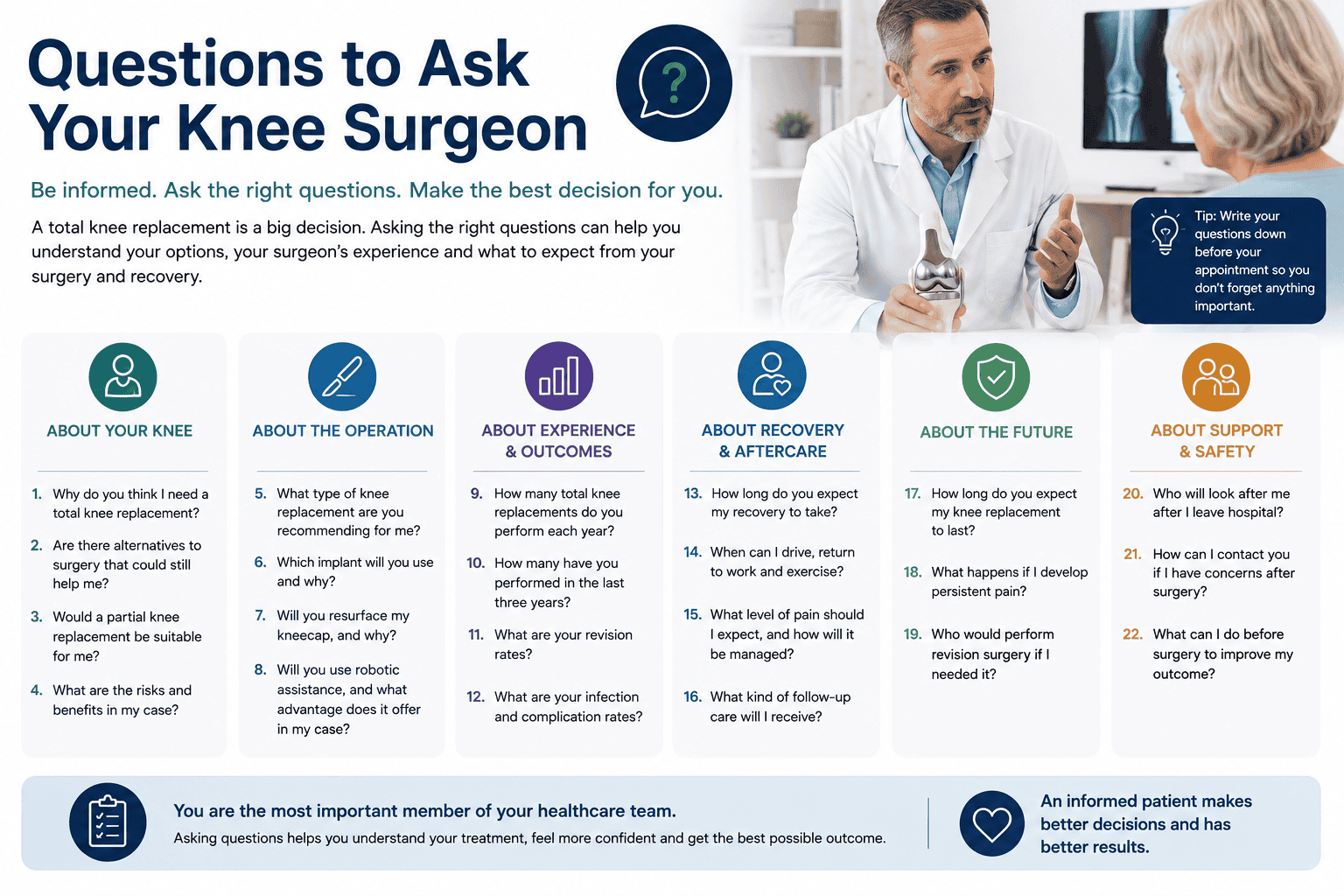
Before making a decision, consider asking:
About your knee
- Why do you think I need a total knee replacement?
- Are there reasonable alternatives I should consider?
- Would a partial knee replacement be suitable for me?
About the operation
- What type of knee replacement are you recommending?
- Which implant will you use?
- Why have you chosen that implant?
- Will you resurface my kneecap, and why?
- Will you use robotic assistance, and what advantage does it offer in my case?
About experience
- How many total knee replacements do you perform each year?
- How many have you performed in the last three years?
- What is your revision rate?
- What are your complication and infection rates?
About recovery
- How long do you expect my recovery to take?
- When can I drive, work and exercise?
- What activities do you expect me to be able to return to?
About the future
- How long do you expect my replacement to last?
- What happens if I develop persistent pain?
- Who would perform revision surgery if I needed it?
Is total knee replacement right for you?
The decision to have a knee replacement is ultimately personal.
The evidence suggests that for appropriately selected patients with severe symptomatic knee arthritis, total knee replacement can provide substantial and lasting improvements in pain, function and quality of life.
But the operation is not simply about replacing an arthritic joint.
You are choosing:
- whether to have surgery;
- when to have it;
- which type of replacement;
- which implant;
- which surgeon;
- which hospital;
- and what you want your life after surgery to look like.
The better informed you are before making those decisions, the better prepared you are to have a meaningful conversation with your surgeon.
Related knee replacement guides
Knee Replacement Cost
Understand private knee replacement prices in the UK and what should be included in a treatment package.
Knee Replacement Risks & Complications
A detailed guide to the potential complications of knee replacement and what you should know before surgery.
Knee Replacement Recovery
A practical guide to what happens after surgery and how recovery progresses.
Unicompartmental / Partial Knee Replacement
Understand when a partial knee replacement may be an alternative to total knee replacement.
Robotic Knee Replacement
Understand what robotic assistance actually does and what the evidence says about its benefits.
Choosing a Knee Replacement Surgeon
The questions to ask and factors to consider when choosing the surgeon who will perform your operation.
Frequently asked questions
Is a full knee replacement the same as a total knee replacement?
Yes. Total knee replacement is the standard medical term; “full knee replacement” is a phrase some patients use when searching for information.
How long does a total knee replacement last?
Modern knee replacements have excellent long-term survivorship. Registry research has estimated approximately 90% survival at 20 years, while current UK NJR data show a 5.28% 20-year revision rate for the most common TKR configuration.
Is total knee replacement successful?
Yes, for most appropriately selected patients it substantially improves pain and function. Most published studies also report high patient satisfaction.
Will my knee feel completely normal?
Not necessarily. Many patients have an excellent functional result but still notice that their replacement feels different from a natural knee.
Can I kneel after knee replacement?
You may be able to, but kneeling can remain difficult or uncomfortable after surgery.
How long does knee replacement recovery take?
Recovery varies considerably. Many patients make substantial progress during the first 6–12 weeks, but strength and function can continue improving for many months.
Can I drive after knee replacement?
Eventually, most patients can return to driving, but there is no universal timetable. You need to be safely able to control the vehicle and should follow your surgical team’s advice.
Can I return to sport?
Many patients return to recreational sport, particularly lower-impact activities. A systematic review found an overall pooled return-to-sport rate of 82%, although rates were substantially lower for high-intensity sports.
Is robotic knee replacement better?
Robotic systems can improve aspects of surgical planning and implant positioning, but greater technological precision does not automatically mean better patient outcomes. Ask your surgeon what benefit robotic assistance offers in your particular case.
Is total or partial knee replacement better?
Neither is universally better. For patients with isolated medial compartment osteoarthritis who are suitable for both, NICE recommends offering a choice and discussing the advantages and disadvantages of each.
How do I choose a knee replacement surgeon?
Look beyond the hospital name or technology advertised. Consider the surgeon’s experience, procedure volume, outcomes, implant choice, approach to complications and postoperative care.
Understanding the evidence
Research describes outcomes in groups of patients. It cannot predict exactly what will happen to you.
Your individual outcome will depend on factors including your knee, general health, age, activity level, expectations, surgical technique, rehabilitation and other circumstances.
The information on Active Again is intended to help you understand your options and prepare for a discussion with a qualified healthcare professional. It is not a substitute for an individual medical assessment or medical advice.