
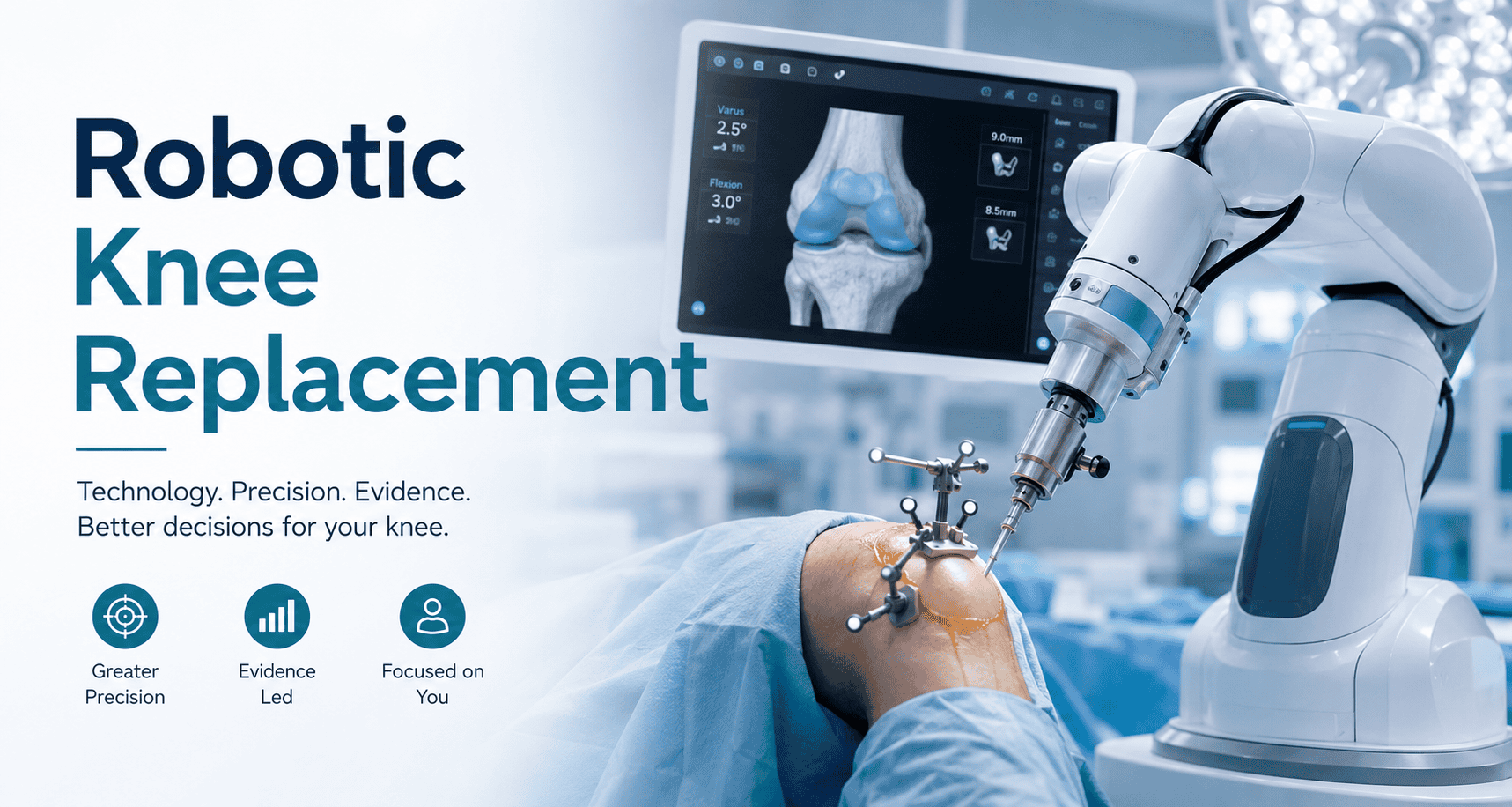
Robotic knee replacement is becoming increasingly available to patients considering knee replacement surgery in the UK.
Robotic technology is used by orthopaedic surgeons to assist with aspects of planning and performing knee replacement surgery. Depending on the system being used, it can provide detailed information about the patient’s anatomy, assist with surgical planning and provide real-time guidance during the operation.
If you are considering robotic knee replacement, you may have questions about how the technology works, whether it is suitable for you, how it differs from conventional knee replacement, what it costs and what you should ask your surgeon.
This guide explains some of the technology and some issues patients may wish to consider. We also provide references to published research and UK guidance so that you can read the evidence for yourself and discuss it with your surgeon.
What is robotic knee replacement?
Robotic knee replacement is knee replacement surgery in which an orthopaedic surgeon uses robotic and computer-assisted technology during the procedure.
The technology can assist with:
- planning the operation;
- assessing the anatomy of the knee;
- measuring alignment;
- planning the position of the implant;
- preparing the bone;
- and providing information and guidance during surgery.
The precise way the technology is used depends on the particular robotic system and the surgeon’s technique.
The robot does not perform the operation
This is an important distinction.
Robotic knee replacement is surgery performed by an orthopaedic surgeon using robotic technology.
The surgeon remains responsible for assessing the patient, deciding whether knee replacement is appropriate, planning the operation and making clinical decisions during surgery.
NICE describes robot-assisted surgery as technology used to support the work of the surgeon, providing imaging, information and feedback during the procedure.
How does robotic knee replacement work?
The exact process varies between robotic systems.
Some systems use imaging before surgery, while others use information collected during the operation.
Depending on the technology, the system may help the surgeon:
- create a three-dimensional representation of the knee;
- assess the patient’s anatomy;
- plan bone cuts;
- determine implant positioning;
- assess alignment;
- assess the balance of the knee;
- and maintain the planned surgical parameters during the procedure.
The surgeon uses this information alongside their clinical judgement.
NICE notes that robotic technologies differ in their functionality, imaging requirements and compatibility with implants. (Nice)
Why are robotic systems used for knee replacement?
One of the main reasons surgeons use robotic technology is to assist with precision and control during surgery.
The technology may provide detailed information about the individual patient’s knee and allow the surgeon to plan the operation before making the relevant bone cuts.
It can also provide information during the operation that may help the surgeon assess whether the planned position and alignment are being achieved.
However, robotic knee replacement is not a completely different operation from conventional knee replacement.
The fundamental aim remains the same:
to remove the damaged parts of the knee and replace them with artificial components designed to relieve pain and improve function.
Is robotic knee replacement different from conventional knee replacement?
The underlying operation is similar, but the technology used to plan and perform aspects of the procedure differs.
With conventional knee replacement, surgeons use established surgical instruments and techniques to determine implant position and alignment.
With robotic-assisted surgery, the surgeon additionally uses a computer-assisted robotic system to provide information and guidance during the procedure.
The precise differences depend on the robotic system being used.
Patients should therefore ask their surgeon:
What will the robotic system actually do differently during my operation?
What robotic knee replacement systems are available in the UK?
There is not one single type of robotic knee replacement system.
NICE’s current UK assessment includes six technologies:
- ApolloKnee System
- CORI Surgical System
- Mako SmartRobotics
- ROSA Knee Solution
- SkyWalker Robotic-assisted Technology
- VELYS Robotic-Assisted Solution.
These systems differ in their:
- imaging requirements;
- planning methods;
- instruments;
- robotic assistance;
- surgical workflow;
- and implant compatibility.
NICE’s assessment describes the six technologies as “closed” systems, meaning that they are designed to be used with implants from the company associated with the robotic technology. (Nice)
This is one reason it is useful to ask your surgeon which system they use and why it has been selected.
Does every patient need robotic knee replacement?
No. Robotic assistance is not automatically appropriate for every patient.
The decision may depend on:
- your diagnosis;
- the condition and anatomy of your knee;
- the type of knee replacement being considered;
- previous surgery;
- the degree of deformity;
- the particular robotic system;
- and your surgeon’s experience.
NICE advises clinicians to use their clinical judgement when deciding whether robot-assisted or conventional surgery is most appropriate for an individual patient.
Your surgeon should therefore be able to explain why robotic assistance is being recommended for you.
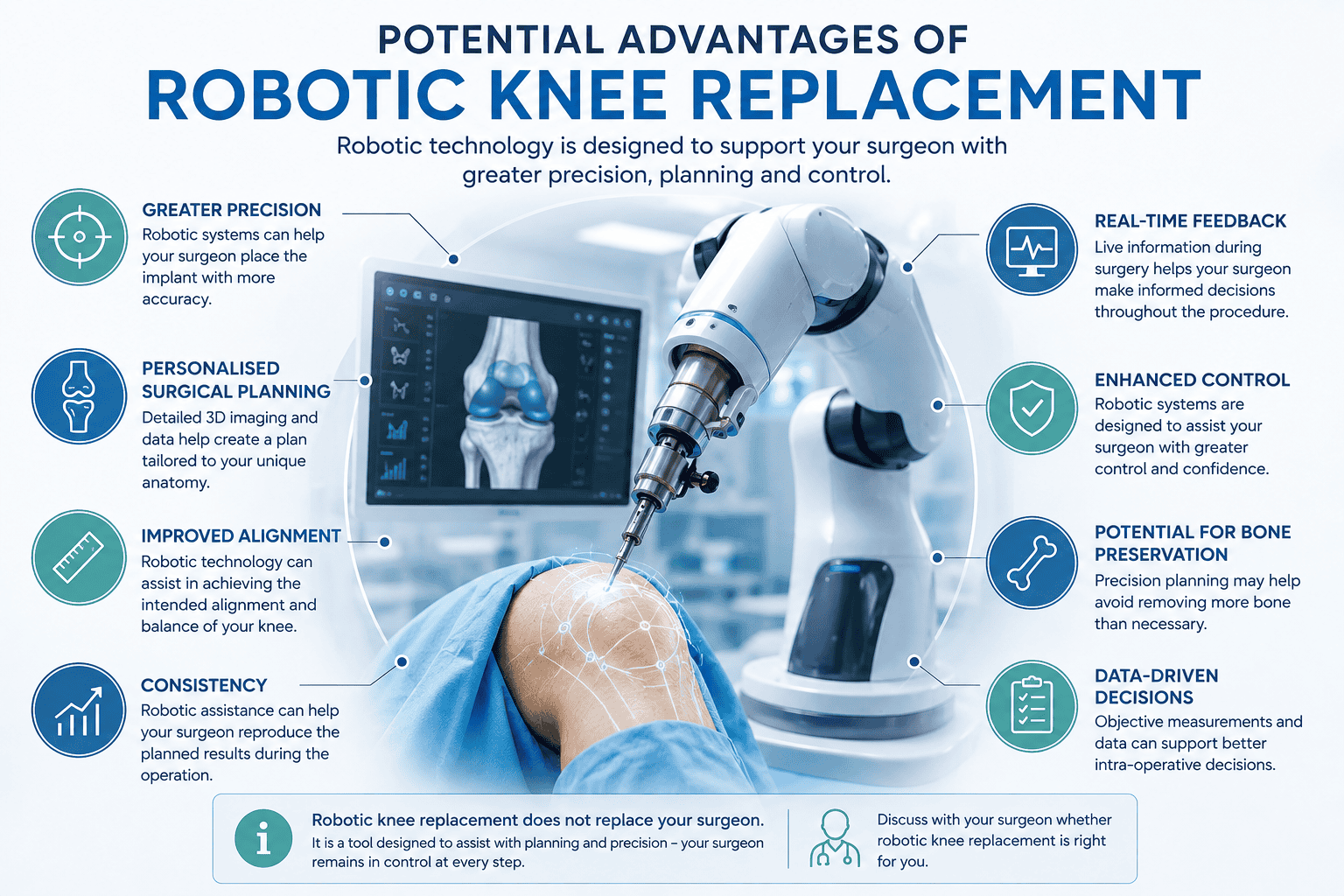
What are the potential advantages of robotic knee replacement?
Potential advantages discussed in the clinical literature and by healthcare professionals include:
Detailed surgical planning
Computer-assisted technology can allow the surgeon to plan aspects of the procedure using detailed information about the patient’s knee.
Precision
Robotic systems can assist with precise positioning of the components of the knee replacement.
Individualised planning
Some systems allow the surgical plan to be tailored to the patient’s individual anatomy.
Real-time information
Some systems provide information to the surgeon during the operation that can assist with alignment and other aspects of the procedure.
Reproducibility
The technology is intended to help the surgeon reproduce the planned surgical parameters during the operation.
These potential advantages should be discussed with your surgeon in the context of your particular knee.
What are the limitations and considerations?
Robotic knee replacement also involves considerations that patients should understand.
The technology does not replace the surgeon
The surgeon remains responsible for the operation and the clinical decisions made during it.
Different systems work differently
There is no single “robotic knee replacement” technique.
Experience matters
A surgeon may have extensive experience in knee replacement but be relatively new to a particular robotic platform.
It is therefore reasonable to ask how many procedures the surgeon has performed using the system being proposed.
Additional technology may have additional costs
Depending on the system and treatment provider, there may be costs associated with:
- equipment;
- maintenance;
- training;
- imaging;
- and other resources.
Some systems require additional imaging
NICE notes that imaging requirements differ between the technologies.
Does robotic knee replacement cost more?
There is no single UK price for robotic knee replacement.
Private treatment costs can vary depending on:
- the surgeon;
- hospital;
- location;
- implant;
- robotic system;
- anaesthetic;
- imaging;
- hospital stay;
- physiotherapy;
- and follow-up arrangements.
If you are considering private robotic knee replacement, ask for a complete treatment price and check exactly what is included.
Questions to ask about the cost
- Is the surgeon’s fee included?
- Is the anaesthetist’s fee included?
- Is the robotic technology included?
- Is any CT or other imaging included?
- Is the implant included?
- Is physiotherapy included?
- Are follow-up appointments included?
- What happens if additional treatment is required?
What should I ask my surgeon about robotic knee replacement?
The technology itself is only part of the decision.
About your operation
- Why do you recommend knee replacement for me?
- What type of knee replacement are you recommending?
- Would conventional knee replacement also be appropriate?
- Why are you recommending robotic assistance?
- What specifically will the robotic system add to my operation?
About the robotic system
- Which robotic system will you use?
- How does it work?
- Does it require a CT scan or other imaging?
- Which implant will be used?
- How long have you been using this system?
About your surgeon’s experience
- How many knee replacements do you perform each year?
- How many are robotic-assisted?
- How many procedures have you performed using this particular robotic system?
- How do you monitor your outcomes?
- What happens if I develop a complication or require further surgery?
About recovery
- What recovery should I realistically expect?
- When should I expect to walk independently?
- When can I drive?
- When can I return to work?
- What activities and sports should I expect to resume?
About the evidence
- What does the research say about robotic versus conventional knee replacement?
- What evidence supports your recommendation?
- Are there any important uncertainties I should understand?
One particularly useful question
“What benefit do you expect the robotic technology to provide in my particular case?”
This encourages a discussion about your individual circumstances, rather than simply whether a hospital offers robotic surgery.
What does the research say?
Robotic-assisted knee replacement is an evolving area of orthopaedic research.
There are studies comparing robotic-assisted and conventional knee replacement, including:
- randomised controlled trials;
- systematic reviews;
- meta-analyses;
- long-term comparative studies;
- and health-technology assessments.
Different studies have examined different outcomes, including:
- implant positioning;
- alignment;
- pain;
- function;
- patient satisfaction;
- complications;
- revision surgery;
- implant survival;
- recovery;
- and costs.
We recommend that patients interested in robotic knee replacement read the research themselves and discuss the findings with their orthopaedic surgeon.
The following are useful starting points.
Key research papers
1. Fu X et al. — 2024
Comparison of robotic-assisted total knee arthroplasty: an updated systematic review and meta-analysis.
Journal of Robotic Surgery, 2024;18:292.
This systematic review compares robotic-assisted and manual total knee replacement across clinical and imaging outcomes.
2. Chen J et al. — 2025
Survivorship in robotic total knee arthroplasty compared with conventional total knee arthroplasty: a systematic review and meta-analysis.
Arthroplasty, 2025;7:21.
This paper specifically examines implant survivorship following robotic and conventional total knee replacement.
3. Long-term randomised comparative research
A large randomised study has examined robotic-assisted versus conventional total knee replacement with long-term follow-up.
Long-term studies are particularly relevant to patients because they can help address questions about durability and revision surgery.
When reading research, pay attention to the study design, number of patients, length of follow-up and outcomes being measured.
NICE guidance for UK patients
NICE published HTG743: Robot-assisted surgery for orthopaedic procedures: early value assessment in April 2025.
The guidance covers robot-assisted surgery for knee and hip replacement and includes six robotic technologies. NICE recommends that these technologies can be used in the NHS during an evidence-generation period while further evidence is collected. (Nice)
NICE also provides information about:
- the technologies;
- their indications;
- evidence generation;
- patient outcomes;
- and the current uncertainties surrounding their use.
Why should patients read the research?
Medical research can sometimes appear complicated, and different studies can produce different findings.
A paper may examine:
- a particular robotic system;
- a particular type of implant;
- a particular group of patients;
- or a particular outcome.
A result from one study therefore does not necessarily tell you what will happen to you personally.
Your surgeon can help you understand:
- which evidence is most relevant to your circumstances;
- how it relates to the robotic system being proposed;
- whether conventional surgery would also be appropriate;
- and what they expect the technology to contribute to your operation.
How to think about the evidence
When reading a research paper, consider:
How many patients were studied?
Larger studies can provide more reliable estimates, although study quality remains important.
Was it randomised?
Randomised controlled trials can reduce some forms of bias when comparing treatments.
How long were patients followed?
A study reporting results after six months cannot answer the same questions as one following patients for ten or fifteen years.
What outcome was measured?
A difference in X-ray alignment is different from a difference in pain, mobility or quality of life.
Was the study about the same robotic system?
Different technologies work differently, so results from one system should not automatically be assumed to apply identically to another.
Robotic knee replacement: questions to consider before making your decision
Before deciding whether robotic-assisted surgery is right for you, consider discussing:
Your diagnosis
- Is knee replacement appropriate for me?
- What alternatives do I have?
The technology
- Which robotic system is being proposed?
- Why?
- What does it actually do during my operation?
Your surgeon
- How experienced are you with knee replacement?
- How experienced are you with this robotic system?
The evidence
- What research supports its use?
- What are the important uncertainties?
The practical issues
- What will my recovery involve?
- What will it cost?
- What is included in the price?
Your alternatives
- Would conventional knee replacement be equally appropriate?
- What are the advantages and disadvantages of each approach in my particular circumstances?
Robotic knee replacement and partial knee replacement
Robotic technology is also used for partial or unicompartmental knee replacement.
The considerations surrounding robotic partial knee replacement are not necessarily identical to those surrounding robotic total knee replacement.
If you are considering a partial knee replacement, our separate guide explains:
Partial / Unicompartmental Knee Replacement
[Internal link to your partial knee replacement page]
Robotic knee replacement: the bottom line
Robotic-assisted knee replacement is an increasingly available technology that allows surgeons to use computer-assisted planning and guidance during knee replacement surgery.
There are different robotic systems, and the way they are used varies.
For patients considering robotic knee replacement, the most important questions are not simply whether a hospital has a robot.
They are:
Why is robotic assistance being recommended for me?
What does the technology add to my particular operation?
How experienced is my surgeon with the technology?
What does the published research show?
Would conventional knee replacement also be appropriate?
What will the treatment cost and what is included?
Reading the research and discussing it with your orthopaedic surgeon can help you understand the options and make a decision that is appropriate for your individual circumstances.
Frequently asked questions
What is robotic knee replacement?
Robotic knee replacement is knee replacement surgery performed by an orthopaedic surgeon using robotic and computer-assisted technology to help with aspects of planning and performing the procedure.
Does a robot perform the knee replacement?
No. The surgeon performs the operation and remains responsible for the clinical decisions.
Is robotic knee replacement suitable for everyone?
No. Suitability depends on the patient’s circumstances, the type of knee replacement required, the robotic system and the surgeon’s clinical judgement.
What robotic knee replacement systems are available in the UK?
NICE’s current assessment includes ApolloKnee, CORI, Mako SmartRobotics, ROSA Knee, SkyWalker and VELYS.
Does robotic knee replacement require a CT scan?
It depends on the system. Some robotic systems use preoperative imaging while others use image-free or intraoperative planning. (Nice)
Does robotic knee replacement cost more?
It can. Costs vary between providers and may depend on the robotic technology, imaging, hospital, surgeon and what is included in the treatment package.
Should I choose robotic or conventional knee replacement?
This is an individual clinical decision. Discuss the options, the evidence and your particular circumstances with your orthopaedic surgeon.
How do I choose a robotic knee replacement surgeon?
Consider the surgeon’s experience in knee replacement, their experience with the particular robotic system, their approach to patient selection and their arrangements for postoperative care.
About the information on this page
This page provides general educational information about robotic knee replacement and is intended to help patients prepare for discussions with their healthcare professionals.
Research in robotic-assisted knee replacement continues to develop. Individual studies can produce different results, and findings from groups of patients cannot predict exactly what will happen to an individual patient.
Evidence reviewed: August 2026
Active Again does not recommend a particular robotic system or manufacturer. Patients should discuss whether robotic-assisted or conventional knee replacement is appropriate for them with their treating clinician.
Popular Guides
Knee Replacement
Knee Replacement Recovery
Knee Replacement
Knee Replacement Cost
Robotic Knee Replacement
Partial Knee Replacement
Total Knee Replacement
Revision Knee Replacement