
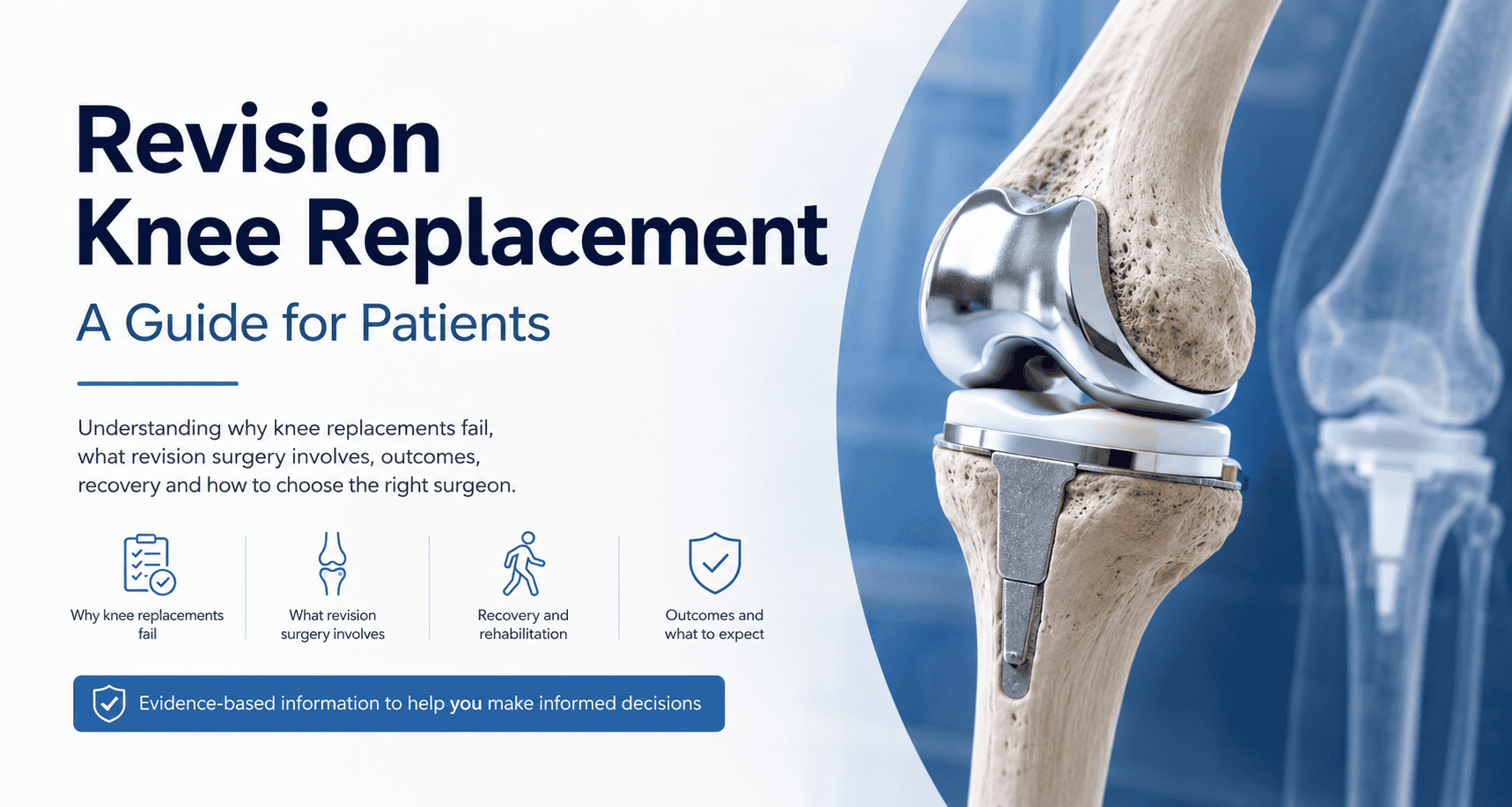
If you have already had a knee replacement but are experiencing pain, stiffness, instability or other problems, you may have been told that you need revision knee replacement surgery.
Revision surgery involves repairing or replacing some or all of an existing knee replacement. It may be recommended because of infection, loosening, instability, wear, fracture or another problem affecting the artificial joint.
Revision knee replacement is not simply a second version of the original operation. It can range from replacing a single component to a complex reconstruction involving significant bone loss, infection or specialised implants.
The most important first question is therefore:
Why has my knee replacement failed, and what needs to be done to fix the problem?
This guide explains how a problematic knee replacement is investigated, what revision surgery can involve, what the research says about outcomes and longevity, recovery and complications, and how to approach choosing a revision knee replacement surgeon.
Revision knee replacement: the quick guide
| Patient question | Short answer |
|---|---|
| Why do knee replacements fail? | Infection, loosening, instability, wear, fracture, stiffness and other mechanical problems |
| Does a painful knee replacement always need revision? | No. The cause should be investigated first |
| Can only part of the replacement be revised? | Sometimes |
| Can revision surgery improve pain and function? | Yes. Research shows many patients experience meaningful improvement |
| Is revision as predictable as primary knee replacement? | Generally not |
| Can a revision fail again? | Yes |
| Does the reason for revision matter? | Very significantly |
| Should I ask about my surgeon’s revision experience? | Yes |
What is revision knee replacement?
Revision knee replacement is surgery performed on a knee that has previously undergone knee replacement.
Depending on the problem, the surgeon may:
- replace the plastic bearing or insert;
- replace one component;
- replace the femoral component;
- replace the tibial component;
- replace both major components;
- remove an infected implant;
- reconstruct damaged or missing bone;
- or perform a more complex reconstruction using specialised implants.
The extent of surgery depends largely on why the original knee replacement has failed and the condition of the implant, bone and surrounding soft tissues.
Revision knee replacement is therefore not one standard operation.
Why might a knee replacement need revision?
There are several reasons why an artificial knee may eventually require further surgery.
Infection
An infection involving the artificial joint, known as a periprosthetic joint infection, can require revision surgery.
Treatment can involve antibiotics and further surgery, sometimes including removal and later replacement of the implant.
Aseptic loosening
An implant can become loose from the surrounding bone without infection being present.
Aseptic loosening is an important cause of later revision surgery.
Instability
The knee can become unstable because of problems involving the implants, ligaments or surrounding soft tissues.
Patients may describe the knee as:
- giving way;
- buckling;
- feeling insecure;
- or not feeling properly supported.
Wear
The bearing surfaces within a knee replacement can wear over time.
Wear can sometimes contribute to inflammation, bone loss or loosening.
Fracture
A fracture can occur around a knee replacement, particularly following an injury or fall.
Treatment depends on the location of the fracture and whether the existing implant remains securely fixed.
Stiffness
Some patients develop significant loss of movement following knee replacement.
Treatment depends on the cause and severity and does not necessarily require complete revision.
Mechanical or alignment problems
Problems involving implant position, alignment, sizing or the mechanics of the knee can sometimes contribute to pain or poor function.
Persistent pain
Persistent pain after knee replacement does not automatically mean that the implant needs to be revised.
There are many possible causes of pain, and careful investigation is important before further surgery is considered.
Why do knee replacements fail?
A 2025 systematic review and meta-analysis examined more than 1.38 million revision knee arthroplasties. Among the documented causes, infection and aseptic loosening were the most common. Infection was particularly prominent among earlier revisions, while aseptic loosening was the most common cause of later revision in the analysis. (ScienceDirect)
The researchers reported:
| Documented cause | Proportion |
|---|---|
| Periprosthetic joint infection | 22.3% |
| Aseptic loosening | 20.5% |
| Instability | 7.0% |
| Implant breakage | 3.6% |
| Dislocation | 3.0% |
| Osteolysis | 2.4% |
| Polyethylene wear | 2.0% |
These figures should not be interpreted as a complete explanation of every revision: the study also found that the cause was unspecified in a substantial proportion of cases.
A painful knee replacement does not automatically need revision
This is one of the most important things to understand.
Pain, stiffness or instability after knee replacement can have many causes.
Before revision surgery is considered, the problem should be investigated and, where possible, a specific cause identified.
The British Orthopaedic Association recommends initial assessment including clinical examination, X-rays and blood tests for infection, with further investigation where appropriate. It also recommends that second opinions and regional referral are considered in complex cases or when there is diagnostic uncertainty.
The BOA specifically states that the decision to proceed to revision should be based on identifying a specific problem where possible, because the likelihood of benefit is lower when no firm diagnosis has been established. (BOA)
A useful question to ask your surgeon
“What is causing my symptoms, and how confident are you that revision surgery will address that cause?”
How is a failed knee replacement investigated?
Your assessment may include:
- a detailed medical history;
- examination of the knee;
- X-rays;
- blood tests;
- tests for infection;
- aspiration of the knee joint;
- microbiology;
- CT or other imaging where appropriate;
- assessment of alignment;
- assessment of stability;
- assessment of range of movement;
- and evaluation of the surrounding bone and soft tissues.
The exact investigations depend on your symptoms and the suspected cause.
If infection is suspected, specialist investigation is particularly important.
Does the reason for revision affect the outcome?
Yes — very significantly.
There is no single “success rate” that applies to every revision knee replacement.
A revision for loosening is different from a revision for infection. A revision for instability may be different again.
A large UK study using linked National Joint Registry, Hospital Episode Statistics and NHS patient-reported outcome data examined 24,540 first revision total knee replacements performed between 2009 and 2019.
At two years, the cumulative incidence of re-revision ranged from:
2.7% following revision for progressive arthritis
to
16.3% following revision for infection. (PubMed)
This illustrates why a patient’s own diagnosis is much more informative than a generic “revision success rate.”
Ask your surgeon about the expected outcome for your particular reason for revision — not just revision surgery in general.
What type of revision might I need?
There is no single revision procedure.
Insert or polyethylene exchange
In selected circumstances, the surgeon may replace the plastic bearing while retaining other components.
Single-component revision
One major component may be removed and replaced while another is retained.
Complete revision
Both major components may need to be removed and replaced.
Complex revision
More extensive reconstruction may be required when there is:
- significant bone loss;
- infection;
- severe instability;
- fracture;
- or previous failed revision surgery.
An important point
The exact extent of revision may not always be completely predictable before surgery.
Your surgeon should explain what they expect to find and what additional procedures might be necessary if the knee proves more complex than anticipated.
Can a knee replacement be revised without replacing everything?
Sometimes.
If one part of the knee replacement is causing the problem and the remaining components are appropriately positioned, securely fixed and suitable for retention, a more limited revision may be possible.
Whether this is appropriate depends on:
- the cause of failure;
- implant fixation;
- implant position;
- bone quality;
- implant compatibility;
- and the condition of the surrounding tissues.
Ask:
“Do all of the components need to be replaced, or could this be treated with a more limited revision?”
What happens if there is bone loss?
Bone can be lost around a knee replacement because of loosening, infection, repeated surgery or other problems.
The amount and location of bone loss can influence the complexity of revision.
Depending on the circumstances, surgeons may use:
- stem extensions;
- metal augments;
- cones or sleeves;
- bone graft or bone substitutes;
- constrained implants;
- or hinged components.
The objective is to create a stable reconstruction while restoring the appropriate alignment and function of the knee.
Revision after partial knee replacement
If you have previously had a partial or unicompartmental knee replacement, revision surgery is a separate situation.
Depending on the reason for failure, the surgeon may be able to revise the existing partial replacement, but in some circumstances it may need to be converted to a total knee replacement.
The operation therefore depends on:
- the condition of the remaining compartments;
- bone stock;
- implant position;
- ligaments;
- and the reason the partial replacement has failed.
Read our guide to Partial Knee Replacement →
Revision knee replacement for infection
Revision for infection is a particularly important category of revision surgery.
Treatment can involve:
- antibiotics;
- removal of the existing implants;
- removal of infected tissue;
- temporary components or a spacer;
- further antibiotic treatment;
- and later reimplantation.
In selected circumstances, a one-stage revision may be possible. In others, a two-stage procedure may be recommended.
The appropriate approach depends on factors including:
- the organism involved;
- duration of infection;
- condition of the implants;
- soft tissues;
- previous treatment;
- and the patient’s individual circumstances.
A systematic review and meta-analysis found that revision for infection had substantially higher risks of reoperation, infection and failure than aseptic revision.
The BOA recommends that known or suspected prosthetic joint infection is managed through a regional multidisciplinary pathway involving orthopaedic and infection specialists.
If infection is suspected
Ask:
“Has infection been properly excluded, and have the appropriate tests been performed?”
What happens during revision knee replacement?
The operation can vary enormously.
A relatively limited procedure may involve replacing a single component.
A complex revision may involve:
- Removing the existing implant.
- Removing old cement where necessary.
- Assessing the bone and soft tissues.
- Managing bone loss.
- Reconstructing the femur and/or tibia.
- Selecting appropriate revision components.
- Restoring alignment and stability.
- Closing and protecting the soft tissues.
The surgeon may use specialised revision components such as stems, augments, constrained implants or hinged designs.
The exact procedure depends on what is found and what is required to create a stable knee.
What does the research say about outcomes?
This is one of the most important questions for patients.
The research suggests that many patients experience meaningful improvements in pain, function and quality of life after revision knee replacement.
However, revision outcomes are generally less predictable than those following primary knee replacement.
Revision knee replacement: the key numbers
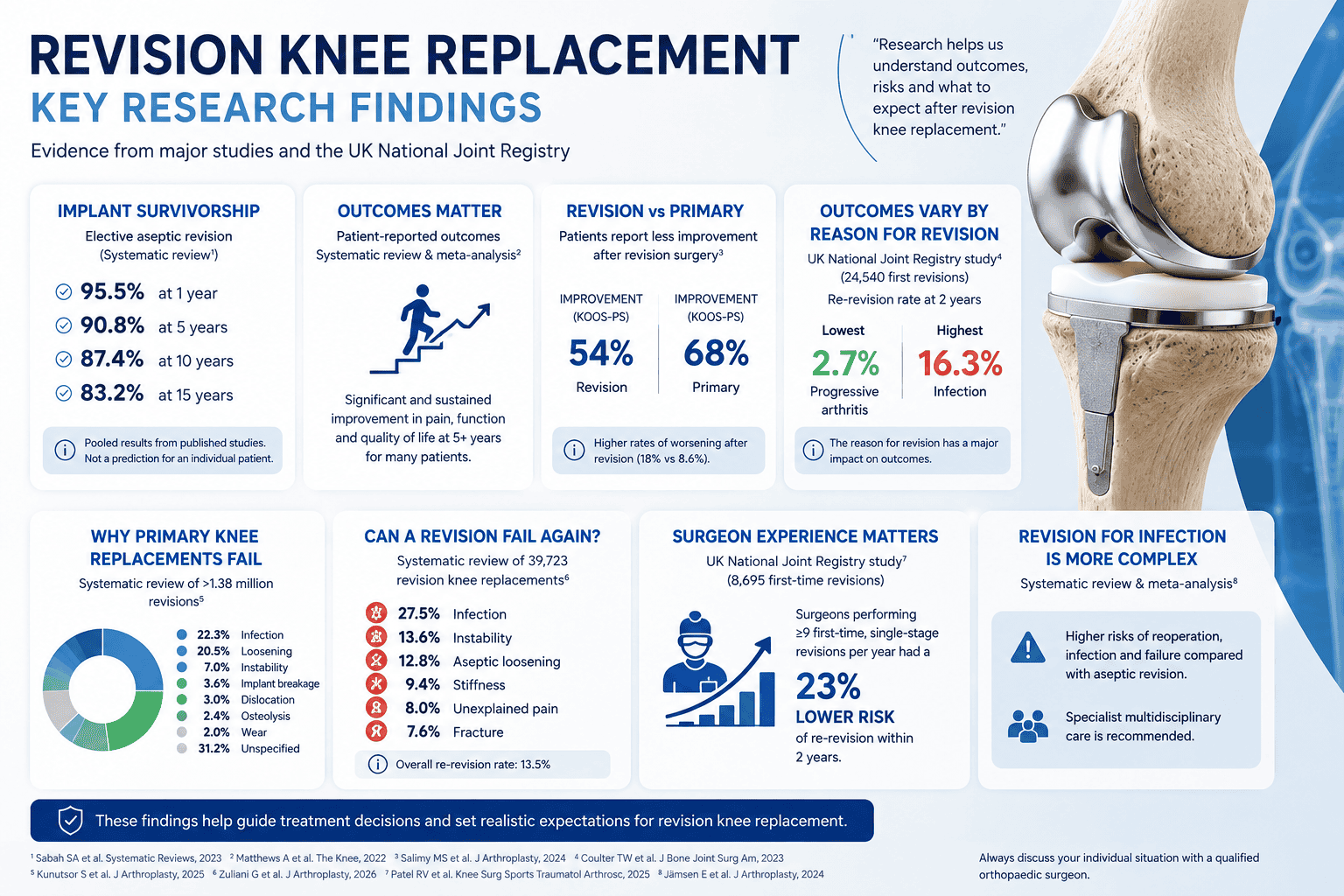
📊 WHAT DOES THE RESEARCH SHOW?
95.5%
Approximate pooled implant survivorship at 1 year following elective aseptic revision.90.8%
Approximate pooled survivorship at 5 years.87.4%
Approximate pooled survivorship at 10 years.83.2%
Approximate pooled survivorship at 15 years.24,540
First revision knee replacements examined in a major UK National Joint Registry study.13.5%
Overall re-revision rate reported in a 2026 systematic review of 39,723 revision knee arthroplasties.Important: these figures come from different studies and patient populations. The survivorship figures above relate specifically to elective aseptic revision and should not be treated as an individual patient’s predicted outcome. (PubMed Central (PMC))
How long does a revision knee replacement last?
There is no guaranteed lifespan.
A systematic review of elective aseptic revision knee arthroplasty found pooled implant survivorship of:
- 95.5% at 1 year
- 90.8% at 5 years
- 87.4% at 10 years
- 83.2% at 15 years.
These figures come from multiple observational studies and should not be interpreted as a personal prediction.
Longevity can be influenced by:
- the reason for revision;
- type of revision;
- implant design;
- fixation;
- bone quality;
- infection;
- patient factors;
- and whether further surgery is required.
Do patients generally feel better after revision?
A 2022 systematic review and meta-analysis included 23 studies and 2,414 patients with at least five years of follow-up.
The researchers found a significant and sustained improvement in patient-reported outcomes following revision knee replacement. However, they also highlighted variation in the outcome measures used between studies.
This is important because successful revision isn’t simply about whether an implant remains in place.
Patients want to know whether they can:
- walk more comfortably;
- reduce pain;
- improve mobility;
- return to activities;
- and improve their quality of life.
The available evidence suggests that many patients do experience meaningful improvement.
Is revision as successful as a first knee replacement?
Generally, outcomes are less predictable after revision.
A comparative study involving 2,448 patients, including 209 revision procedures, found lower rates of clinically important improvement and higher rates of worsening following revision compared with primary knee replacement across several patient-reported measures.
For example, clinically meaningful improvement in the KOOS-PS physical-function measure occurred in:
54% after revision
versus
68% after primary knee replacement.
The same study found worsening in:
18% after revision
versus
8.6% after primary knee replacement.
This does not mean that revision surgery is unlikely to help.
It means that expectations should be realistic and tailored to the individual patient.
Can a revision knee replacement fail again?
Yes.
A revision knee replacement can itself require another operation, known as re-revision.
A 2026 systematic review and meta-analysis examined 39,723 revision knee arthroplasties across 16 studies.
The overall re-revision rate was 13.5%, although there was substantial variation between the studies.
The most commonly reported causes of revision failure were:
| Cause | Proportion |
|---|---|
| Periprosthetic joint infection | 27.5% |
| Instability | 13.6% |
| Aseptic loosening | 12.8% |
| Arthrofibrosis/stiffness | 9.4% |
| Unexplained pain | 8.0% |
| Periprosthetic fracture | 7.6% |
These figures should be interpreted cautiously because the studies included different patients, indications, implants and follow-up periods.
What are the risks and complications?
Revision surgery is generally more complex than primary knee replacement.
Potential complications include:
- infection;
- blood clots;
- bleeding;
- wound problems;
- stiffness;
- instability;
- fracture;
- nerve or blood-vessel injury;
- persistent pain;
- implant loosening;
- further surgery;
- and medical or anaesthetic complications.
The risks depend substantially on the type of revision.
For example, revision for infection is very different from a relatively limited revision for isolated polyethylene wear.
In the systematic review of elective aseptic revision, reported 90-day complication rates ranged from 9.1% to 37.2% across studies. The wide range reflects differences in study populations and definitions of complications.
How long is recovery after revision knee replacement?
There is no standard recovery time for revision knee replacement.
A limited revision can have a very different rehabilitation pathway from major reconstruction involving infection or significant bone loss.
Recovery may involve:
- walking aids;
- physiotherapy;
- range-of-motion exercises;
- strengthening;
- gait retraining;
- and gradual return to normal activities.
Research into rehabilitation specifically after revision knee replacement is considerably less developed than research following primary knee replacement. A systematic review found very limited evidence and no randomised controlled trials evaluating rehabilitation programmes specifically in this patient group.
Ask your surgeon:
- How long am I likely to need crutches?
- When can I drive?
- When can I return to work?
- How much physiotherapy will I need?
- When can I return to exercise?
- Are there restrictions on weight-bearing?
Can I exercise after revision knee replacement?
The answer depends on the type of revision and your recovery.
Your surgeon and physiotherapist can advise you about appropriate activities.
Walking, strengthening and range-of-motion exercises are generally important parts of rehabilitation, while higher-impact activities require individual discussion.
Rather than following a generic timetable, ask:
“What activities will be appropriate for my knee once it has recovered?”
Should I get a second opinion?
A second opinion can be particularly useful when:
- the diagnosis is uncertain;
- you have been advised to undergo complex revision;
- infection is involved;
- significant bone loss is suspected;
- you are considering re-revision;
- you have been told that no clear cause for your symptoms can be found;
- or you simply want greater confidence before making a major decision.
The British Orthopaedic Association specifically states that second opinions are encouraged, with regional referral recommended in complex cases and diagnostic uncertainty.
A second opinion does not necessarily mean that the first surgeon is wrong.
It can simply provide another assessment of:
- the diagnosis;
- the proposed operation;
- the complexity of the revision;
- and the likely alternatives.
Choosing a revision knee replacement surgeon
Choosing a surgeon for revision surgery can be different from choosing a surgeon for a straightforward primary knee replacement.
Revision surgery is technically demanding and some cases require specialist multidisciplinary support.
The BOA revision standard recommends coordinated revision services and says that complex cases — including infection, significant bone loss and re-revision — should be discussed at regional multidisciplinary meetings. It also recommends that surgeons work in units with at least two surgeons regularly undertaking revision knee replacement.
Questions to ask about your surgeon
Experience
- How many revision knee replacements do you perform each year?
- How many cases like mine do you treat?
- How many complex revisions do you perform?
- How many revisions for infection do you perform?
Your particular problem
“How much experience do you have treating the specific reason my knee replacement has failed?”
This may be more useful than simply asking how many knee replacements the surgeon performs.
The wider team
- Is my case discussed at a revision MDT?
- Is specialist infection support available?
- Is another experienced revision surgeon available if required?
- Does the hospital perform complex revision reconstruction?
Does surgeon volume matter?
A 2025 study using UK National Joint Registry data examined 8,695 first-time single-stage revisions for non-infected indications, including aseptic loosening, instability and malalignment.
After adjustment for other factors, surgeons performing nine or more such revisions annually had lower odds of re-revision within two years than surgeons performing fewer than nine, with an adjusted odds ratio of 0.77. (PubMed)
This was a retrospective observational study, so it demonstrates an association, not proof that a particular number of operations guarantees better care.
It does, however, provide a reasonable basis for asking a prospective surgeon about their revision experience.
What does the BOA recommend?
The 2020 BOA revision knee standard stated that, in general, units undertaking revision knee replacement should be expected to achieve 30+ procedures annually and individual surgeons 15+, while recognising that circumstances such as career stage and service disruption need to be taken into account.
These figures are BOA guidance from 2020, not a universal legal or regulatory threshold.
Does the hospital matter?
For complex revision surgery, the wider service around the surgeon may be important.
The BOA recommends coordinated revision services and multidisciplinary pathways, particularly for complex cases and infection.
Recent UK registry research has also found an association between higher hospital volume and lower early re-revision following first-time single-stage revision for infection, although the researchers were unable to establish a specific volume threshold for hospitals.
You may therefore wish to ask:
- How many revision knee replacements does this hospital perform?
- Does it have a specialist revision service?
- Is there specialist infection and microbiology support?
- Can complex bone reconstruction be performed here?
- What happens if unexpected complexity is found?
What should I ask my revision knee surgeon?
About the diagnosis
- Why has my knee replacement failed?
- Are you certain revision surgery is necessary?
- Have you ruled out infection?
- Are there alternatives to revision?
About the operation
- What exactly needs to be revised?
- Will one component or the whole replacement be removed?
- How much bone loss do I have?
- Will I need stems or augments?
- What implant are you expecting to use?
- Could the operation become more extensive during surgery?
About experience
- How many revision knee replacements do you perform each year?
- How many are for the same problem as mine?
- How many complex revisions do you perform?
- How often do you treat infected knee replacements?
About outcomes
- What improvement should I realistically expect?
- What symptoms might remain?
- What is the likelihood of needing another revision?
- How do you monitor your outcomes?
About recovery
- How long will I stay in hospital?
- Will I be allowed to put full weight on the leg?
- How long will I need crutches?
- What physiotherapy will I need?
- When can I drive?
- When can I return to work?
- When can I exercise?
About complications
- What are the main risks in my particular case?
- What is my infection risk?
- What happens if infection is found during surgery?
- What happens if more bone loss is found than expected?
About cost
- What is the total cost?
- Is the surgeon’s fee included?
- Is the anaesthetist’s fee included?
- Are implants included?
- Are investigations included?
- Is physiotherapy included?
- What happens if additional surgery is required?
How much does revision knee replacement cost privately?
There is no single UK price for revision knee replacement.
The cost can vary considerably because revision surgery can range from a relatively limited procedure to a highly complex reconstruction.
Factors that can affect the cost include:
- surgeon;
- hospital;
- complexity of surgery;
- implant;
- imaging;
- infection investigations;
- anaesthetic;
- length of hospital stay;
- rehabilitation;
- and follow-up.
If you are considering private treatment, ask for a written breakdown of what is and isn’t included.
Read our guide to Knee Replacement Cost →
Key research on revision knee replacement
If you are considering revision surgery, you may wish to read some of the underlying research and discuss the findings with your surgeon.
Outcomes and implant survival
Patient-relevant outcomes following elective, aseptic revision knee arthroplasty: a systematic review
This systematic review examined implant survivorship, function, quality of life and complications following elective aseptic revision. (PubMed Central (PMC))
Long-term patient-reported outcomes
What is the patient experience following revision knee replacement? A systematic review and meta-analysis of the medium-term patient reported outcomes
This review examined patient-reported outcomes at five years or more following revision surgery.
Revision versus primary knee replacement
Patients Consistently Report Worse Outcomes Following Revision Total Knee Arthroplasty Compared to Primary Total Knee Arthroplasty
This study compared patient-reported outcomes following primary and revision knee replacement.
UK National Joint Registry outcomes
Patient-Relevant Outcomes Following First Revision Total Knee Arthroplasty, by Diagnosis
This large UK study examined 24,540 first revisions and compared outcomes according to the reason for revision.
Why primary knee replacements fail
Why Are Primary Total Knee Arthroplasties Failing? A Systematic Review and Meta-Analysis
This 2025 review examined more than 1.38 million revision arthroplasties and investigated the causes of primary knee replacement failure. (ScienceDirect)
Why revisions fail
Etiology of Failure in Revision Total Knee Arthroplasty: A Systematic Review and Meta-Analysis
This 2026 review examined 39,723 revision arthroplasties and the causes of subsequent revision.
Surgeon volume
Higher surgeon volume reduces early failure in first time revision of non-infected total knee arthroplasty
This UK National Joint Registry study examined the relationship between surgeon volume and early re-revision.
Infection
Clinical Outcomes and Complications of 2-Stage Septic Versus Aseptic Revision Total Knee Arthroplasty: A Systematic Review and Meta-Analysis
Useful for understanding why revision for infection is a different clinical situation.
You do not need to read every paper. If you are considering revision surgery, you may wish to take the studies most relevant to your situation to your surgeon and ask them to explain how the findings apply to you.
UK guidance
The British Orthopaedic Association has published guidance covering the investigation of problematic knee replacements and the surgical management of revision knee replacement.
The guidance emphasises:
- thorough investigation;
- identifying a specific cause where possible;
- second opinions where appropriate;
- multidisciplinary discussion;
- specialist pathways for complex cases;
- and appropriate revision service organisation.
The revision knee replacement patient journey
1. Something isn’t right
Pain, stiffness, instability or another problem develops.
↓
2. Investigation
Your knee is assessed and appropriate imaging and tests are undertaken.
↓
3. Identify the cause
The aim is to establish why the knee replacement isn’t working properly.
↓
4. Consider the options
Depending on the problem, treatment may include non-surgical management, a limited procedure or revision surgery.
↓
5. Plan the revision
The surgeon determines what components may need to be replaced and considers bone, ligaments and soft tissues.
↓
6. Revision surgery
The necessary components are removed, replaced or reconstructed.
↓
7. Rehabilitation
Physiotherapy and gradual return to activity form part of recovery.
↓
8. Long-term follow-up
Your progress and the performance of the revised knee are monitored.
Revision knee replacement: the bottom line
Revision knee replacement can be a major operation, but it can also provide substantial improvements in pain, function and quality of life for appropriately selected patients.
The most important thing to understand is:
There is no single revision knee replacement operation and no single revision success rate.
The likely outcome depends on:
- why the original replacement has failed;
- whether infection is present;
- how much bone and soft-tissue support remains;
- the complexity of the revision;
- the patient’s general health;
- and other individual factors.
Research suggests that many patients improve following revision surgery, while also showing that outcomes are generally less predictable than after primary knee replacement and that further revision remains possible.
Before making a decision, consider asking:
Why has my knee replacement failed?
Is revision surgery definitely necessary?
What exactly needs to be revised?
What outcome should I realistically expect?
How much experience does my surgeon have with this type of revision?
What specialist support is available at the hospital?
What does the research say about patients in my situation?
Reading the research and discussing your individual circumstances with an appropriately experienced revision knee surgeon can help you make a better-informed decision.
Frequently asked questions
What is revision knee replacement?
Revision knee replacement is surgery to repair or replace some or all of a previous knee replacement.
Why do knee replacements fail?
Common causes include infection, loosening, instability, wear, fracture, stiffness and other mechanical problems. Infection and aseptic loosening are among the most frequently documented causes.
Does a painful knee replacement always need revision?
No. Pain can have many causes and should be investigated before revision surgery is considered. BOA guidance recommends establishing a specific cause where possible.
Is revision knee replacement more difficult than primary knee replacement?
It can be. Revision may involve removing existing components, managing bone loss and reconstructing the knee using specialised implants.
Can only part of a knee replacement be revised?
Sometimes. The appropriate extent of revision depends on the reason for failure and the condition of the existing components and surrounding tissues.
How successful is revision knee replacement?
Many patients experience significant improvement in pain, function and quality of life. However, outcomes are generally less predictable than following primary knee replacement.
How long does revision knee replacement last?
There is no guaranteed lifespan. In elective aseptic revision, one systematic review estimated approximately 91% implant survivorship at five years and 87% at ten years.
Can a revision knee replacement fail again?
Yes. A 2026 systematic review reported an overall re-revision rate of 13.5% across 39,723 revision arthroplasties, although the studies varied considerably.
Is revision for infection different?
Yes. Revision for infection can require a different treatment pathway involving specialist infection management and, in some cases, staged surgery.
How long is recovery after revision knee replacement?
Recovery varies considerably depending on the complexity of the operation. Evidence specifically evaluating rehabilitation after revision is less extensive than evidence following primary knee replacement.
Should I get a second opinion?
A second opinion can be particularly useful where the diagnosis is uncertain or surgery is complex. BOA guidance specifically encourages second opinions and regional referral in complex cases.
How do I choose a revision knee surgeon?
Ask about the surgeon’s experience with revision knee replacement and, particularly, experience treating the specific reason your original replacement has failed. UK registry research has found an association between higher surgeon volume and lower early re-revision in certain non-infected revision cases.
How much does revision knee replacement cost privately?
There is no standard UK price. Costs vary according to the complexity of the revision, surgeon, hospital, implants, investigations, hospital stay and rehabilitation.
About the information on this page
This page provides general educational information about revision knee replacement and is intended to help patients prepare for discussions with qualified healthcare professionals.
Research findings can vary between studies, and results from groups of patients cannot predict exactly what will happen to an individual.
The outcome of revision surgery depends on the reason for revision, complexity of the operation, the patient’s health and many other factors.
Evidence reviewed: August 2026