

Hip replacement surgery is one of the most established treatments for severe hip pain and loss of function. For people whose hip has become sufficiently damaged that everyday activities are increasingly difficult, replacing the damaged joint can provide substantial relief from pain and restore mobility.
But deciding whether you actually need a hip replacement is not simply a question of how bad an X-ray looks.
The important question is how much your hip is affecting your life, what treatments you have already tried, and whether the likely benefits of surgery outweigh its risks for you.
For many people, the underlying problem is osteoarthritis. However, hip replacement can also be considered when the joint has been damaged by other conditions, including inflammatory arthritis, previous injury or fracture, or other forms of joint deterioration.
This guide explains what a hip replacement is, why it may be recommended, and the signs that it may be time to have a serious discussion with a healthcare professional about surgery.
It is designed to help you understand your options before making decisions about treatment. It does not replace an individual assessment by your GP, orthopaedic surgeon or other qualified healthcare professional.
Hip Replacement at a Glance
What is a hip replacement?
Hip replacement surgery replaces damaged parts of the hip joint with artificial components, restoring an artificial ball-and-socket joint designed to reduce pain and improve function.
What is the most common reason for a hip replacement?
The most common reason is osteoarthritis, where damage and loss of the joint’s normal cartilage contribute to pain, stiffness and reduced movement. Other conditions can also damage the hip sufficiently to require replacement.
When might you need one?
A hip replacement may be considered when hip pain, stiffness or reduced function is having a substantial effect on your quality of life and appropriate non-surgical treatments have not provided enough relief or are unsuitable. This is consistent with current NICE guidance.
Do you have to reach a particular age before having a hip replacement?
No. Age alone should not be used to exclude someone from referral for consideration of joint replacement. NICE recommends that decisions should be based on clinical assessment and the individual’s circumstances rather than an arbitrary age threshold.
Do you need severe arthritis on an X-ray before surgery is considered?
Not necessarily. Imaging can be important when assessing structural damage and planning surgery, but the decision to refer for joint replacement should be based on the overall clinical picture rather than an X-ray or numerical severity score alone.
Will a hip replacement cure every type of hip pain?
No. Hip replacement is primarily intended to treat pain and disability arising from significant damage to the hip joint. Pain can have other causes, including problems outside the hip joint, so establishing the correct diagnosis is important before considering surgery.
Is hip replacement a major operation?
Yes. Although hip replacement is a well-established procedure, it is still major surgery and carries potential complications. The decision should therefore involve a balanced discussion of the expected benefits, risks and alternatives.
How long can a hip replacement last?
Modern hip replacements can last for many years, but no artificial joint can be guaranteed to last for a particular individual. Longevity depends on factors including the implant, the patient and activity levels. The National Joint Registry (NJR) provides long-term information on hip replacement outcomes and implant performance.
What Is a Hip Replacement?
A hip replacement is an operation in which damaged parts of the natural hip joint are removed and replaced with artificial components.
The natural hip is a ball-and-socket joint. The rounded head at the top of the thigh bone (femur) fits into a cup-shaped socket in the pelvis (the acetabulum). Normally, the surfaces of these bones are covered by smooth cartilage, allowing the joint to move with very little friction.
When the joint becomes significantly damaged, this smooth movement can be lost. Pain, stiffness and reduced movement may develop, and activities that once seemed effortless can become increasingly difficult.
During a total hip replacement, the damaged femoral head is replaced with an artificial ball attached to a stem, while the damaged surface of the socket is replaced with an artificial cup. The components may be made from combinations of materials such as metal, ceramic and polyethylene (a type of medical-grade plastic).
The artificial components are collectively known as the hip implant or prosthesis.
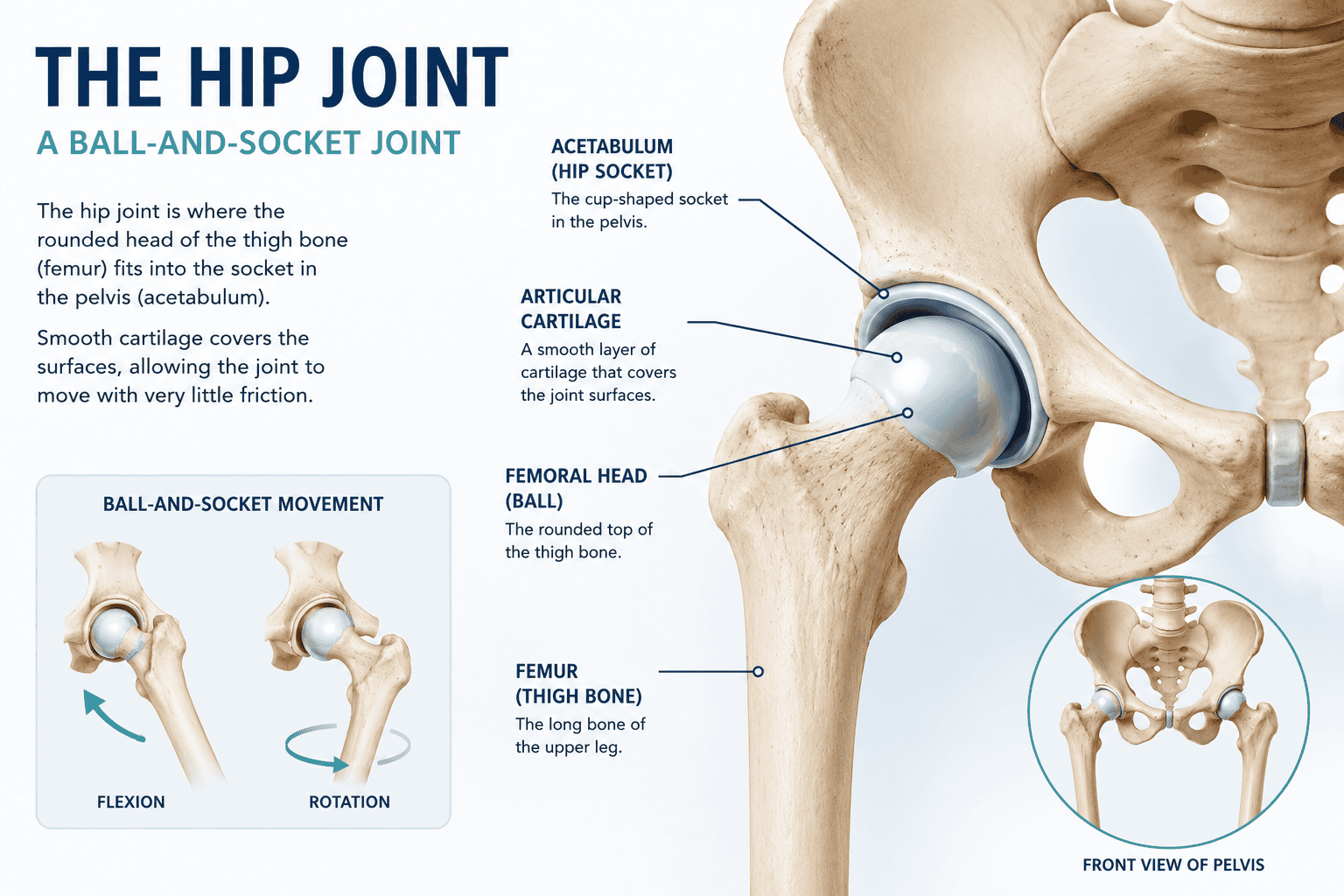
What does a hip replacement actually replace?
A total hip replacement normally replaces the two main articulating surfaces of the joint:
- the femoral head — the ball at the top of the thigh bone
- the acetabulum — the socket within the pelvis
The femoral component consists of a stem inserted into the femur and an artificial head. The socket component consists of an acetabular cup and a bearing surface.
There are different combinations of implant design, fixation method and bearing materials. The most appropriate choice depends on factors such as your age, anatomy, bone quality, activity, diagnosis and the surgeon’s assessment.
There is therefore no single “best hip replacement” that is suitable for everyone.
The NJR records hip replacement procedures across the UK and provides information about different implant types and their performance. It also emphasises the importance of discussing implant choices and their advantages and disadvantages with your clinical team.
Total hip replacement versus hip resurfacing
When people talk about a “hip replacement”, they are usually referring to a total hip replacement.
There is another procedure called hip resurfacing. Rather than removing the femoral head completely, resurfacing reshapes it and places a covering over its surface, while the socket is also resurfaced.
Hip resurfacing is not appropriate for everyone and is used much less commonly than conventional total hip replacement. Whether it is an option depends on individual factors and the particular circumstances of the patient.
The important point is that the choice between procedures should be based on an individual assessment rather than assuming that one operation is automatically better than another.
What is the aim of hip replacement surgery?
The principal aim is straightforward:
to reduce pain and improve your ability to use the hip.
For someone with severe hip arthritis, this can translate into very practical improvements: walking more comfortably, getting dressed more easily, climbing stairs, getting in and out of a car, returning to activities that have become difficult, and sleeping more comfortably.
The extent of improvement varies between individuals. Hip replacement is intended to improve pain and function, not to recreate a completely natural hip or guarantee that every previous activity will be possible.
That distinction matters when thinking about whether surgery is right for you.
Why Might You Need a Hip Replacement?
Osteoarthritis is the most common reason
The most common reason for hip replacement is osteoarthritis of the hip.
Osteoarthritis is a condition affecting joints. In the hip, changes to the joint can lead to pain, stiffness and reduced function. Symptoms can range from relatively mild and intermittent problems to persistent pain and substantial disability. NICE notes that osteoarthritis does not inevitably worsen in a simple, predictable way; symptoms can fluctuate and flares can occur.
As hip osteoarthritis becomes more troublesome, everyday movements may become increasingly difficult.
You might notice that you:
- walk shorter distances than you used to
- avoid hills or stairs
- struggle to put on socks and shoes
- find getting into or out of a car difficult
- have difficulty getting up from a chair
- stop taking part in sports or recreational activities
- wake during the night because of hip pain
- need increasing amounts of pain relief
- change the way you walk because of discomfort
- organise your day around what your hip will allow you to do.
These changes can occur gradually, making it difficult to recognise how much the problem has affected your life.
A useful question is not simply “How bad is my arthritis?”
It is:
“What can I no longer do because of my hip that I want or need to be able to do?”
That is often much more relevant when discussing treatment.
Other conditions can damage the hip
Osteoarthritis is not the only reason someone may eventually need a hip replacement.
Other causes include:
Inflammatory arthritis
Conditions such as rheumatoid arthritis can damage the hip joint and cause pain, stiffness and loss of function.
Previous injury or fracture
A significant injury to the hip can damage the joint directly or lead to subsequent deterioration.
Avascular necrosis (osteonecrosis)
Loss of blood supply to the femoral head can cause the bone to deteriorate. In advanced cases, hip replacement may be considered.
Other forms of hip joint damage
Previous surgery, developmental abnormalities and other conditions affecting the structure or function of the hip can sometimes lead to sufficiently severe joint damage that replacement becomes appropriate.
The reason for your hip problem matters because it influences the assessment, treatment options and, in some circumstances, the type of surgery that may be considered.
When Should You Consider a Hip Replacement?
There is no single pain score, X-ray appearance or number of years with arthritis that tells everyone when they should have a hip replacement.
Instead, the decision is based on the combination of symptoms, functional limitations, previous treatment, general health, expectations and the likely balance between benefits and risks.
NICE recommends considering referral for joint replacement when symptoms such as pain, stiffness, reduced function or progressive joint deformity are substantially affecting quality of life and non-surgical management has been ineffective or unsuitable.
The key question: how much is your hip affecting your life?
Hip replacement becomes more relevant when the problem is no longer simply an inconvenience but is interfering substantially with the things that matter to you.
For example, you may be finding that:
- walking to the shops has become difficult
- you cannot walk as far as you want to
- you have stopped exercising
- you have difficulty working or carrying out physical tasks
- you struggle with stairs
- you cannot comfortably get in and out of a car
- putting on socks and shoes has become difficult
- you are avoiding social activities
- you are sleeping poorly because of pain
- you need regular pain medication
- your hip restricts activities you value
- you are planning your life around your pain.
These are important reasons to discuss your options with a healthcare professional.
You do not have to wait until the pain becomes unbearable
A common misconception is that you should delay hip replacement until you can barely walk or your pain becomes intolerable.
That is not what current NICE guidance says.
The decision should be based on the impact of your symptoms on your quality of life and the effectiveness or suitability of non-surgical treatment, rather than requiring you to reach an arbitrary level of disability.
Equally, having some hip pain does not automatically mean that surgery is appropriate.
Hip replacement is a major operation, so it makes sense to consider it when the expected improvement is meaningful enough to justify the risks and recovery involved.
The decision is therefore about impact and balance, not simply severity.
Have you tried appropriate non-surgical treatment?
Hip replacement is generally considered after appropriate non-surgical approaches have been explored.
Depending on the individual, these can include:
- education and advice about osteoarthritis
- therapeutic exercise
- strengthening and physical activity
- weight management where appropriate
- pain-relieving medication
- other treatments tailored to the person’s circumstances.
NICE recommends therapeutic exercise for people with osteoarthritis and recommends support with weight management for people who are living with overweight or obesity.
Not every treatment is suitable for every patient. Equally, the fact that a treatment has not worked for someone else does not necessarily mean it will not help you.
The important question is whether reasonable non-surgical options have been tried and whether they provide enough benefit for you.
If they do not, and your hip continues to substantially affect your quality of life, it may be appropriate to discuss referral for joint replacement.
What if physiotherapy or exercise has not worked?
Failure of physiotherapy or exercise to eliminate your symptoms does not automatically mean that surgery is required.
Exercise is an important part of managing osteoarthritis, but its purpose is not necessarily to “repair” damaged cartilage. It can help maintain strength, mobility and physical function and may reduce symptoms.
If appropriate non-surgical management has been tried but your hip remains sufficiently painful or disabling, surgery may become a reasonable option to discuss.
This is one reason why the decision should be made with a clinician who can assess the whole picture rather than relying on a single treatment response.
Does the X-ray determine whether you need a hip replacement?
No. Your X-ray is important, but it is not the only factor.
An X-ray can show structural changes in the hip and is particularly relevant when surgery is being considered. However, NICE recommends that the decision to refer for joint replacement should be based on clinical assessment rather than numerical scoring systems.
This reflects an important reality:
An X-ray and a person’s experience are not always the same thing.
Two people can have apparently similar changes on imaging but very different levels of pain and disability.
Conversely, significant symptoms should be properly assessed rather than dismissed simply because an X-ray does not appear dramatic.
The purpose of assessment is therefore to understand both the condition of the joint and what that condition means for you.
Is there a minimum age for hip replacement?
No. There is no universal age at which someone becomes eligible for hip replacement.
NICE specifically recommends that people should not be excluded from referral for joint replacement because of age, sex or gender, smoking, comorbidities, or overweight or obesity based on BMI.
That does not mean these factors are irrelevant.
Your age and general health can affect the risks associated with surgery, and these risks should be discussed with you. But they should not be used as an arbitrary reason to prevent someone from being assessed.
Similarly, being relatively young does not automatically mean that you should avoid hip replacement if the condition is causing substantial disability and other options are no longer suitable.
The discussion should instead focus on the likely benefits, risks, alternatives and longer-term implications for that particular patient.
Should you wait until you are older?
Not necessarily.
There is sometimes an assumption that younger patients should simply “put up with” hip pain for as long as possible because an artificial hip may eventually require further surgery.
Longevity is an important consideration, particularly for younger people, but it is only one part of the decision.
If hip disease is substantially restricting your life despite appropriate treatment, the potential cost of continuing to live with severe pain and disability also needs to be considered.
The decision is individual and should take account of your diagnosis, age, health, activity, expectations, implant options and the likely consequences of both having and not having surgery.
The NJR provides long-term information on hip replacement and implant performance that can help support these discussions.
What if you are overweight?
Being overweight or living with obesity does not, by itself, mean that you should be denied consideration for hip replacement.
NICE specifically states that BMI should not be used as a barrier to referral for joint replacement. However, individual factors associated with weight can affect surgical risk, and those risks should be discussed as part of an individual assessment.
Weight management can also be an important part of managing osteoarthritis and preparing for surgery where appropriate.
This is an area where individual medical advice matters: the right approach depends on your overall health, mobility, nutritional status and other medical conditions.
What if you have other medical conditions?
Having another medical condition does not automatically rule out hip replacement.
People being assessed for surgery may have conditions such as high blood pressure, diabetes, heart disease, respiratory disease or other long-term health problems. These need to be taken into account because they can affect the risks associated with anaesthesia, surgery and recovery.
NICE recommends that comorbidities should not automatically exclude someone from referral. Instead, the risks and benefits should be considered for that individual.
This is particularly important because “fit for surgery” is not simply a yes-or-no label. A specialist team can assess your health, optimise relevant medical conditions where possible, and explain the risks that apply specifically to you.
How do you know when it is time to ask for a referral?
A useful starting point is to ask yourself four questions:
1. How much does my hip interfere with my everyday life?
Think beyond pain. Consider walking, work, sleep, exercise, hobbies, relationships, travel and independence.
2. Have appropriate non-surgical treatments been tried?
Consider whether exercise, pain management and other appropriate measures have provided enough improvement.
3. Are my symptoms continuing to get in the way despite those treatments?
If your quality of life remains substantially affected, it may be time for a more detailed discussion.
4. Am I willing to consider the benefits and risks of surgery?
A referral does not mean that you have committed to having an operation. It creates an opportunity to discuss whether surgery is appropriate.
The National Joint Registry recommends shared decision-making when considering joint replacement. You should have the opportunity to understand the proposed treatment, alternatives, risks and likely benefits and to ask questions before making a decision.
What happens if you are not sure?
You do not have to decide immediately.
If you are unsure whether your symptoms are severe enough, or whether surgery is right for you, speaking to your GP or an appropriately qualified musculoskeletal or orthopaedic clinician can help clarify the situation.
A referral for an orthopaedic opinion is not the same as agreeing to surgery.
It is an opportunity to establish:
- what is causing your symptoms
- how advanced the joint damage appears to be
- whether your symptoms are actually coming from the hip
- what non-surgical options remain
- whether hip replacement is likely to help
- what the potential risks would be for you
- what alternatives exist
- and what timing would make sense if surgery is appropriate.
The final decision to proceed with surgery remains yours.
The NJR describes this process as shared decision-making: combining your own priorities and circumstances with clinical evidence and your surgeon’s expertise to reach a decision that is appropriate for you.
A practical way to think about the decision
Rather than asking:
“Is my hip bad enough for surgery?”
it can be more helpful to ask:
“Is my hip affecting my life enough that the potential benefits of replacing it outweigh the disadvantages and risks of having major surgery?”
That is the central decision.
There is no universal point at which everyone should have a hip replacement. Some people with significant X-ray changes remain comfortable and function well without surgery. Others may experience considerable pain and disability and reasonably decide that surgery is the right next step.
Your symptoms, function, health, expectations and treatment history all matter.
If your hip is increasingly determining where you go, how far you walk, what activities you do or how you sleep, it is reasonable to have a conversation about your options rather than simply accepting that you have to live with it.
The next stage is understanding how hip arthritis is diagnosed, what assessments you can expect, and what alternatives should be considered before deciding on replacement.
Part 2 continues directly from Part 1. I’ve kept it relatively compact because the cumulative pillar needs to remain within the agreed 4,500–5,500-word range, while leaving room for the final sections rather than allowing the supporting topics to consume the entire article.
7. What Happens Before Hip Replacement Surgery?
Once hip replacement has been recommended, there is usually a period of assessment and preparation before the operation.
This is not simply an administrative step. It is an opportunity to confirm that surgery is appropriate, identify anything that could increase your risk, prepare you for recovery and make sure you understand what the operation involves.
What happens at the pre-operative assessment?
You will normally have a pre-operative or pre-admission assessment before surgery. The exact process varies between hospitals, but it may include:
- reviewing your medical history and current medicines
- checking your general health and fitness for surgery
- blood tests
- blood pressure and other routine observations
- an ECG where appropriate
- assessment of your anaesthetic risk
- reviewing previous operations or anaesthetic problems
- checking for conditions that may need optimisation before surgery
- discussing the operation and recovery
- planning your discharge and support at home.
The NHS advises that preparation may also include strengthening exercises, weight management where appropriate, stopping smoking and maintaining a healthy diet. (nhs.uk)
Your surgeon and anaesthetist may also ask about medicines that affect bleeding, diabetes, heart or lung conditions, allergies and any previous problems with anaesthesia.
Do you need to prepare physically for a hip replacement?
Yes, where possible. Being as fit and well prepared as you can be before surgery may make the recovery process easier.
Maintaining strength and mobility before an operation can be useful because hip arthritis itself may have reduced your activity over time.
However, preparation needs to be realistic. Someone with severe hip arthritis may not be able to undertake vigorous exercise. Your healthcare team can advise on exercises that are appropriate for you.
Stopping smoking is also advisable because smoking can adversely affect surgical recovery and wound healing. If you are overweight, weight management may be discussed, but NICE states that BMI should not be used as an arbitrary barrier to referral for joint replacement.
What should you ask before agreeing to surgery?
You should have enough information to make an informed decision.
Useful questions include:
- Why do you recommend hip replacement for me?
- What are my alternatives?
- What type of replacement are you recommending?
- How will the implant be fixed?
- Which surgical approach will you use?
- What are the important risks for me personally?
- How long might I need help at home?
- When can I expect to walk, drive and return to work?
- What should I expect the operation to achieve?
- What happens if I decide not to have surgery now?
The NJR describes this process as shared decision-making and provides information to help patients discuss implant and treatment choices with their clinical team. (NJR Centre)
8. How Is a Hip Replacement Performed?
A total hip replacement replaces the damaged ball and socket of the hip with artificial components.
The operation is normally performed in hospital under either a general anaesthetic or a regional anaesthetic, sometimes with sedation. The most appropriate anaesthetic technique depends on your health, the operation and discussions with your anaesthetist.
What happens during the operation?
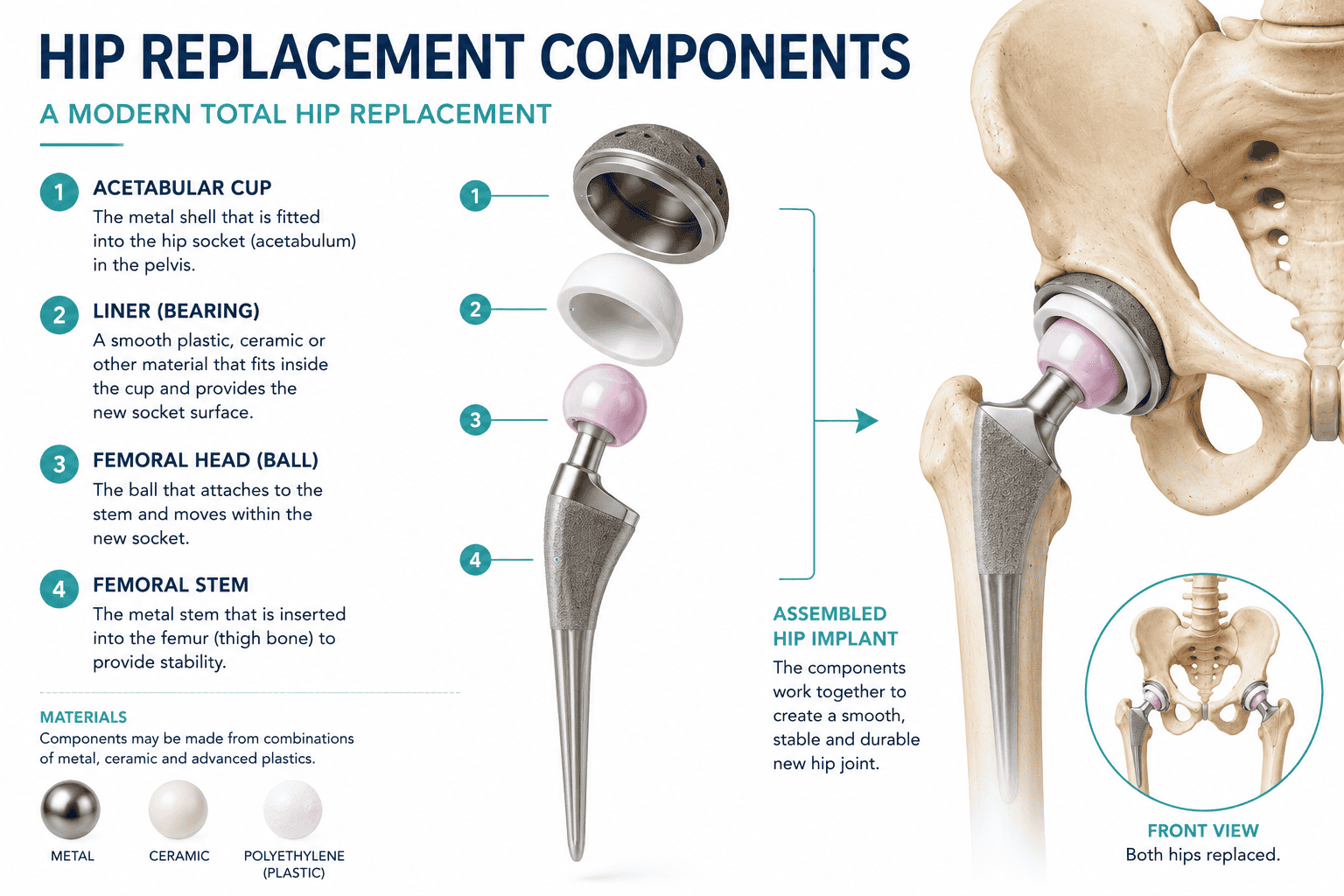
In simplified terms, the surgeon:
- makes an incision to access the hip joint
- removes the damaged femoral head
- prepares the inside of the femur for the new stem
- prepares the damaged socket
- inserts the artificial acetabular component
- inserts the femoral stem and artificial head
- brings the new components together
- checks the movement and stability of the reconstructed hip
- closes the wound.
The NHS describes the same basic sequence for total hip replacement.
The exact technique varies between surgeons, patients and hospitals.
How long does hip replacement surgery take?
The operation itself commonly takes around one to two hours, although the total time you spend in the operating and recovery areas will be longer. The Royal National Orthopaedic Hospital gives a typical operative duration of one to two hours.
The length of the operation is not, by itself, an indication of how successful it will be.
What happens immediately afterwards?
After surgery, you will spend some time in a recovery area while the effects of the anaesthetic wear off.
Pain relief will be provided and the clinical team will monitor you for complications. You will normally be encouraged to start moving relatively soon after the operation, with help from physiotherapy staff.
Early mobilisation is an important part of modern hip replacement care and also forms part of measures used to reduce complications such as blood clots.
9. What Types of Hip Replacement Are There?
There is no single type of hip replacement that is right for every patient.
The main distinctions concern what part of the hip is replaced, how the components are fixed to the bone and what materials are used for the bearing surfaces.
| Type | What it means |
|---|---|
| Total hip replacement | Both the femoral head and acetabular surface are replaced |
| Hemiarthroplasty | The femoral head is replaced but the natural socket is retained |
| Hip resurfacing | The femoral head is preserved and its surface is covered with an artificial component |
| Cemented replacement | Bone cement is used to secure one or more components |
| Cementless replacement | Components are designed to achieve fixation without bone cement, with bone growing onto or into the implant surface |
| Hybrid replacement | Typically combines a cemented femoral component with an uncemented acetabular component |
For most people having planned surgery for severe hip arthritis, the relevant operation is a total hip replacement.
Hemiarthroplasty is more commonly associated with particular hip fractures rather than routine elective treatment of osteoarthritis.
The NJR records different fixation methods, including cemented, cementless, hybrid and reverse-hybrid replacements.
Which type is best?
There is no universally best hip replacement.
The appropriate implant and fixation method depend on factors including your age, bone quality, diagnosis, anatomy, activity and the surgeon’s assessment.
Implant selection should therefore be an individual clinical decision rather than a choice based simply on which technology sounds newest.
A more detailed discussion of implant selection and the evidence behind different options should be covered with your surgeon pre operatively.
10. What Surgical Approaches Are Used?
The term surgical approach describes the route the surgeon uses to reach the hip joint.
Common approaches include:
- posterior approach
- anterolateral or lateral approach
- direct anterior approach.
These approaches involve working through different tissues around the hip to reach the joint.
Is one surgical approach better than the others?
Not universally.
Different approaches have potential advantages and disadvantages, and outcomes can depend on factors including surgical experience, patient characteristics, implant choice and rehabilitation.
It is therefore important not to assume that “anterior”, “posterior”, “minimally invasive” or any other label automatically means a better hip replacement.
The most appropriate approach is a clinical decision for you and your surgeon.
The approach should also be considered separately from the implant itself. A particular surgical approach does not necessarily require a particular implant, and an implant brand should not be assumed to be superior simply because it is used with a particular approach.
This distinction is important when comparing information about hip replacement online.
11. What Implants Are Used?
A total hip replacement consists of several components.
The main components
Femoral stem
This sits inside the thigh bone and supports the artificial femoral head.
Femoral head
This forms the new “ball” of the hip and can be manufactured from materials including metal or ceramic.
Acetabular component
This replaces the damaged socket surface.
Bearing surface
This is the surface where the artificial ball moves against the artificial socket liner.
Different combinations of materials are available, including metal-on-polyethylene and ceramic-on-polyethylene, as well as other combinations.
Cemented or uncemented?
A cemented component is fixed to the bone using bone cement.
An uncemented component is designed to achieve an initial mechanical fit and, depending on its design, allow bone to grow onto or into its surface.
Some replacements combine the two approaches.
The choice depends on individual factors rather than there being one universally superior fixation method. The NJR publishes information on implant types and revision outcomes to support informed discussions about these choices.
Does the implant brand matter?
Yes, but brand name alone should not determine your decision.
There are many hip implant designs and manufacturers. Their performance is monitored through systems including the National Joint Registry, which collects information about joint replacement procedures and subsequent revisions.
When discussing your proposed implant with your surgeon, useful questions include:
- What implant are you recommending?
- Why is it appropriate for me?
- How is it fixed to the bone?
- What bearing surfaces are being used?
- What evidence is available for its performance?
- Is there anything particular about my age, anatomy or activity that influenced the choice?
The NJR publishes implant and revision information and encourages patients to discuss their individual implant choice with their clinical team.
12. What Are the Risks and Complications?
Hip replacement is a major operation and, although it is commonly performed, complications can occur.
Most patients do not experience a serious complication, but understanding the potential risks is an important part of deciding whether surgery is right for you.
The risks vary between individuals, so figures quoted elsewhere should not be interpreted as your personal risk.
What are the main complications?
Potential complications include:
| Complication | What it means |
|---|---|
| Blood clot | A DVT can develop in the leg and, rarely, travel to the lungs as a pulmonary embolism |
| Infection | Infection can affect the wound or, more seriously, the artificial joint |
| Dislocation | The artificial ball can come out of the socket |
| Leg-length difference | The operated leg may end up slightly longer or shorter |
| Nerve or blood-vessel injury | Structures around the hip can occasionally be damaged |
| Bleeding | Blood loss can occur during or after surgery |
| Loosening or wear | Components can deteriorate or lose fixation over time |
| Persistent pain | Some patients continue to experience pain despite technically successful surgery |
| Fracture | Bone around the implant can occasionally fracture |
| Revision surgery | Further surgery may eventually be required if the replacement fails or develops a significant complication |
The NHS specifically identifies blood clots, infection, leg-length difference, nerve or tissue injury, dislocation and wear among recognised complications of hip replacement.
Some complications are more likely in particular circumstances, which is why your own medical history matters.
Can a hip replacement fail?
Yes.
A hip replacement is designed to be durable, but it is not a lifetime guarantee. Over time, components can wear, loosen, become infected or otherwise fail.
Some patients eventually require revision hip replacement surgery, in which some or all of the original components are replaced or otherwise treated.
The NJR provides long-term data on hip replacement and revision procedures.
A detailed explanation of individual complications, warning symptoms and revision treatment should sit within the dedicated Hip Replacement Risks and Hip Replacement Revision pages rather than being repeated in full here.
13. What Is Hip Replacement Recovery Like?
Recovery begins immediately after surgery and continues for several weeks and months.
There is considerable individual variation. Your age, general health, fitness, muscle strength, the condition of the other hip and your type of work or activity can all affect how quickly you return to normal.
What happens immediately after surgery?
You will normally be encouraged to get out of bed and start walking with assistance relatively soon after the operation.
Initially, you may use crutches or a walking frame. A physiotherapist will help you with movement and exercises and may advise you about stairs and everyday activities before you leave hospital.
Some people can leave hospital on the day of surgery or the following day, while others need longer. The appropriate timing depends on your recovery and local arrangements.
What is the first few weeks like?
It is normal to experience some pain, swelling, stiffness and tiredness following surgery.
You will usually be given pain relief and exercises to continue at home. Walking little and often, within the limits advised by your clinical team, is generally encouraged.
You may initially need help with tasks such as:
- putting on socks and shoes
- bathing
- shopping
- cooking
- housework
- driving
- caring for other people.
Preparing your home and arranging practical help before surgery can therefore make the early recovery period considerably easier.
How long does it take to recover?
There is no single recovery timetable that applies to everyone.
The NHS notes that recovery can take several months. Many people are able to return progressively to normal activities during this period, but the speed of recovery varies.
Returning to work depends particularly on the type of work you do. Driving should only resume when you are medically fit and able to control the vehicle safely; the NHS advises waiting at least six weeks and checking with your doctor.
The aim is not simply to get you through the first few weeks. Rehabilitation is about progressively restoring strength, movement, confidence and function.
A detailed week-by-week discussion of recovery, driving, work, exercise, sport, sleeping and longer-term rehabilitation belongs on the dedicated Hip Replacement Recovery page.
What should you expect from recovery?
It is helpful to think of recovery as a progression rather than a single event.
Early recovery is primarily about controlling pain, protecting the wound, moving safely and becoming independent.
Later recovery is increasingly about rebuilding strength, improving walking and returning to activities that matter to you.
Some people feel dramatically better relatively quickly. Others experience a slower improvement, particularly if they have had severe arthritis, reduced mobility or significant muscle weakness before surgery.
A good recovery does not necessarily mean that the new hip feels exactly like a natural hip. The realistic goal is to achieve a substantial improvement in pain and function while allowing the artificial joint to become part of your normal daily life.
The detailed recovery plan should always come from your own surgical and rehabilitation team because protocols vary between patients and hospitals.
7. What Happens Before Hip Replacement Surgery?
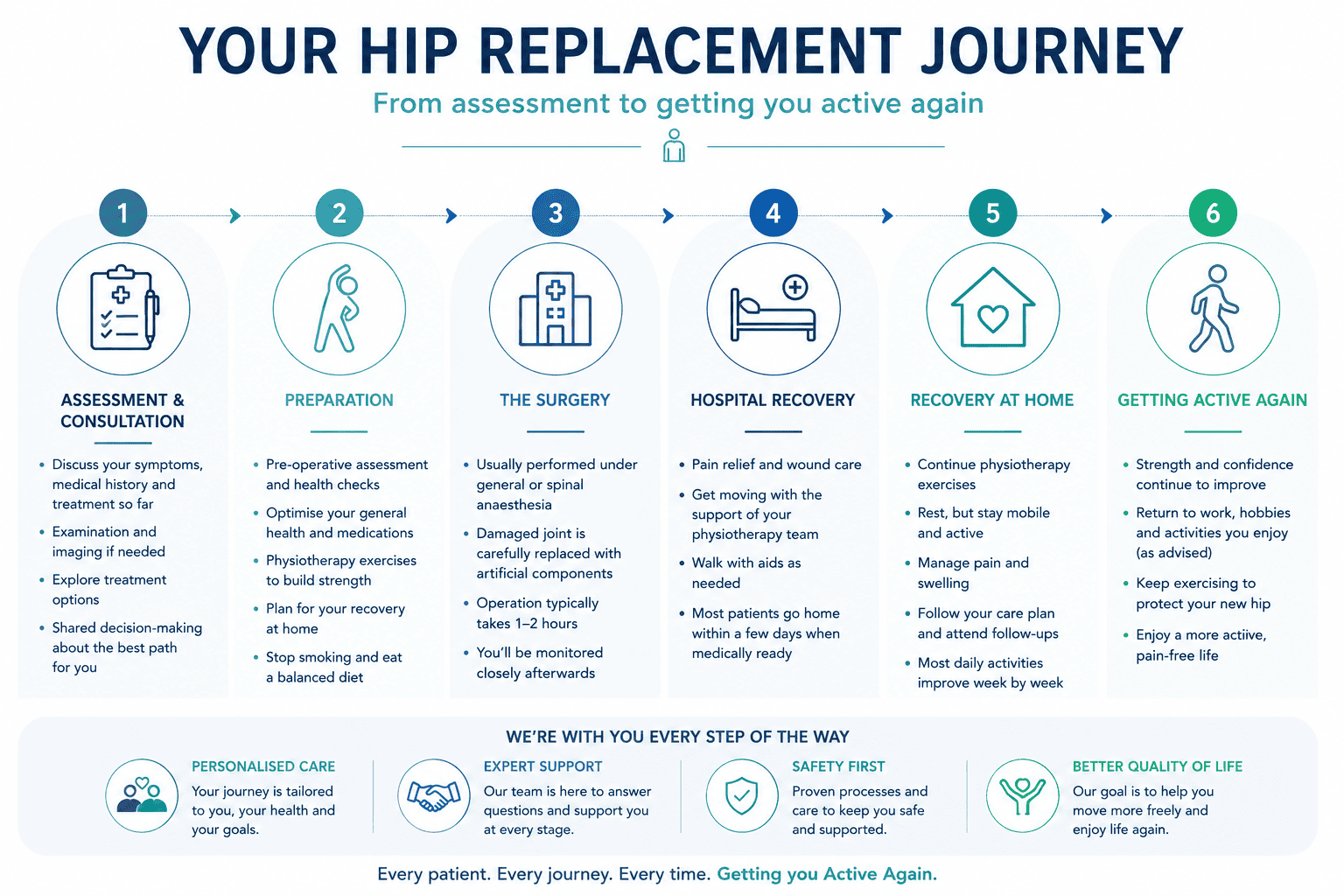
Once hip replacement has been recommended, there is usually a period of assessment and preparation before the operation.
This is not simply an administrative step. It is an opportunity to confirm that surgery is appropriate, identify anything that could increase your risk, prepare you for recovery and make sure you understand what the operation involves.
What happens at the pre-operative assessment?
You will normally have a pre-operative or pre-admission assessment before surgery. The exact process varies between hospitals, but it may include:
- reviewing your medical history and current medicines
- checking your general health and fitness for surgery
- blood tests
- blood pressure and other routine observations
- an ECG where appropriate
- assessment of your anaesthetic risk
- reviewing previous operations or anaesthetic problems
- checking for conditions that may need optimisation before surgery
- discussing the operation and recovery
- planning your discharge and support at home.
The NHS advises that preparation may also include strengthening exercises, weight management where appropriate, stopping smoking and maintaining a healthy diet.
Your surgeon and anaesthetist may also ask about medicines that affect bleeding, diabetes, heart or lung conditions, allergies and any previous problems with anaesthesia.
Do you need to prepare physically for a hip replacement?
Yes, where possible. Being as fit and well prepared as you can be before surgery may make the recovery process easier.
Maintaining strength and mobility before an operation can be useful because hip arthritis itself may have reduced your activity over time.
However, preparation needs to be realistic. Someone with severe hip arthritis may not be able to undertake vigorous exercise. Your healthcare team can advise on exercises that are appropriate for you.
Stopping smoking is also advisable because smoking can adversely affect surgical recovery and wound healing. If you are overweight, weight management may be discussed, but NICE states that BMI should not be used as an arbitrary barrier to referral for joint replacement.
What should you ask before agreeing to surgery?
You should have enough information to make an informed decision.
Useful questions include:
- Why do you recommend hip replacement for me?
- What are my alternatives?
- What type of replacement are you recommending?
- How will the implant be fixed?
- Which surgical approach will you use?
- What are the important risks for me personally?
- How long might I need help at home?
- When can I expect to walk, drive and return to work?
- What should I expect the operation to achieve?
- What happens if I decide not to have surgery now?
The NJR describes this process as shared decision-making and provides information to help patients discuss implant and treatment choices with their clinical team.
8. How Is a Hip Replacement Performed?
A total hip replacement replaces the damaged ball and socket of the hip with artificial components.
The operation is normally performed in hospital under either a general anaesthetic or a regional anaesthetic, sometimes with sedation. The most appropriate anaesthetic technique depends on your health, the operation and discussions with your anaesthetist.
What happens during the operation?
In simplified terms, the surgeon:
- makes an incision to access the hip joint
- removes the damaged femoral head
- prepares the inside of the femur for the new stem
- prepares the damaged socket
- inserts the artificial acetabular component
- inserts the femoral stem and artificial head
- brings the new components together
- checks the movement and stability of the reconstructed hip
- closes the wound.
The NHS describes the same basic sequence for total hip replacement.
The exact technique varies between surgeons, patients and hospitals.
How long does hip replacement surgery take?
The operation itself commonly takes around one to two hours, although the total time you spend in the operating and recovery areas will be longer. The Royal National Orthopaedic Hospital gives a typical operative duration of one to two hours.
The length of the operation is not, by itself, an indication of how successful it will be.
What happens immediately afterwards?
After surgery, you will spend some time in a recovery area while the effects of the anaesthetic wear off.
Pain relief will be provided and the clinical team will monitor you for complications. You will normally be encouraged to start moving relatively soon after the operation, with help from physiotherapy staff.
Early mobilisation is an important part of modern hip replacement care and also forms part of measures used to reduce complications such as blood clots.
9. What Types of Hip Replacement Are There?
There is no single type of hip replacement that is right for every patient.
The main distinctions concern what part of the hip is replaced, how the components are fixed to the bone and what materials are used for the bearing surfaces.
| Type | What it means |
|---|---|
| Total hip replacement | Both the femoral head and acetabular surface are replaced |
| Hemiarthroplasty | The femoral head is replaced but the natural socket is retained |
| Hip resurfacing | The femoral head is preserved and its surface is covered with an artificial component |
| Cemented replacement | Bone cement is used to secure one or more components |
| Cementless replacement | Components are designed to achieve fixation without bone cement, with bone growing onto or into the implant surface |
| Hybrid replacement | Typically combines a cemented femoral component with an uncemented acetabular component |
For most people having planned surgery for severe hip arthritis, the relevant operation is a total hip replacement.
Hemiarthroplasty is more commonly associated with particular hip fractures rather than routine elective treatment of osteoarthritis.
The NJR records different fixation methods, including cemented, cementless, hybrid and reverse-hybrid replacements.
Which type is best?
There is no universally best hip replacement.
The appropriate implant and fixation method depend on factors including your age, bone quality, diagnosis, anatomy, activity and the surgeon’s assessment.
Implant selection should therefore be an individual clinical decision rather than a choice based simply on which technology sounds newest.
A more detailed discussion of implant selection and the evidence behind different options can be covered in the dedicated [Hip Replacement Types and Implants] section of the Active Again cluster.
10. What Surgical Approaches Are Used?
The term surgical approach describes the route the surgeon uses to reach the hip joint.
Common approaches include:
- posterior approach
- anterolateral or lateral approach
- direct anterior approach.
These approaches involve working through different tissues around the hip to reach the joint.
Is one surgical approach better than the others?
Not universally.
Different approaches have potential advantages and disadvantages, and outcomes can depend on factors including surgical experience, patient characteristics, implant choice and rehabilitation.
It is therefore important not to assume that “anterior”, “posterior”, “minimally invasive” or any other label automatically means a better hip replacement.
The most appropriate approach is a clinical decision for you and your surgeon.
The approach should also be considered separately from the implant itself. A particular surgical approach does not necessarily require a particular implant, and an implant brand should not be assumed to be superior simply because it is used with a particular approach.
This distinction is important when comparing information about hip replacement online.
11. What Implants Are Used?
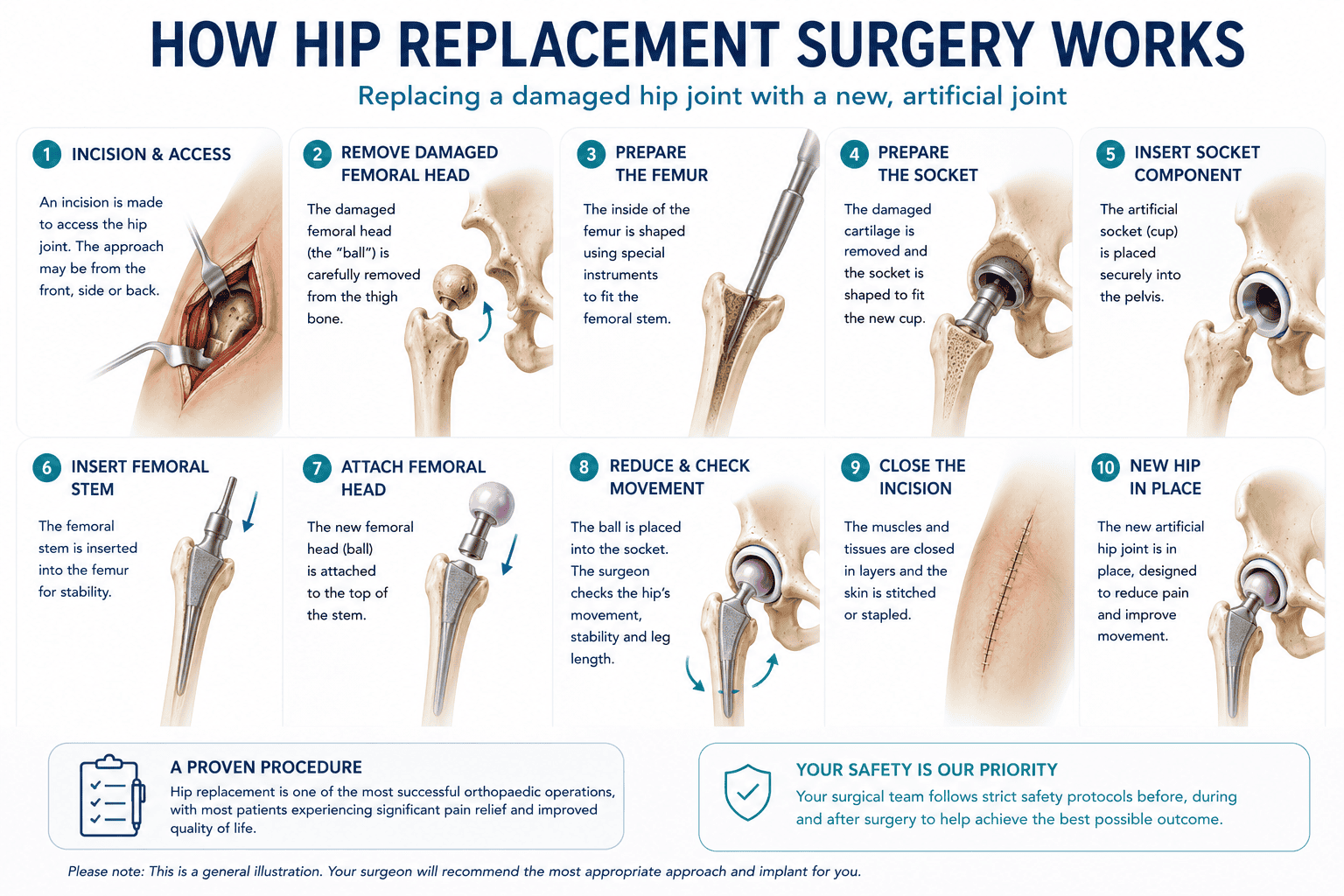
A total hip replacement consists of several components.
The main components
Femoral stem
This sits inside the thigh bone and supports the artificial femoral head.
Femoral head
This forms the new “ball” of the hip and can be manufactured from materials including metal or ceramic.
Acetabular component
This replaces the damaged socket surface.
Bearing surface
This is the surface where the artificial ball moves against the artificial socket liner.
Different combinations of materials are available, including metal-on-polyethylene and ceramic-on-polyethylene, as well as other combinations.
Cemented or uncemented?
A cemented component is fixed to the bone using bone cement.
An uncemented component is designed to achieve an initial mechanical fit and, depending on its design, allow bone to grow onto or into its surface.
Some replacements combine the two approaches.
The choice depends on individual factors rather than there being one universally superior fixation method. The NJR publishes information on implant types and revision outcomes to support informed discussions about these choices.
Does the implant brand matter?
Yes, but brand name alone should not determine your decision.
There are many hip implant designs and manufacturers. Their performance is monitored through systems including the National Joint Registry, which collects information about joint replacement procedures and subsequent revisions.
When discussing your proposed implant with your surgeon, useful questions include:
- What implant are you recommending?
- Why is it appropriate for me?
- How is it fixed to the bone?
- What bearing surfaces are being used?
- What evidence is available for its performance?
- Is there anything particular about my age, anatomy or activity that influenced the choice?
The NJR publishes implant and revision information and encourages patients to discuss their individual implant choice with their clinical team.
12. What Are the Risks and Complications?
Hip replacement is a major operation and, although it is commonly performed, complications can occur.
Most patients do not experience a serious complication, but understanding the potential risks is an important part of deciding whether surgery is right for you.
The risks vary between individuals, so figures quoted elsewhere should not be interpreted as your personal risk.
What are the main complications?
Potential complications include:
| Complication | What it means |
|---|---|
| Blood clot | A DVT can develop in the leg and, rarely, travel to the lungs as a pulmonary embolism |
| Infection | Infection can affect the wound or, more seriously, the artificial joint |
| Dislocation | The artificial ball can come out of the socket |
| Leg-length difference | The operated leg may end up slightly longer or shorter |
| Nerve or blood-vessel injury | Structures around the hip can occasionally be damaged |
| Bleeding | Blood loss can occur during or after surgery |
| Loosening or wear | Components can deteriorate or lose fixation over time |
| Persistent pain | Some patients continue to experience pain despite technically successful surgery |
| Fracture | Bone around the implant can occasionally fracture |
| Revision surgery | Further surgery may eventually be required if the replacement fails or develops a significant complication |
The NHS specifically identifies blood clots, infection, leg-length difference, nerve or tissue injury, dislocation and wear among recognised complications of hip replacement.
Some complications are more likely in particular circumstances, which is why your own medical history matters.
Can a hip replacement fail?
Yes.
A hip replacement is designed to be durable, but it is not a lifetime guarantee. Over time, components can wear, loosen, become infected or otherwise fail.
Some patients eventually require revision hip replacement surgery, in which some or all of the original components are replaced or otherwise treated.
The NJR provides long-term data on hip replacement and revision procedures.
A detailed explanation of individual complications, warning symptoms and revision treatment should sit within the dedicated Hip Replacement Risks and Hip Replacement Revision pages rather than being repeated in full here.
13. What Is Hip Replacement Recovery Like?
Recovery begins immediately after surgery and continues for several weeks and months.
There is considerable individual variation. Your age, general health, fitness, muscle strength, the condition of the other hip and your type of work or activity can all affect how quickly you return to normal.
What happens immediately after surgery?
You will normally be encouraged to get out of bed and start walking with assistance relatively soon after the operation.
Initially, you may use crutches or a walking frame. A physiotherapist will help you with movement and exercises and may advise you about stairs and everyday activities before you leave hospital.
Some people can leave hospital on the day of surgery or the following day, while others need longer. The appropriate timing depends on your recovery and local arrangements.
What is the first few weeks like?
It is normal to experience some pain, swelling, stiffness and tiredness following surgery.
You will usually be given pain relief and exercises to continue at home. Walking little and often, within the limits advised by your clinical team, is generally encouraged.
You may initially need help with tasks such as:
- putting on socks and shoes
- bathing
- shopping
- cooking
- housework
- driving
- caring for other people.
Preparing your home and arranging practical help before surgery can therefore make the early recovery period considerably easier.
How long does it take to recover?
There is no single recovery timetable that applies to everyone.
The NHS notes that recovery can take several months. Many people are able to return progressively to normal activities during this period, but the speed of recovery varies.
Returning to work depends particularly on the type of work you do. Driving should only resume when you are medically fit and able to control the vehicle safely; the NHS advises waiting at least six weeks and checking with your doctor.
The aim is not simply to get you through the first few weeks. Rehabilitation is about progressively restoring strength, movement, confidence and function.
A detailed week-by-week discussion of recovery, driving, work, exercise, sport, sleeping and longer-term rehabilitation belongs on the dedicated Hip Replacement Recovery page.
What should you expect from recovery?
It is helpful to think of recovery as a progression rather than a single event.
Early recovery is primarily about controlling pain, protecting the wound, moving safely and becoming independent.
Later recovery is increasingly about rebuilding strength, improving walking and returning to activities that matter to you.
Some people feel dramatically better relatively quickly. Others experience a slower improvement, particularly if they have had severe arthritis, reduced mobility or significant muscle weakness before surgery.
A good recovery does not necessarily mean that the new hip feels exactly like a natural hip. The realistic goal is to achieve a substantial improvement in pain and function while allowing the artificial joint to become part of your normal daily life.
The detailed recovery plan should always come from your own surgical and rehabilitation team because protocols vary between patients and hospitals.
Hip Replacement
Hip replacement surgery is one of the most established treatments for severe hip pain and loss of function. For people whose hip has become sufficiently damaged that everyday activities are increasingly difficult, replacing the damaged joint can provide substantial relief from pain and improve mobility and quality of life.
But deciding whether you actually need a hip replacement is not simply a question of how an X-ray looks.
The more important questions are how much your hip is affecting your life, what treatments you have already tried, whether the diagnosis is clear, and whether the potential benefits of surgery outweigh its risks for you.
For many people, the underlying problem is osteoarthritis. Hip replacement may also be considered when the joint has been damaged by other conditions, including inflammatory arthritis, previous injury or fracture, or other forms of joint deterioration.
This guide explains what a hip replacement involves, why it may be recommended, what happens before and during surgery, the main choices surrounding implants and surgical approaches, the potential risks, recovery, private costs and how to approach choosing a surgeon and hospital.
It is designed to help you have a better-informed conversation with your healthcare team. It is general information and does not replace an individual medical assessment.
Hip Replacement at a Glance
What is a hip replacement?
Hip replacement surgery removes damaged parts of the hip joint and replaces them with artificial components designed to recreate a functioning ball-and-socket joint.
Why do people have hip replacements?
The most common reason is osteoarthritis causing significant pain, stiffness and loss of function. Other conditions can also cause sufficient joint damage to require replacement.
When should you consider one?
NICE recommends considering referral for joint replacement when joint symptoms substantially affect quality of life and non-surgical management is ineffective or unsuitable. The decision should be based on clinical assessment rather than an arbitrary pain score, age or X-ray threshold.
Do you have to be a particular age?
No. Age alone should not prevent someone from being considered for joint replacement. However, age and general health can influence individual surgical risks and longer-term considerations.
Does an X-ray determine whether you need surgery?
No. Imaging is useful, but symptoms, function, diagnosis, general health, previous treatment and expectations all matter.
Is hip replacement major surgery?
Yes. It is a major operation even though it is routinely performed. There are potential complications, and the decision should balance expected benefits against those risks.
How long does a hip replacement last?
Many modern hip replacements provide durable long-term function, but no implant can be guaranteed to last for a particular period in an individual patient. Implant survival depends on several factors and is monitored through the National Joint Registry (NJR).
What Is a Hip Replacement?
A hip replacement replaces damaged parts of the natural hip joint with artificial components.
The natural hip is a ball-and-socket joint. The rounded femoral head at the top of the thigh bone fits into the acetabulum, a socket in the pelvis. Smooth cartilage normally covers the joint surfaces and allows movement with little friction.
When the joint becomes significantly damaged, pain, stiffness and reduced movement can develop.
In a total hip replacement, the damaged femoral head is removed and replaced with an artificial ball attached to a stem. The damaged surface of the socket is replaced with an artificial acetabular component.
The implant may contain combinations of metal, ceramic and polyethylene, depending on the design selected.
What does a hip replacement actually replace?
A total hip replacement normally replaces:
- the femoral head — the “ball”
- the acetabular surface — the “socket”.
The new joint therefore has an artificial ball moving within an artificial socket.
There are many implant designs and combinations of fixation and bearing materials. There is no single implant that is automatically the best choice for every patient.
Total hip replacement versus resurfacing
Most planned hip replacements for advanced arthritis are total hip replacements.
Hip resurfacing is different. The femoral head is preserved and reshaped rather than completely removed, with an artificial covering placed over it, while the socket is resurfaced.
Resurfacing is a more selective procedure and is not appropriate for everyone. The choice depends on individual factors and should be discussed with an orthopaedic surgeon.
What is the aim of surgery?
The principal aims are to:
- reduce pain
- improve hip function
- improve mobility
- improve quality of life.
The objective is not necessarily to recreate a completely natural hip or guarantee that every previous activity will be possible.
Why Might You Need a Hip Replacement?
Osteoarthritis
The most common reason is osteoarthritis of the hip.
Hip osteoarthritis can cause activity-related pain, stiffness and loss of function. Symptoms can vary considerably between people and may fluctuate over time.
You may notice that you:
- walk shorter distances
- struggle with stairs or hills
- have difficulty putting on socks and shoes
- find getting into a car difficult
- have stopped exercising
- wake because of pain
- need regular pain relief
- avoid social activities
- have difficulty working
- have changed the way you walk.
The important question is not simply how abnormal your X-ray looks.
It is:
What can I no longer do because of my hip that I want or need to do?
Other causes
Hip replacement can also be considered following:
- inflammatory arthritis
- previous hip injury or fracture
- avascular necrosis of the femoral head
- developmental abnormalities
- other conditions causing severe joint damage.
The underlying diagnosis matters because it influences the treatment options and surgical assessment.
When Should You Consider a Hip Replacement?
There is no single pain score, X-ray appearance or age at which everyone should have a hip replacement.
NICE recommends considering referral when symptoms such as pain, stiffness, reduced function or progressive deformity are substantially affecting quality of life and non-surgical management is ineffective or unsuitable.
Do you have to wait until the pain is unbearable?
No.
You do not need to wait until you can barely walk.
Equally, having hip arthritis does not automatically mean you need surgery.
The decision should consider how substantially the condition affects your life and whether the likely benefits justify the risks and recovery associated with major surgery.
Have you tried non-surgical treatment?
Depending on the individual, this may include:
- therapeutic exercise
- physical activity and strengthening
- weight-management support where appropriate
- pain relief
- education and self-management.
NICE recommends therapeutic exercise and appropriate weight-management support as part of osteoarthritis management.
If appropriate treatments have been tried without providing sufficient relief, surgery may become a reasonable option to discuss.
Does the X-ray determine whether you need surgery?
No.
NICE recommends clinical assessment rather than numerical scoring systems when considering referral for joint replacement.
Two people can have similar-looking X-rays but very different levels of pain and disability.
Is there a minimum age?
No.
NICE states that people should not be excluded from referral because of age, smoking, comorbidities, overweight or obesity based on BMI, or other listed characteristics. These factors can nevertheless influence individual surgical risk and should be discussed.
What Happens Before Hip Replacement Surgery?
Once surgery is being considered, you will normally undergo assessment and preparation before the operation.
This may include:
- review of your medical history
- medication assessment
- blood tests
- blood pressure and other observations
- an ECG when appropriate
- anaesthetic assessment
- assessment of other medical conditions
- discussion of the operation and recovery
- planning for discharge and support at home.
NICE recommends pre-operative rehabilitation advice covering exercise, lifestyle, weight management, diet, smoking cessation and maximising functional independence where appropriate.
What should you ask before agreeing to surgery?
Useful questions include:
- Why do you recommend hip replacement for me?
- What alternatives are available?
- What improvement should I realistically expect?
- Which implant are you recommending?
- How will it be fixed?
- Which surgical approach will you use?
- What are my individual risks?
- How long might recovery take?
- What support will I need at home?
- What happens if I decide to wait?
NICE recommends that people offered joint replacement receive procedure-specific information about benefits, risks, alternatives, implants, anaesthesia, recovery and future surgery.
How Is a Hip Replacement Performed?
A total hip replacement replaces the damaged ball and socket with artificial components.
The operation is performed under either a general or regional anaesthetic, depending on the circumstances and the anaesthetic plan.
In broad terms, the surgeon:
- accesses the hip joint
- removes the damaged femoral head
- prepares the femur
- prepares the acetabulum
- inserts the artificial socket
- inserts the femoral stem and head
- assembles the new joint
- checks its movement and stability
- closes the wound.
The precise technique varies according to the patient, surgeon, implant and circumstances.
How long does the operation take?
The operation itself commonly takes around one to two hours, although the complete theatre and recovery process takes longer.
The length of an operation alone does not determine its success.
After surgery, you will be monitored in recovery and encouraged to start moving as soon as it is safe to do so.
What Types of Hip Replacement Are There?
There are several ways of classifying hip replacements.
| Type | What it means |
|---|---|
| Total hip replacement | The femoral head and socket are replaced |
| Hemiarthroplasty | The femoral head is replaced while the natural socket remains |
| Hip resurfacing | The femoral head is preserved and resurfaced |
| Cemented | Bone cement fixes the component to the bone |
| Cementless | The component is designed to achieve fixation without cement |
| Hybrid | Different fixation methods are used for the femoral and acetabular components |
For planned treatment of severe hip osteoarthritis, total hip replacement is generally the relevant procedure.
Hemiarthroplasty is more commonly associated with particular hip fractures rather than routine elective osteoarthritis surgery.
The NJR collects information about hip replacement procedures, components and fixation methods across the UK.
What Surgical Approaches Are Used?
The surgical approach is the route used to reach the hip joint.
Common approaches include:
- posterior
- lateral or anterolateral
- direct anterior.
Is one approach better?
There is no universally superior approach for every patient.
Each has potential advantages and disadvantages. Outcomes can also depend on patient characteristics, surgeon experience, implant selection and rehabilitation.
Terms such as “anterior”, “minimally invasive” or “muscle-sparing” should therefore not automatically be interpreted as meaning that one operation is better.
NICE specifically includes discussion of surgical approaches within its guidance on elective hip replacement, supporting individualised decision-making rather than a blanket recommendation for one approach.
What Implants Are Used?
A total hip replacement normally contains:
- a femoral stem
- a femoral head
- an acetabular cup
- a bearing surface.
Materials can include metal, ceramic and polyethylene.
Cemented or cementless?
Cemented components use bone cement to achieve fixation.
Cementless components are designed to achieve initial fixation and allow biological fixation as bone grows onto or into the implant surface.
Hybrid replacements combine fixation methods.
The choice may depend on age, bone quality, anatomy, diagnosis and other individual factors.
Does the implant brand matter?
It can matter, but brand name should not be treated as a guarantee of superior performance.
The NJR monitors hip replacement procedures and implant performance and provides information that can support discussions between patients and clinicians.
A useful question is not simply “Which implant is best?”
It is:
“Why is this implant appropriate for me, and what evidence supports its use?”
What Are the Risks and Complications?
Hip replacement is major surgery and complications are possible.
Recognised complications include:
- blood clots, including DVT and pulmonary embolism
- infection
- bleeding
- dislocation
- difference in leg length
- nerve or blood-vessel injury
- fracture around the implant
- persistent pain
- implant wear or loosening
- failure requiring further surgery.
The NHS identifies these among the recognised complications of hip replacement.
Your individual risk is influenced by factors including your general health, medical conditions, the operation and other patient-specific circumstances.
Can a hip replacement fail?
Yes.
An artificial hip can eventually wear, loosen, dislocate, become infected or otherwise fail.
If this happens, further surgery may sometimes be necessary. This is known as revision hip replacement.
The detailed symptoms, risk factors, complication rates and treatment options should be covered on the dedicated Hip Replacement Risks and Hip Replacement Revision pages rather than repeated extensively here.
What Is Hip Replacement Recovery Like?
Recovery starts immediately after surgery and continues for weeks and months.
You will normally be helped to mobilise soon after surgery, initially using crutches or a walking frame if necessary.
The NHS notes that many people go home within a few days when medically and functionally ready, while complete recovery can take several months.
The early weeks
You may experience:
- pain
- swelling
- stiffness
- tiredness
- reduced confidence with movement.
Physiotherapy and prescribed exercises are important parts of rehabilitation.
Practical preparation can also make a significant difference. You may initially need help with shopping, cooking, housework, bathing or other daily activities.
When can you drive or work?
There is no single timetable for everyone.
The NHS advises waiting at least six weeks before driving and confirming that you are fit to drive. Returning to work depends on the nature of your job and your recovery.
The dedicated Hip Replacement Recovery page should provide the detailed information on recovery milestones, driving, work, exercise and sport.
14. How Long Does a Hip Replacement Last?
A hip replacement is designed to provide long-term function, but no artificial joint is guaranteed to last for a particular number of years.
The NHS states that modern hip replacement joints are designed to last for at least 15 years, although individual outcomes vary.
Long-term evidence is more useful than a simple “15-year guarantee” interpretation. A systematic review and meta-analysis of studies with at least 15 years of follow-up has examined the longevity of total hip replacement, and the NJR continues to provide large-scale registry data on hip procedures and revisions.
How long an individual replacement lasts can be influenced by factors including:
- age at the time of surgery
- activity
- implant design
- fixation
- diagnosis
- bone quality
- complications
- wear or loosening.
Younger patients have more years in which an implant may potentially need further surgery, which is one reason implant longevity and revision should form part of the decision-making process.
This does not mean that a younger patient should automatically delay surgery. The decision should balance the potential benefits of treatment against the implications of living with severe hip disease and the possibility of future revision.
15. How Much Does a Hip Replacement Cost Privately?
There is no single UK private price for hip replacement.
The amount you pay depends on the hospital, surgeon, anaesthetist, implant, location, length of stay and exactly what the quoted package includes.
Current PHIN data published in April 2026 gives average private hospital package prices for hip replacement in a range of UK cities. The listed averages range from approximately £13,847 to £17,540 per hip, depending on location. PHIN stresses that these are guide prices and that the final price depends on individual circumstances.
A package may cover major elements of treatment, including hospital, surgeon and anaesthetist fees, but this is not universal.
Possible additional costs include:
- initial consultation
- investigations and scans
- pre-operative assessment
- physiotherapy
- medication
- additional hospital nights
- specialist equipment
- treatment of complications
- follow-up outside the package.
PHIN specifically advises patients to confirm what is included in a package in writing before booking.
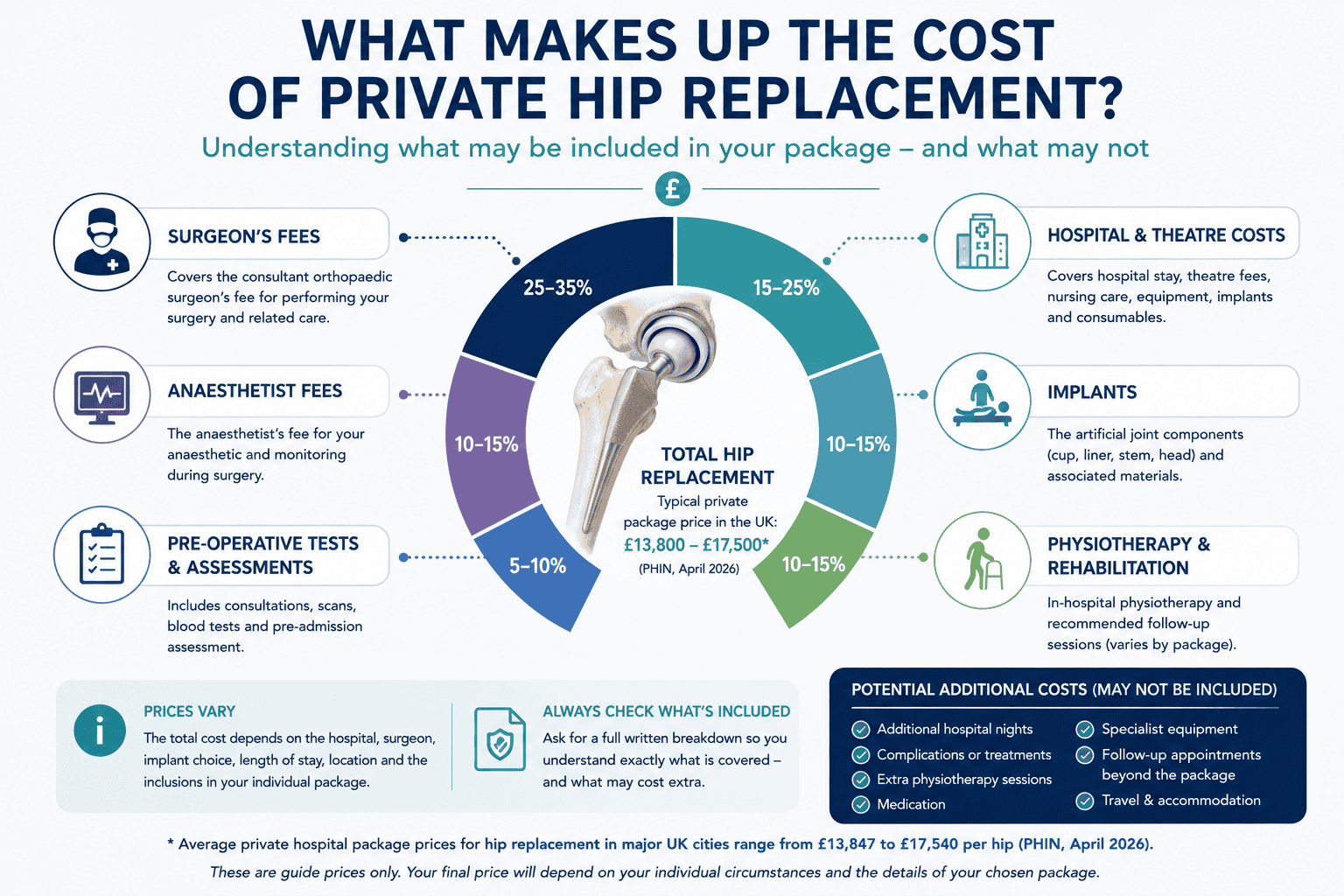
What should a private hip replacement quote include?
Ask for a written breakdown covering:
| Cost | Question to ask |
|---|---|
| Surgeon | Is the surgeon’s fee included? |
| Anaesthetist | Is anaesthesia included? |
| Hospital | What accommodation and theatre costs are included? |
| Implant | Is the prosthesis included? |
| Tests | Are scans and blood tests included? |
| Physiotherapy | Is rehabilitation included? |
| Follow-up | How many postoperative consultations are included? |
| Complications | What happens financially if an unexpected complication occurs? |
| Additional nights | What happens if you need to stay longer? |
For a more detailed breakdown, see Hip Replacement Cost.
Private treatment should therefore be compared on what is included and the overall care pathway, not simply the headline price.
16. How Do You Choose a Hip Replacement Surgeon and Hospital?
Choosing a surgeon and hospital is an important part of private treatment.
The aim should not be to find the surgeon with the most impressive marketing or the cheapest package. It should be to establish whether the proposed team is appropriate for your circumstances and whether you understand the care you will receive.
What should you look for in a surgeon?
Consider asking about:
- their orthopaedic training and current specialist practice
- their experience with hip replacement
- how frequently they perform the procedure
- the types of patients they commonly treat
- their approach to implant selection
- their complication and revision experience
- who provides care if you have a problem after surgery
- arrangements for follow-up.
Experience should be considered in context. A high procedure volume is useful information, but it is not by itself proof that one surgeon is better than another.
What should you look for in a hospital?
Consider:
- appropriate surgical facilities
- anaesthetic support
- physiotherapy and rehabilitation
- infection-control arrangements
- postoperative nursing
- emergency support
- arrangements for managing complications
- access to further treatment if something goes wrong.
Ask what happens after you leave hospital, not just what happens on the day of surgery.
What about surgeon and hospital outcome data?
Where reliable information is available, patients should consider objective data alongside clinical experience and their own priorities.
The NJR provides information on joint replacement activity, implant performance and revision procedures.
In private healthcare, PHIN can also provide information on consultant fees and aspects of patient experience and activity where sufficient data are available.
No single statistic should determine your choice.
17. Questions to Ask Before Having a Hip Replacement
Take a written list to your consultation.
About the diagnosis
- What is causing my hip pain?
- Is the pain definitely coming from the hip joint?
- How severe is the joint damage?
- Are there other conditions that could be contributing?
About the decision
- Why do you think replacement is appropriate now?
- What happens if I wait?
- What alternatives are available?
- What improvement is realistic for me?
About the operation
- Which type of hip replacement are you recommending?
- Which implant will you use?
- How will it be fixed?
- Which surgical approach will you use?
- Why have you chosen these options for me?
- What anaesthetic will I have?
About risks
- What are the important risks in my particular case?
- What is your plan for preventing and treating complications?
- What happens if the hip becomes infected or dislocates?
- What happens if the replacement eventually fails?
About recovery
- How long am I likely to need crutches?
- When can I drive?
- When can I return to work?
- When can I exercise?
- Who should I contact if I have a problem?
About private treatment
- What exactly is included in the price?
- Are surgeon and anaesthetist fees included?
- Is the implant included?
- What happens if I need an additional hospital night?
- What follow-up is included?
- What happens financially if a complication requires further treatment?
A good consultation should leave you understanding not only what is being recommended, but why.
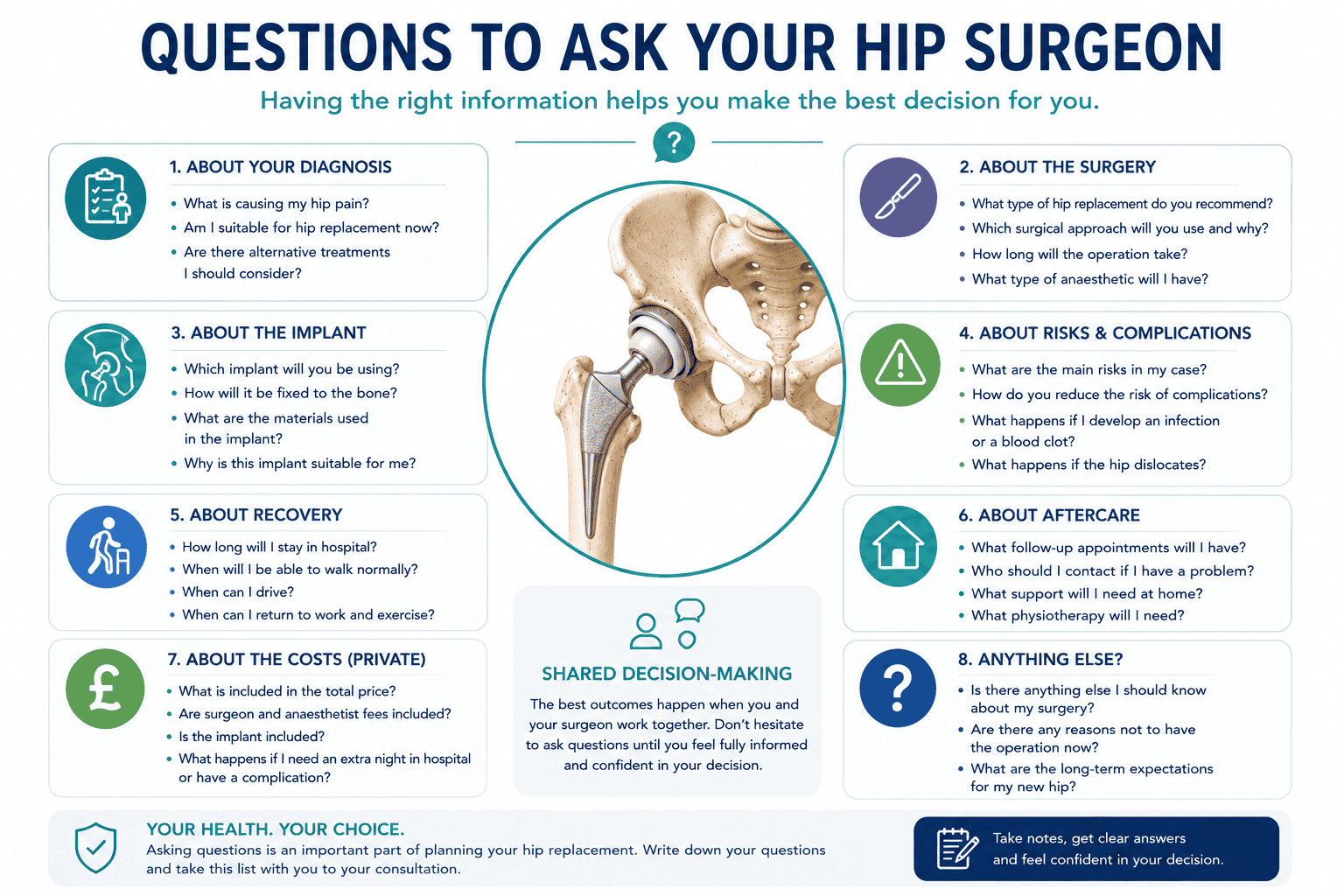
18. Hip Replacement: Key Things to Know
If you remember only a few things from this guide, remember these:
1. Hip replacement is primarily about symptoms and quality of life.
The decision is not based on an X-ray alone.
2. You do not have to reach a particular age.
Age should not be an arbitrary barrier to referral, although it remains relevant to individual risk and long-term considerations.
3. Surgery is not the only treatment.
Exercise, weight management where appropriate, pain management and other non-surgical options may be useful.
4. There is no universally best implant or surgical approach.
The choice should be individualised.
5. Hip replacement is major surgery.
It is effective for many people but has potential complications.
6. Recovery takes time.
Early mobilisation is important, but full recovery can continue for several months.
7. Private prices vary substantially.
Compare complete packages rather than headline prices.
8. Ask what happens if something goes wrong.
A good treatment pathway includes clear arrangements for postoperative problems and further treatment.
9. You should be involved in the decision.
NICE recommends shared decision-making and information about alternatives, benefits, risks, implants, anaesthesia and recovery.
19. Frequently Asked Questions
Is a hip replacement worth it?
For people with substantial hip pain and disability who have not obtained enough benefit from appropriate non-surgical treatment, hip replacement can be an effective treatment. Whether it is worthwhile for you depends on your individual symptoms, health, expectations and assessment.
Can you walk normally after a hip replacement?
Many people regain substantially improved walking ability after surgery, but recovery varies. Strength, balance, confidence and other health conditions can influence the result.
Can you live a normal life after a hip replacement?
Many people return to a wide range of everyday activities. The appropriate level of activity depends on your recovery, health and advice from your clinical team.
Is hip replacement very painful?
There is usually some pain after surgery, but modern pain-management strategies are used to control it. Pain generally improves during recovery, although the speed and extent of improvement differ between patients.
Can a hip replacement dislocate?
Yes. Dislocation is a recognised complication, although it is not common. It can occur soon after surgery or, less commonly, later.
Can you kneel after a hip replacement?
Many people can eventually kneel, although it may initially feel uncomfortable or unusual. Your surgeon or physiotherapist can advise you based on your operation and recovery.
When can you drive after hip replacement?
The NHS advises waiting at least six weeks and checking with your doctor that you are fit to drive. You must also be able to control the vehicle safely.
How soon can you return to work?
It depends on your occupation and recovery. Office-based work may be possible sooner than physically demanding work. Your clinical team can advise based on your circumstances.
Can you exercise after a hip replacement?
Yes. Rehabilitation includes movement and exercise, and many people return to physical activity. The appropriate activities and timing depend on your recovery and individual advice.
Does a hip replacement ever need replacing?
Yes. An artificial hip can eventually fail because of wear, loosening, infection, dislocation or other problems. Some patients require revision surgery.
Is anterior hip replacement better?
Not necessarily. Surgical approaches have different characteristics, and there is no universally superior approach for every patient. The choice should be discussed with your surgeon.
Is a ceramic hip replacement better?
Not automatically. Ceramic is one of several bearing materials used in hip replacement. The appropriate combination depends on the individual patient and implant design.
Can you have both hips replaced?
Yes. Some patients require replacement of both hips. Whether they should be treated separately or through another planned approach depends on individual circumstances and surgical assessment.
Should I have a hip replacement privately?
Private treatment may offer different choices around timing, location and consultant, but it involves significant cost and should be evaluated on the whole care pathway rather than speed or price alone.
20. Medical Sources and References
The principal sources used for this guide include:
NICE — Osteoarthritis in over 16s: diagnosis and management (NG226).
This is the principal UK guideline for osteoarthritis management and referral for joint replacement. It supports clinical assessment, shared decision-making and consideration of quality-of-life impact rather than arbitrary referral thresholds.
NICE — Joint replacement (primary): hip, knee and shoulder (NG157).
This covers shared decision-making, pre-operative rehabilitation, anaesthesia, surgical approaches, implant considerations and postoperative care.
National Joint Registry (NJR).
The NJR provides UK registry data on hip replacement procedures, implants, revision surgery and longer-term outcomes. Its annual reports and research publications are particularly important when discussing implant performance and longevity.
NHS — Hip replacement.
NHS patient information was used for the basic description of surgery, preparation, recovery, complications and practical recovery advice.
PHIN — Private healthcare information.
PHIN’s April 2026 package-price information was used for the private-cost section. PHIN notes that package prices are guides and that inclusions vary.
Peer-reviewed evidence on implant longevity.
Long-term systematic-review evidence on hip replacement survival should be used alongside contemporary NJR data when discussing durability.
Before publication, the final medical reviewer should verify all clinical statements against the latest available guidance and NJR data.
21. Making an Informed Decision About Hip Replacement
Choosing hip replacement is a personal decision.
For some people, surgery represents the opportunity to move beyond years of pain and regain activities that have gradually disappeared from everyday life. For others, symptoms may not yet justify the risks and recovery involved.
There is no universal “right time”.
The most useful starting point is to understand what is causing your symptoms, how much they are affecting your life, what alternatives remain, and what a hip replacement is realistically likely to achieve.
If you are considering private treatment, look beyond the headline price. Understand the surgeon’s recommendation, the implant being proposed, the hospital, the anaesthetic arrangements, rehabilitation, follow-up and what happens if a complication occurs.
Most importantly, make sure you have enough information to make a decision that is right for you.
Active Again is designed to help patients understand their orthopaedic options clearly, so they can approach conversations with surgeons and healthcare providers better informed and better prepared.
If you are considering hip replacement, explore the detailed Active Again guides on hip replacement cost, hip replacement recovery, hip replacement risks and revision hip replacement to understand the parts of the journey that matter most to you.
Author/medical reviewer
For a medical Active Again page, I recommend displaying something like:
Written and Medically Reviewed by: Active Again Medical Team
Last medically reviewed: 2nd September 2026
Next review due: September 2027
Popular Guides
Hip Replacement
- Hip Replacement
- Hip Replacement Cost
- Private Hip Replacement
- Revision Hip Replacement
- Hip Replacement Recovery
- Hip Replacement Risks
- Hip Replacement in London
- Hip Replacement in Oxford
- NICE, Osteoarthritis in over 16s: diagnosis and management (NG226) — referral and preparation principles. (Nice)
- NHS, What is a hip replacement? — current NHS description of the procedure.
- NHS, How a hip replacement is done — operative steps, hemiarthroplasty and resurfacing.
- NHS, Preparing for a hip replacement — pre-operative assessment and preparation.
- NHS, Complications of a hip replacement — principal recognised complications.
- NHS, Recovering from a hip replacement — mobilisation and recovery principles. (nhs.uk)
- National Joint Registry — implant types, fixation, shared decision-making and registry information. (NJR Centre)