
Partial Knee Replacement: A Complete Patient Guide
Partial knee replacement, also called unicompartmental knee replacement (UKR), can provide excellent pain relief and a faster recovery for carefully selected patients. But it is not suitable for everyone, and the evidence comparing it with total knee replacement is more nuanced than the simple claim that one operation is “better”.
If you have osteoarthritis affecting predominantly one part of your knee, you may have been told that you could have either a partial knee replacement or a total knee replacement.
Understanding the difference — and the evidence behind each option — can help you have a more informed discussion with your surgeon and decide which approach is most appropriate for you.
What is a unicompartmental knee replacement?
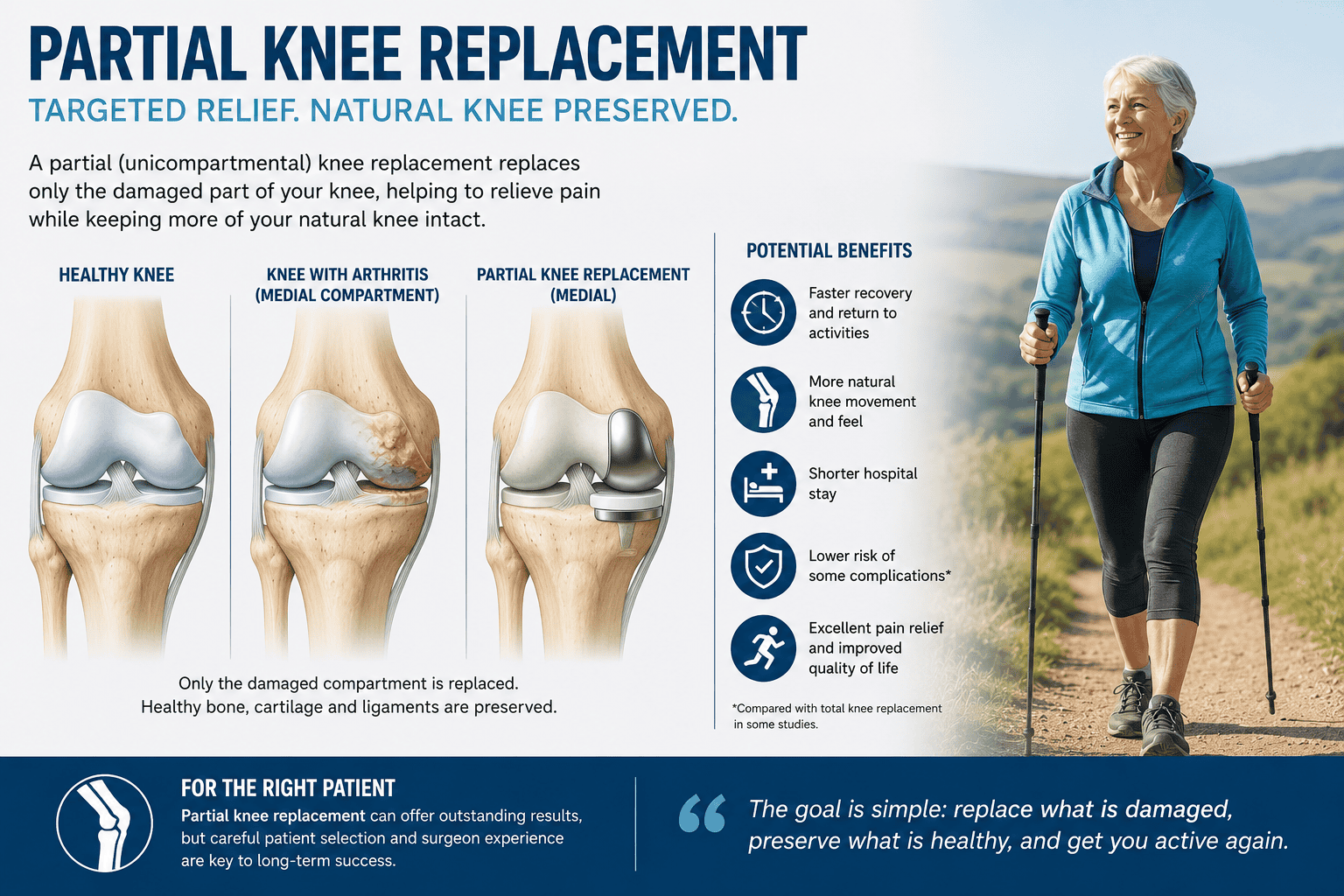
A unicompartmental knee replacement is another name for a partial knee replacement.
The knee is broadly divided into three compartments:
- Medial compartment – the inner side of the knee
- Lateral compartment – the outer side
- Patellofemoral compartment – where the kneecap meets the thigh bone
In a unicompartmental replacement, the surgeon replaces the damaged compartment while preserving much of the rest of the knee.
For example, if arthritis is predominantly confined to the medial compartment, a medial unicompartmental knee replacement may replace the damaged surfaces on the inner side of the knee while leaving the other compartments intact.
This is different from a total knee replacement, which replaces the damaged surfaces more extensively.
NICE recommends that people with isolated medial compartmental osteoarthritis who are having knee replacement should be offered a choice between partial and total knee replacement, with the potential benefits and risks of each discussed.
Why might someone have a partial knee replacement?
The basic philosophy is straightforward:
Replace the damaged part of the knee while preserving as much of the patient’s natural knee as possible.
A successful unicompartmental replacement can preserve more of:
- the patient’s natural bone;
- healthy areas of cartilage;
- the surrounding soft tissues;
- and the normal anatomy and movement of the knee.
For an appropriately selected patient, this can potentially produce a knee that feels more natural and allows a faster recovery.
But preserving the rest of the knee also creates the main long-term trade-off:
the untreated parts remain your own knee and can subsequently develop arthritis.
Who is suitable for a unicompartmental knee replacement?
This is one of the most important questions.
Having arthritis that appears worse on one side of your knee does not automatically make you suitable for a partial replacement.
Your surgeon will consider several factors.
Where the arthritis is located
The arthritis should be predominantly confined to the compartment being considered for replacement.
The condition of the other compartments
The remaining compartments need to be sufficiently healthy for a partial replacement to make sense.
Your ligaments
The function and condition of the important knee ligaments form part of the assessment.
Knee alignment
Your overall knee and leg alignment will be considered.
Range of movement
Your surgeon will assess how far your knee bends and straightens.
Stability
The stability of your knee is an important part of determining suitability.
Your symptoms
The location and nature of your pain should correspond with the compartment affected by arthritis.
This is why an X-ray alone does not determine whether you should have a partial knee replacement.
The decision should take account of your symptoms, examination, imaging and overall circumstances.
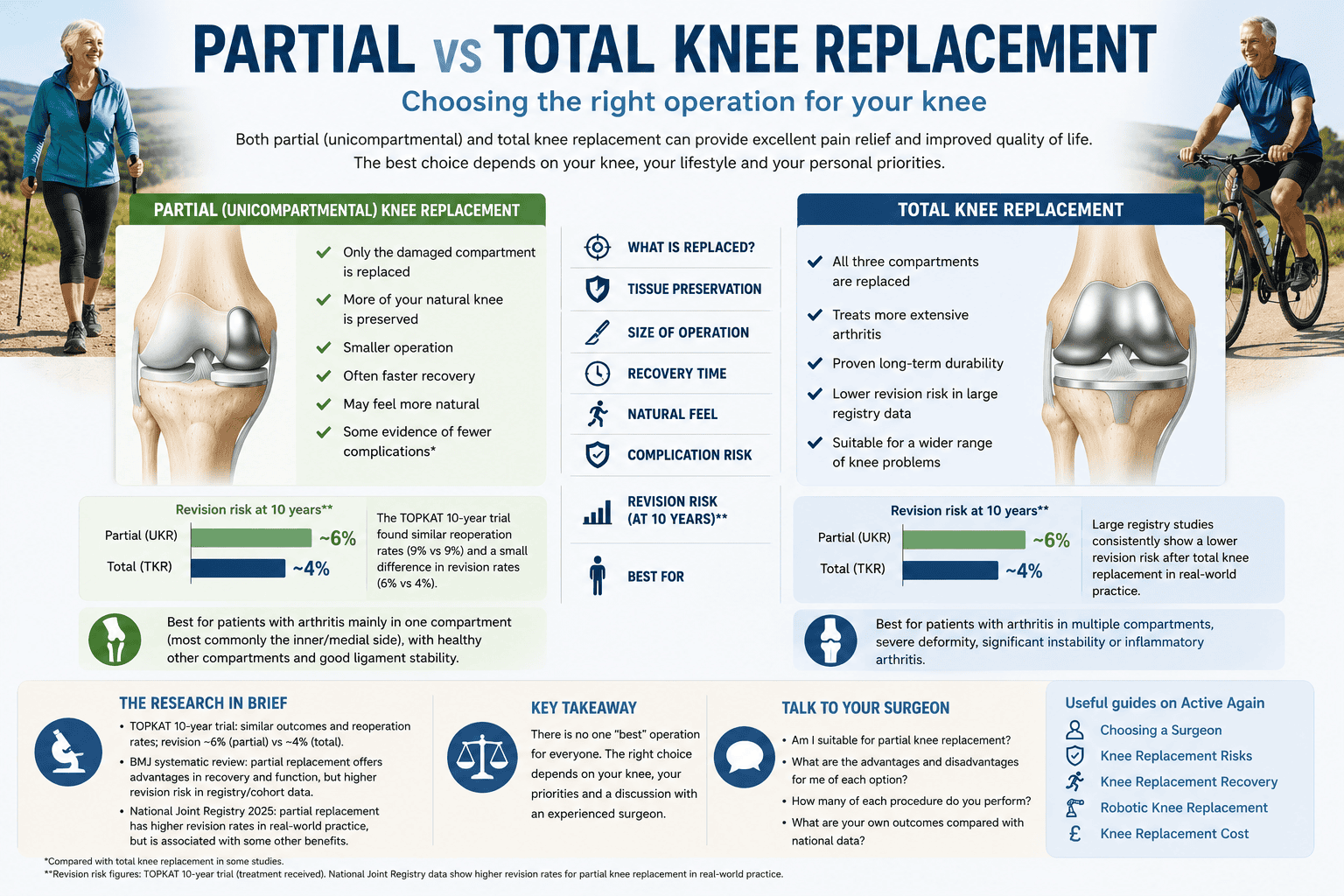
Partial versus total knee replacement
For someone who is genuinely suitable for either procedure, the decision becomes more interesting.
Neither operation is universally better.
They have different advantages and disadvantages.
| Partial / unicompartmental replacement | Total knee replacement | |
|---|---|---|
| Area replaced | One compartment | More extensive replacement of the knee |
| Natural knee preserved | More | Less |
| Surgical intervention | Generally smaller | More extensive |
| Recovery | Often faster | Usually longer |
| Early function | Often very good | Very good |
| Remaining knee | Can develop arthritis later | More of the arthritic joint is replaced |
| Revision risk | Higher in large registry data | Generally lower |
| Suitability | Requires appropriate disease pattern | Suitable for a broader range of arthritis |
| Long-term consideration | Remaining compartments remain relevant | More comprehensive treatment of the arthritic knee |
NICE concluded that both procedures have advantages and disadvantages. Recovery after partial replacement tends to be faster, with a shorter hospital stay and less pain during recovery, while National Joint Registry data show a greater likelihood of revision within 10 years after partial replacement.
What are the advantages of partial knee replacement?
1. More of your natural knee is preserved
Only the affected compartment is replaced.
This means that more of your original knee remains intact than with a total knee replacement.
For an appropriately selected patient, preserving healthy structures can be an important advantage.
2. Recovery can be faster
One of the main attractions of partial replacement is the potential for a quicker recovery.
NICE’s review found that recovery following partial knee replacement tends to be faster, with shorter hospital stays and less pain during recovery.
The evidence does not mean that every patient will recover faster, but it is an important potential advantage.
3. The knee may feel more natural
Because more of the original knee is retained, partial replacement can preserve more of the knee’s natural anatomy and movement.
Some patients therefore report a more natural-feeling knee.
However, this should not be presented as a guarantee. Individual experiences vary.
4. There may be fewer complications
Comparative evidence suggests that some complications may be less frequent following partial replacement.
The five-year TOPKAT randomised trial found complications in 20% of patients receiving partial replacement compared with 27% receiving total replacement when analysed according to treatment received. PubMed Central
NICE also concluded that complications such as infection, blood clots, heart attack and stroke are uncommon after both procedures but are thought to be less frequent following partial replacement.
This is one of the reasons the decision should not be based on revision rates alone.
What are the disadvantages?
1. It isn’t suitable for everyone
If arthritis affects several compartments of the knee, replacing only one compartment may not address all of the source of your symptoms.
Careful patient selection is therefore essential.
2. The remaining knee can develop arthritis
This is the principal long-term trade-off.
A partial knee replacement does not replace the entire knee.
The untreated compartments remain your own knee. If arthritis subsequently develops there and becomes sufficiently symptomatic, you may eventually require additional treatment.
In some patients, this can mean conversion of the partial replacement to a total knee replacement.
NICE specifically identifies the possibility of arthritis developing in the remaining parts of the knee as an important consideration
3. Revision is an important consideration
Large registry studies have generally found higher revision rates after partial knee replacement than after total knee replacement.
The National Joint Registry’s latest report is particularly relevant to UK patients. It reports that UKRs have worse revision estimates than TKRs, with the chance of revision at estimated time points approximately double or more than that of total knee replacement in the registry data.
For cemented medial or lateral unicondylar replacements, the NJR reports a revision estimate approximately three times that of cemented total knee replacement at 10 years.
But this does not mean that partial replacement is a bad operation.
Revision is only one outcome.
A patient may reasonably prefer an operation that potentially offers:
- faster recovery;
- preservation of more of the natural knee;
- good function;
- and fewer early complications,
even if there is a greater possibility of another operation later.
That is why the decision should consider the whole balance of outcomes, rather than revision alone.
What does the best research say?
This is one of the most important sections of this guide.
Rather than relying on claims made by individual surgeons, hospitals or implant manufacturers, patients can look at comparative research.
TOPKAT: the most important randomised trial
The TOPKAT trial is one of the most important studies comparing partial and total knee replacement.
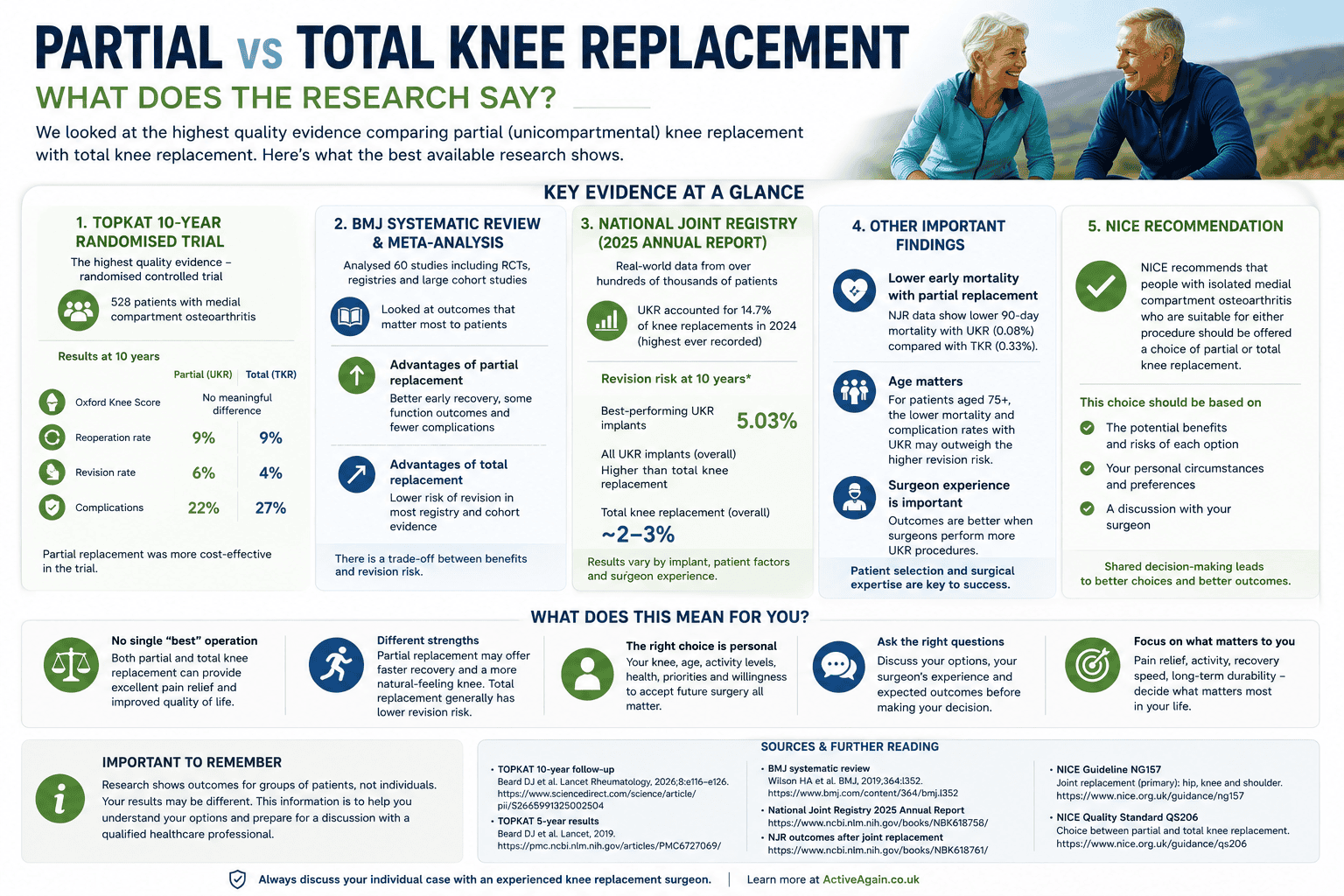
It was a multicentre UK randomised controlled trial involving 528 patients with medial compartment knee osteoarthritis. Patients were randomly assigned to partial or total knee replacement. (ScienceDirect)
The trial has now reported 10-year results.
What did it find?
At 10 years:
- Oxford Knee Scores were not meaningfully different between the two groups.
- Reoperation rates were 9% for both procedures when analysed by treatment received.
- Revision was 6% after partial replacement versus 4% after total replacement when analysed by treatment received.
- Complications occurred in 22% after partial versus 27% after total replacement.
- Partial replacement was more cost-effective in the trial.
The researchers concluded that the two procedures had similar clinical outcomes, reoperation rates and revision rates at 10 years, with cost-effectiveness favouring partial replacement.
What does that mean for patients?
It challenges two overly simplistic claims:
“Partial replacement is always better because it is a smaller operation.”
and
“Total replacement is always better because it has a lower revision rate.”
The evidence is more complicated.
In this carefully conducted randomised trial involving appropriately selected patients and experienced surgical teams, both operations produced good 10-year outcomes.
Why does TOPKAT differ from National Joint Registry data?
This is a particularly useful question for patients.
The TOPKAT trial and the National Joint Registry are answering somewhat different questions.
Randomised trials
A randomised trial allocates patients to different treatments. This reduces some of the differences between patient groups and provides a strong comparison of the treatments.
TOPKAT therefore helps answer:
“What happens when suitable patients are offered partial or total knee replacement in a controlled comparative study?”
National Joint Registry
The NJR records huge numbers of knee replacements performed in routine UK practice.
It helps answer:
“What happens to patients having these operations in real-world NHS and private practice?”
The registry therefore includes a much broader range of patients and surgeons.
The latest NJR report also notes that patients receiving unicondylar replacements were typically five to six years younger than those receiving total knee replacements.
Age matters when interpreting revision rates because younger patients have a longer period during which a further operation may become necessary.
The important conclusion
The different sources of evidence should not simply be treated as competing answers.
The randomised trial and registry data provide different perspectives.
Together they suggest that:
- partial replacement can produce excellent clinical outcomes;
- recovery and some complication outcomes may favour partial replacement;
- revision remains an important consideration;
- patient selection and surgical expertise matter;
- and there is no single operation that is best for everyone.
What does the National Joint Registry tell us?
The National Joint Registry is particularly valuable for UK patients because it provides very large-scale real-world evidence.
The 2025 NJR report shows that unicondylar knee replacements accounted for 14.7% of knee replacements in 2024, the highest proportion recorded.
The registry also reports improving revision performance for medial unicondylar replacements.
The best-performing unicondylar brands had estimated revision rates of approximately:
1.88% at five years
and
5.03% at ten years.
However, these are implant-specific figures, not a prediction for every partial knee replacement patient.
Across the registry overall, unicondylar replacements still have higher revision estimates than total knee replacements.
This is an important message:
There isn’t one single “partial knee replacement” outcome.
Outcomes vary according to factors including the patient, implant, surgical technique and surgeon.
What does the BMJ systematic review say?
A major systematic review and meta-analysis published in The BMJ examined 60 studies comparing unicompartmental and total knee replacement.
It included:
- randomised controlled trials;
- national joint registries;
- national databases;
- and large cohort studies.
Its purpose was specifically to compare outcomes that matter to patients and clinicians and support informed decision-making.
The overall evidence showed a genuine trade-off.
Partial knee replacement was associated with advantages in areas including recovery, function and some complications, while registry and observational evidence generally showed a higher risk of revision.
The authors emphasised the importance of considering these different outcomes together when making a decision.
The message for patients is simple: there is no single statistic that tells you which operation is best.
So which is better: partial or total knee replacement?
There isn’t a universal answer.
For an appropriately selected patient with isolated medial compartment arthritis, partial replacement may be particularly attractive if you value:
- preserving more of your natural knee;
- faster recovery;
- earlier return to activity;
- potentially fewer complications;
- and a more natural-feeling knee.
Total knee replacement may be more attractive if:
- arthritis affects multiple compartments;
- the knee is unsuitable for partial replacement;
- or avoiding the higher revision risk seen in large registry datasets is particularly important to you.
But these aren’t simply opposing choices.
The right question is:
Which operation gives me the best balance of recovery, function, complications and long-term durability for my particular knee?
What does NICE recommend?
This is particularly important for patients in the UK.
NICE recommends that people with isolated medial compartmental osteoarthritis who are having knee replacement should be offered a choice of partial or total knee replacement, with the benefits and risks of each discussed.
NICE’s quality standard says that where both procedures are clinically and radiologically suitable, the choice should take account of the patient’s personal circumstances and preferences.
This means that if your surgeon considers you suitable for both operations, it is entirely reasonable to ask:
“Why are you recommending one rather than the other in my particular case?”
How important is surgeon experience?
This is an important question for anyone considering partial knee replacement.
The National Joint Registry reports that in the three years covered by its latest report, 50,329 primary unicondylar knee replacements were performed by 962 consultant surgeons, giving a median of 29 procedures per surgeon over that period.
That does not mean that a surgeon performing fewer procedures is necessarily unsafe or unsuitable.
But it does demonstrate that there is considerable variation in individual surgeon experience with this particular operation.
So don’t just ask:
“Do you perform knee replacements?”
Ask:
“How many unicompartmental knee replacements do you perform?”
and:
“What proportion of your knee replacements are partial?”
You can also ask about their revision and complication rates and how they compare with national data.
Questions to ask your surgeon
About your knee
Which compartment of my knee has the arthritis?
Are the other compartments healthy enough for a partial replacement?
Are my ligaments functioning normally?
Is there anything about my knee that makes total replacement preferable?
About the choice
Why are you recommending partial rather than total replacement for me?
What would be the advantages of total replacement in my particular case?
What are the disadvantages of partial replacement for me?
If both are suitable, what would you recommend and why?
About experience
How many unicompartmental knee replacements do you perform each year?
What proportion of your knee replacements are partial?
What is your revision rate following partial knee replacement?
How does your experience compare with National Joint Registry data?
About the future
What happens if arthritis develops in another part of my knee?
If the partial replacement fails, would I need a total knee replacement?
How often does that happen in your patients?
What would conversion to a total replacement involve?
What is recovery like?
One of the potential attractions of partial knee replacement is a faster recovery.
Compared with total knee replacement, patients may experience:
- earlier mobilisation;
- shorter hospital stays;
- less postoperative pain;
- faster return to normal activities;
- and quicker functional recovery.
NICE specifically identifies faster recovery, shorter hospital stay and less pain during recovery as potential advantages of partial replacement.
However, faster does not mean instant.
You will still need time for:
- the wound to heal;
- swelling to settle;
- muscle strength to return;
- and the knee to adapt to the replacement.
Your starting fitness, age, general health and rehabilitation can all influence recovery.
What activities can I return to?
The aim of successful knee replacement is to restore useful, relatively pain-free function.
Many patients can return to activities such as:
- walking;
- cycling;
- swimming;
- golf;
- hiking;
- gardening;
- and other recreational activities.
Your surgeon and physiotherapy team can advise you about higher-impact activities.
You should not choose a partial replacement simply because you want to return to a particular sport. Suitability for the operation comes first.
What are the risks?
Unicompartmental knee replacement is still major surgery.
Potential complications include:
- infection;
- blood clots;
- bleeding;
- persistent pain;
- stiffness;
- instability;
- implant loosening;
- wear;
- progression of arthritis elsewhere in the knee;
- and the possibility of further surgery.
The overall risk needs to be considered alongside the potential benefits.
One of the reasons partial replacement is attractive is that comparative evidence suggests some complications may be less frequent than following total knee replacement. However, that needs to be balanced against the higher revision rates seen in much of the registry evidence.
What about robotic-assisted partial knee replacement?
Robotic-assisted systems are increasingly used for some knee replacement procedures.
They can assist with:
- preoperative planning;
- implant positioning;
- bone preparation;
- and intraoperative assessment.
But robotic technology does not answer the fundamental question:
Is partial knee replacement the right operation for my knee?
The most important questions remain:
Am I suitable for a partial replacement?
Why is it preferable to total replacement in my case?
How experienced is my surgeon with the procedure?
Technology can be useful, but it should not replace careful patient selection and experienced surgical decision-making.
A useful way to think about the decision
There are really three separate questions.
1. Am I suitable for a partial replacement?
This depends on the pattern of arthritis, the rest of your knee, your ligaments, alignment, movement and other clinical factors.
2. If I’m suitable, what are the advantages and disadvantages compared with total replacement?
This is where the research becomes important.
Partial replacement may offer faster recovery and fewer complications, while total replacement generally has better revision survivorship in registry data.
3. Which operation best fits my priorities?
This is where your preferences matter.
For example, two patients with very similar knees might reasonably make different choices.
One may prioritise:
“I want the fastest recovery possible and want to preserve as much of my natural knee as I can.”
Another may prioritise:
“I want to minimise the possibility of needing another operation in the future.”
Neither preference is inherently wrong.
The bottom line
Unicompartmental knee replacement can be an excellent operation for the right patient.
It can provide excellent pain relief and function while preserving more of the natural knee, and evidence suggests that recovery may be faster and some complications less common than after total knee replacement.
The main trade-off is that the remaining parts of the knee are not replaced, and large UK registry datasets show higher revision rates for partial replacement than for total knee replacement.
However, the latest high-quality randomised evidence gives a more nuanced picture.
The 10-year TOPKAT trial, involving 528 patients with medial compartment osteoarthritis, found no clinically meaningful difference in Oxford Knee Scores, identical overall reoperation rates of 9% when analysed by treatment received, and revision rates of 6% for partial versus 4% for total replacement. It concluded that both operations produced good 10-year outcomes, with partial replacement more cost-effective in the trial.
The best interpretation is therefore not:
“Partial is better.”
or:
“Total is better.”
It is:
“If I am suitable for both, which operation gives me the best balance of recovery, function, complications and long-term durability for my particular knee?”
That is the conversation you should have with an experienced knee replacement surgeon.
Key research behind this guide
TOPKAT — 10-year randomised controlled trial
Beard DJ et al. Assessing clinical and cost effectiveness of total versus partial knee replacement (TOPKAT): 10-year follow-up of a multicentre, randomised controlled trial.
The Lancet Rheumatology, 2026; 8: e116–e126.
The largest and longest UK randomised comparison of partial and total knee replacement. It included 528 patients with medial compartment osteoarthritis and found similar 10-year clinical outcomes, reoperation rates and revision rates, with cost-effectiveness favouring partial replacement.
Plain-text link:
https://www.sciencedirect.com/science/article/pii/S2665991325002504
TOPKAT — five-year results
Beard DJ et al. The clinical and cost-effectiveness of total versus partial knee replacement in patients with medial compartment osteoarthritis (TOPKAT): 5-year outcomes of a randomised controlled trial.
The Lancet, 2019.
The five-year trial found both procedures effective, with similar clinical outcomes and fewer complications after partial replacement in the analysis by treatment received.
Plain-text link:
https://pmc.ncbi.nlm.nih.gov/articles/PMC6727069/
BMJ systematic review and meta-analysis
Wilson HA et al. Patient relevant outcomes of unicompartmental versus total knee replacement: systematic review and meta-analysis.
The BMJ, 2019;364:l352.
This review examined 60 eligible studies, including randomised trials, national registries and large cohort studies, specifically to compare outcomes relevant to patients and clinicians.
Plain-text link:
https://www.bmj.com/content/364/bmj.l352
National Joint Registry — 22nd Annual Report
The National Joint Registry 2025 Annual Report provides large-scale UK data on unicondylar and total knee replacements, including revision outcomes and surgeon volumes.
The latest report shows that unicondylar replacements accounted for 14.7% of knee replacements in 2024 and provides detailed information on their long-term outcomes
NJR outcomes chapter:
https://www.ncbi.nlm.nih.gov/books/NBK618761/
NICE NG157
NICE Guideline NG157, Joint replacement (primary): hip, knee and shoulder.
NICE recommends offering a choice of partial or total knee replacement to people with isolated medial compartmental osteoarthritis and discussing the potential benefits and risks of each option.
Understanding the evidence
Research can help you understand the advantages and disadvantages of different operations, but studies describe groups of patients rather than predicting exactly what will happen to you.
Your suitability for partial or total knee replacement depends on your individual knee, your general health and your circumstances.
The information on Active Again is intended to help you understand your options and prepare for a discussion with a qualified healthcare professional. It is not a substitute for an individual medical assessment or medical advice.
Explore your knee replacement options
If you are considering knee replacement, you may also find our guides useful:
Choosing a Knee Replacement Surgeon
How to assess a surgeon’s experience, the questions to ask and what information to look for before making your decision.
Knee Replacement Risks and Complications
A balanced guide to the potential risks of knee replacement surgery and what you can do to prepare.
What to expect after surgery, from the first few days through to returning to normal activities.
How robotic-assisted surgery works and what patients should know before choosing a robotic procedure.
A guide to the costs of private knee replacement in the UK and what should be included in a treatment quotation.