
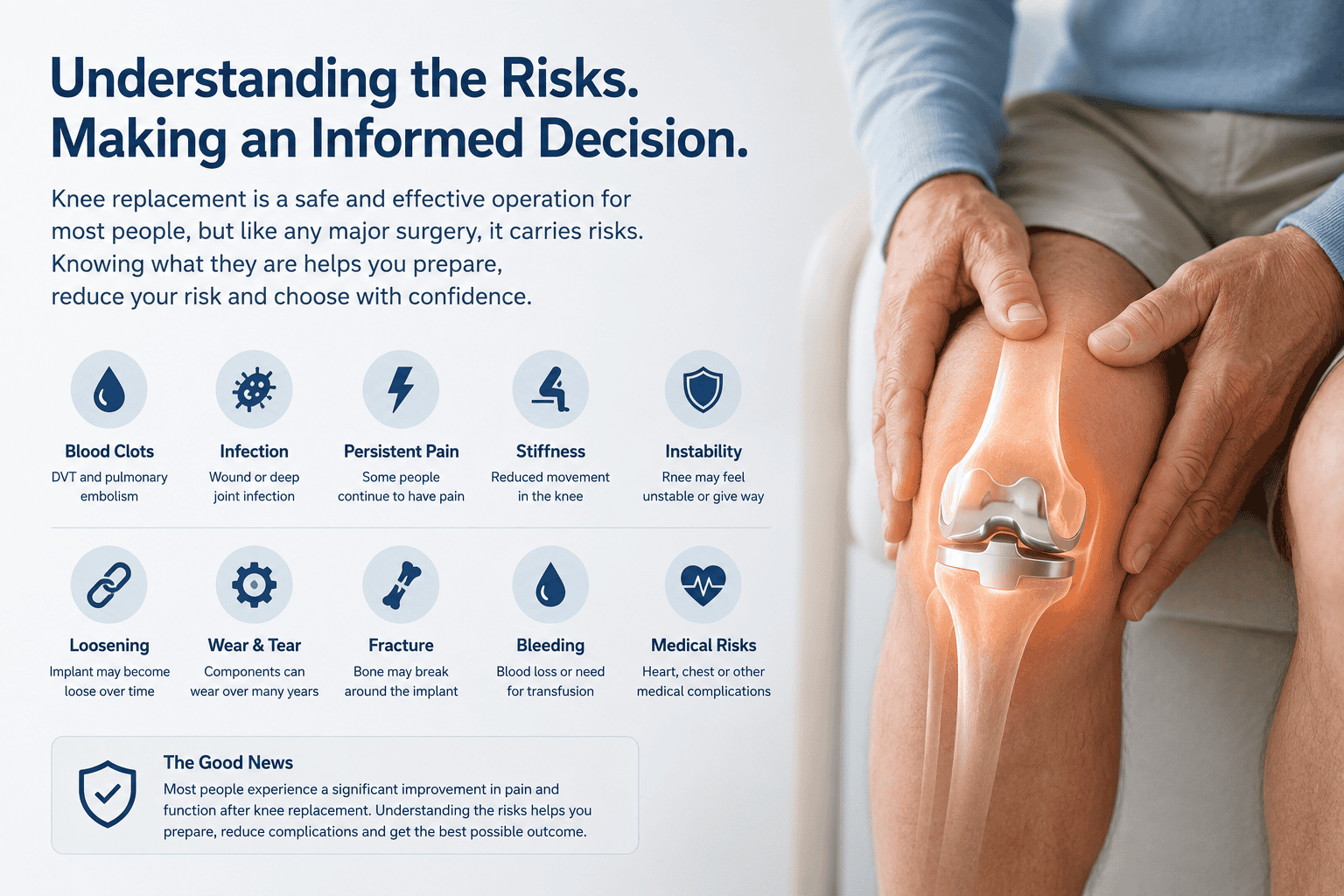
What are the risks and Complications of Knee Replacement Surgery?
Knee replacement is a well-established operation that can significantly reduce pain and improve mobility and quality of life for many people.
Like any major operation, it carries risks. Most people do not experience a major complication, but it is important to understand the potential problems before deciding whether surgery is right for you.
The purpose of this guide is not to discourage you from having knee replacement. It is to help you understand the risks in context, know what questions to ask your surgeon and prepare properly for surgery and recovery.
The good news: most patients improve
The results of knee replacement surgery are generally encouraging.
The latest NHS England Patient Reported Outcome Measures (PROMs) data for 2024/25 show that, among patients who provided postoperative responses:
- 72.8% reported feeling “much better” after knee replacement
- a further 16.8% reported feeling “a little better”
That means 89.6% reported some improvement following surgery.
These figures are based on patients’ own assessments of how they felt after their operation. They do not mean that every patient will experience the same result, but they provide useful context when considering the risks of surgery.
The NHS describes knee replacement as a common and safe procedure and states that most people have no complications.
Reference: NHS England, Patient Reported Outcome Measures (PROMs) in England, Final 2024/25 data; NHS, Complications of a knee replacement.
89.6% of responding patients reported feeling better
72.8% felt much better and 16.8% felt a little better after knee replacement.
NHS England PROMs, 2024/25
How long does a knee replacement last?
Modern knee replacements are designed to provide long-term benefit.
The NHS states that most knee replacements last around 20 years or more, although individual results vary.
The UK’s National Joint Registry (NJR) provides some of the most extensive evidence available on how knee replacements perform over time.
The 2025 NJR Annual Report includes approximately 1.8 million primary knee replacements. Across all primary knee replacements in the registry, the estimated cumulative rate of revision was:
| Time after surgery | Estimated revision rate |
|---|---|
| 1 year | 0.49% |
| 5 years | 2.35% |
| 10 years | 3.82% |
| 15 years | 5.49% |
| 20 years | 7.58% |
These are population-level estimates, not predictions of what will happen to an individual patient.
Revision means that another operation was performed on the knee replacement. It does not necessarily mean that the knee was completely unsuccessful or that the patient experienced severe symptoms.
Reference: National Joint Registry, 22nd Annual Report 2025, Chapter 3: Outcomes after joint replacement.
The NJR also reports particularly encouraging long-term results for the most common total knee replacement configuration. Its estimated revision rate at 20 years was 5.28%.
Reference: National Joint Registry, 22nd Annual Report 2025, Table 3.K5.
Why revision isn’t the same as failure
A revision operation is an important outcome, but it isn’t the only way to judge whether a knee replacement has been successful.
A patient may have:
- a well-functioning replacement that never requires further surgery;
- some residual pain but a major improvement in daily life;
- occasional stiffness but good overall mobility;
- or a replacement that eventually requires revision after many years.
The NJR figures therefore provide useful context about long-term durability, rather than a guarantee of the experience an individual patient will have.
What are knee replacement risks?
Although most people recover without a major complication, problems can occur.
Some are temporary and form part of the normal recovery process. Others are uncommon but potentially serious.
It is useful to think about the risks in three groups.
During early recovery
- pain and swelling
- bruising
- temporary stiffness
- difficulty walking initially
- tiredness
- blood clots
Less common complications
- infection
- significant bleeding
- nerve or blood-vessel injury
- persistent stiffness
- instability
- persistent pain
Problems that can develop later
- loosening
- wear
- instability
- fracture around the replacement
- progressive arthritis following partial knee replacement
- revision surgery
Your individual risk depends on your health, your knee, the operation being considered and other personal factors.
Blood clots: DVT and pulmonary embolism
A deep vein thrombosis (DVT) is a blood clot that forms in a deep vein, usually in the leg.
The risk of developing a blood clot increases temporarily after knee replacement because of the effects of surgery and reduced mobility.
Occasionally, a clot can travel to the lungs. This is called a pulmonary embolism (PE) and can be serious.
Your surgical team will assess your risk and may recommend measures such as anticoagulant medication, compression measures and early mobilisation.
Your individual risk may be affected by factors including your medical history, mobility and previous history of blood clots.
Reference: NHS, Complications of a knee replacement.
Infection
Infection is an uncommon but important complication of knee replacement.
A wound infection may sometimes be treated with antibiotics. A deeper infection involving the artificial joint can be more difficult to treat and may require additional surgery.
Infection is also one of the principal reasons why some knee replacements subsequently require revision.
The latest National Joint Registry data identify infection, aseptic loosening/lysis and progressive arthritis among the important causes of revision across primary knee replacements.
It is important to distinguish this from the overall risk of infection: a statistic describing causes of revision does not mean that the same percentage of all knee replacement patients develop that complication.
Reference: National Joint Registry, 22nd Annual Report 2025, Chapter 3: Outcomes after joint replacement.
Pain after knee replacement
It is important to have realistic expectations.
Most patients experience a substantial improvement in pain, but knee replacement does not guarantee a completely pain-free knee.
Some people continue to experience pain or discomfort after surgery.
There can be several possible causes, including:
- stiffness;
- instability;
- infection;
- loosening;
- problems involving the kneecap;
- soft-tissue problems;
- nerve-related pain;
- problems originating elsewhere, such as the hip or spine;
- or pain where no clear structural problem can be identified.
This does not necessarily mean that the operation has been unsuccessful.
The important question is whether the operation has achieved a meaningful improvement in pain, mobility and quality of life for the individual patient.
Stiffness and reduced movement
Stiffness is common during the early stages of recovery while swelling settles and the muscles around the knee recover.
Most patients gradually regain movement through rehabilitation and normal activity.
A smaller number develop significant persistent stiffness that may require additional treatment.
NICE recommends that rehabilitation should begin promptly after surgery and include mobilisation and exercises appropriate to the individual’s circumstances.
Reference: NICE Guideline NG157, Joint replacement (primary): hip, knee and shoulder.
Instability
Some patients experience a sensation that their artificial knee is unstable or may give way.
This can have several causes, including the balance of the soft tissues around the knee or changes occurring around the implant.
Mild symptoms may sometimes be managed with rehabilitation, while significant instability can occasionally require further surgery.
Instability is one of the recognised reasons for revision knee replacement.
Reference: National Joint Registry, 22nd Annual Report 2025, Chapter 3: Outcomes after joint replacement.
Loosening of the replacement
Over time, an artificial knee can become loose from the surrounding bone.
This is called aseptic loosening when infection is not responsible.
It may cause increasing pain or reduced function and, if significant, can require revision surgery.
Aseptic loosening/lysis is one of the most common documented causes of revision in the National Joint Registry.
The encouraging point is that modern knee replacements can provide very long-lasting results. The NJR reports a 20-year revision estimate of 5.28% for the most common total knee replacement configuration.
Reference: National Joint Registry, 22nd Annual Report 2025, Chapter 3 and Table 3.K5.
Wear and implant failure
Artificial knee components are designed to withstand many years of movement.
However, like any mechanical device, they can wear or develop problems over time.
Modern implant design, surgical techniques and patient selection have contributed to increasingly good long-term results.
The National Joint Registry’s very large UK dataset provides evidence of good long-term survivorship for commonly used total knee replacement configurations.
Importantly, you should not assume that a knee replacement will automatically need replacing after 20 years. Many continue functioning beyond this point.
Reference: National Joint Registry, 22nd Annual Report 2025; NHS, Complications of a knee replacement.
Partial versus total knee replacement
For some people with arthritis confined to a particular part of the knee, partial knee replacement may be an alternative to total knee replacement.
NICE recommends that people with isolated medial compartmental osteoarthritis who are suitable for both procedures should be offered a choice between partial and total knee replacement, with the benefits and risks of each discussed.
Partial knee replacement can have advantages, including a faster recovery for appropriately selected patients. However, arthritis can subsequently develop in other parts of the knee, and National Joint Registry data indicate a greater likelihood of revision within 10 years following partial knee replacement.
The important point is that partial isn’t automatically better and total isn’t automatically better.
The right operation depends on the condition of your knee and your individual circumstances.
References: NICE Guideline NG157, Joint replacement (primary): hip, knee and shoulder; NICE Quality Standard QS206, Choice between partial and total knee replacement; National Joint Registry, 22nd Annual Report 2025.
Nerve, blood-vessel and tissue injury
Important nerves, blood vessels and ligaments are located around the knee.
They can occasionally be damaged during surgery.
This is uncommon, and such injuries may sometimes be repaired during surgery or heal afterwards.
Reference: NHS, Complications of a knee replacement.
Fracture around the artificial knee
A fracture can occur around an artificial knee, either during surgery or later following an injury.
These fractures can sometimes be more complicated to treat because the stability of the implant and the surrounding bone also need to be considered.
They are relatively uncommon compared with problems such as pain, infection or loosening.
Bleeding and blood transfusion
Knee replacement involves some blood loss.
Modern surgical and anaesthetic techniques have reduced the need for blood transfusion.
NICE recommends tranexamic acid during joint replacement surgery to help reduce blood loss.
Significant bleeding can nevertheless occur in some patients and may require additional treatment or, occasionally, a blood transfusion.
Reference: NICE Guideline NG157, Joint replacement (primary): hip, knee and shoulder.
Medical and anaesthetic complications
Knee replacement is major surgery, so complications are not restricted to the knee itself.
Depending on your age and medical history, potential complications can include:
- cardiovascular problems;
- stroke;
- chest infection;
- urinary infection;
- delirium;
- complications associated with anaesthesia.
Your pre-operative assessment is therefore an important part of preparing for surgery.
It provides an opportunity for your team to identify health problems and consider how your individual risk can be reduced.
NICE recommends that patients are involved in discussions about anaesthesia and analgesia, including their potential benefits and risks.
Reference: NICE Guideline NG157, Joint replacement (primary): hip, knee and shoulder.
Can you reduce your risk?
Not every complication can be prevented, but there are things you can do before and after surgery that can improve your preparation and recovery.
NICE recommends preoperative rehabilitation for people having knee replacement, including advice on:
- exercises before and after surgery;
- lifestyle;
- weight management;
- diet;
- smoking cessation;
- maintaining independence and wellbeing.
Depending on your circumstances, your preparation may therefore include:
Improve your fitness
Building strength and maintaining mobility before surgery can help you prepare for rehabilitation afterwards.
Stop smoking
If you smoke, stopping before surgery can improve your general health and may reduce some surgical risks.
Optimise medical conditions
Conditions such as diabetes, anaemia, cardiovascular disease and high blood pressure should be appropriately managed.
Understand your medication
Your surgical team should tell you which medicines you should continue or stop before surgery.
Prepare for recovery
Think about how you will manage stairs, shopping, driving, work, pets and other daily activities during the early recovery period.
Follow your rehabilitation programme
Rehabilitation and gradual return to activity are important parts of recovery.
NICE recommends that rehabilitation is tailored to the individual’s clinical and personal circumstances.
Reference: NICE Guideline NG157, Joint replacement (primary): hip, knee and shoulder.
Choosing your surgeon and hospital
Understanding the risks of knee replacement also explains why it is worth taking time to research your treatment options.
You should not expect any surgeon to promise that you will have no complications. No responsible surgeon can make that guarantee.
Instead, look for someone who can clearly explain:
- why knee replacement is appropriate for you;
- which type of replacement they recommend;
- why they recommend it;
- what alternatives are available;
- what your individual risks are;
- what outcome you can realistically expect;
- and what happens if you experience a complication.
It is also worth understanding the hospital and aftercare arrangements.
For private treatment, ask:
- Where will the operation take place?
- Who provides your postoperative care?
- Who do you contact if you develop a problem?
- Where would you be treated if you developed an infection?
- What happens if you need additional treatment?
- What is included in the quoted price?
Our guide to Choosing a Knee Replacement Surgeon explores this in more detail.
A complication isn’t the same as a poor outcome
This is an important distinction.
A patient can have:
No major complication but still have some pain.
A correctly positioned implant but some stiffness.
A technically successful operation but a slower recovery than expected.
A well-functioning knee that eventually needs revision many years later.
Equally, many patients experience a substantial improvement in their pain, mobility and daily life.
The latest NHS PROMs data provide useful evidence of this: nearly nine in ten responding knee-replacement patients reported feeling better after surgery.
The aim of surgery isn’t necessarily to produce a “perfect” knee.
It is to achieve a meaningful improvement in pain, function and quality of life.
Reference: NHS England, Patient Reported Outcome Measures (PROMs) in England, Final 2024/25 data.
Questions to ask your surgeon
Before agreeing to knee replacement, consider asking:
About the decision
- Why do you recommend knee replacement for me?
- What alternatives do I have?
- What might happen if I decide not to have surgery?
About the operation
- Which type of knee replacement do you recommend?
- Why is it appropriate for me?
- Would a partial knee replacement be suitable?
- How frequently do you perform this operation?
About risk
- What are my individual risks?
- Am I at increased risk of blood clots?
- What is my risk of infection?
- What can I do to reduce my risk?
About recovery
- What should I expect during the first few weeks?
- What rehabilitation will I receive?
- When should I expect to drive?
- When can I return to normal activities?
About complications
- What happens if I develop a complication?
- Who would treat me if I developed an infection?
- What happens if the replacement becomes loose?
- What happens if I eventually need revision surgery?
About private treatment
- What exactly is included in the price?
- Are there additional costs if I develop a complication?
- Who provides follow-up care?
These questions can help you have a more useful conversation with your surgeon and make a decision based on your circumstances rather than a generic complication statistic.
Making an informed decision
Knee replacement is a major decision, but the evidence should not make you unnecessarily fearful of surgery.
The latest UK patient-reported data show that the large majority of patients report improvement, while National Joint Registry data demonstrate encouraging long-term durability for modern knee replacements.
At the same time, knee replacement is major surgery and complications can occur.
The best approach is therefore neither to assume that surgery is risk-free nor to focus solely on what can go wrong.
Instead, consider:
Is knee replacement appropriate for me?
What alternatives do I have?
Which type of replacement is appropriate?
What are my individual risks?
What result should I realistically expect?
Who is the right surgeon and hospital for my circumstances?
NICE recommends shared decision-making, including discussion of the available procedures, potential benefits and risks, implant options, alternatives and the possibility of further surgery. Information should be understandable, specific to the procedure and provided throughout the patient’s care.
Reference: NICE Guideline NG157, Joint replacement (primary): hip, knee and shoulder.
The bottom line

For most people, knee replacement is a successful operation that can make a substantial difference to pain, mobility and quality of life.
The latest NHS data show that 89.6% of responding patients reported feeling better after knee replacement, while the National Joint Registry provides evidence of good long-term implant survival.
There are nevertheless genuine risks, including blood clots, infection, bleeding, stiffness, persistent pain, instability, loosening, fracture and the possibility of further surgery.
Understanding these risks doesn’t mean that you should be worried about having a knee replacement.
It means you can approach the decision with realistic expectations, prepare properly and ask better questions.
Your individual risk will depend on your health, your knee and the procedure being considered. Your orthopaedic surgeon and anaesthetist should discuss these factors with you before surgery.
Ready to explore your options?
If knee pain is affecting your quality of life and you’re considering private knee replacement, Active Again can help you understand the treatment options, costs, recovery and questions to ask before choosing a surgeon. Read some of knee replacement guides below.
References
- NHS England. Patient Reported Outcome Measures (PROMs) in England, Final 2024/25 data.
- National Joint Registry. 22nd Annual Report 2025, Chapter 3: Outcomes after joint replacement.
- National Joint Registry. 22nd Annual Report 2025, Table 3.K5: Cumulative revision estimates in primary knee replacements.
- NICE. Joint replacement (primary): hip, knee and shoulder, Guideline NG157.
- NICE. Joint replacement (primary): hip, knee and shoulder, Quality Standard QS206.
- NHS. Complications of a knee replacement.