

Private Hip Replacement: Waiting Times, NHS vs Private Care
If you’ve just been told that you may need a hip replacement, you may be wondering what happens next.
Should you stay with the NHS? Could you have the operation privately? If you have private medical insurance, will it pay for your treatment? And if you are considering paying yourself, how much should you expect to spend?
There is no single answer.
Private hip replacement can offer greater choice over your consultant and hospital and may provide faster access to treatment. But private treatment does not automatically mean better clinical outcomes, and paying for surgery yourself means understanding costs, exclusions and what happens if something goes wrong.
There is another option that is sometimes overlooked: NHS-funded treatment can be provided by an independent hospital.
The terminology can be confusing, and so can the prices.
PHIN’s 2026 research found that 28% of people who would research private healthcare said they would not know where to start, while only 26% felt very confident organising and using private healthcare.
This guide is designed to help.
It explains how NHS and private hip replacement differ, how private treatment is funded, what it currently costs, how waiting times work, what the evidence says about outcomes, and how to compare a consultant, hospital or private quotation.
Private hip replacement at a glance
Private hip replacement in the UK generally means having your hip replacement funded privately, either through private medical insurance or by paying yourself.
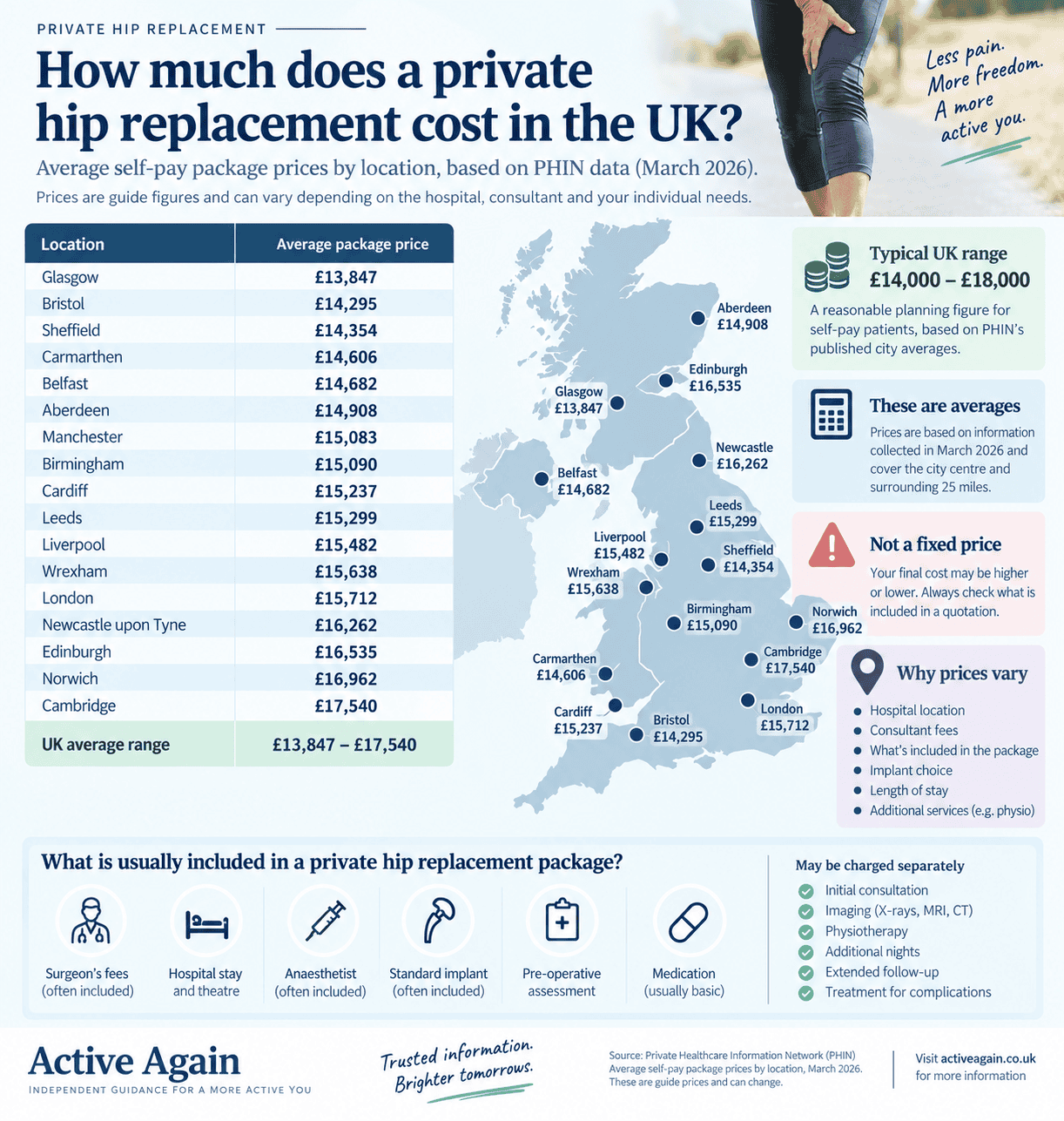
For self-pay patients, PHIN’s latest published city-level averages, based on information collected in March 2026, range from £13,847 to £17,540 per hip. These are guide prices rather than guaranteed final costs.
| Question | Short answer |
|---|---|
| Can I have a hip replacement privately? | Yes. You can use private medical insurance or self-pay. |
| Do I need insurance? | No. Self-pay is an option. |
| How much does it cost? | PHIN’s current city averages are broadly £14,000–£18,000 per hip. |
| Is private treatment faster? | It can be, but there is no single national private waiting time. |
| Is private surgery better than NHS surgery? | Not necessarily. The evidence does not show that paying privately automatically produces better clinical outcomes. |
| Can I choose my surgeon? | Usually there is more choice, although insurers may restrict your options. |
| Can the NHS pay for treatment in a private hospital? | Yes. NHS-funded care can be delivered by an independent provider. |
| What should I compare? | Consultant, hospital, total cost, what’s included, aftercare and complication arrangements. |
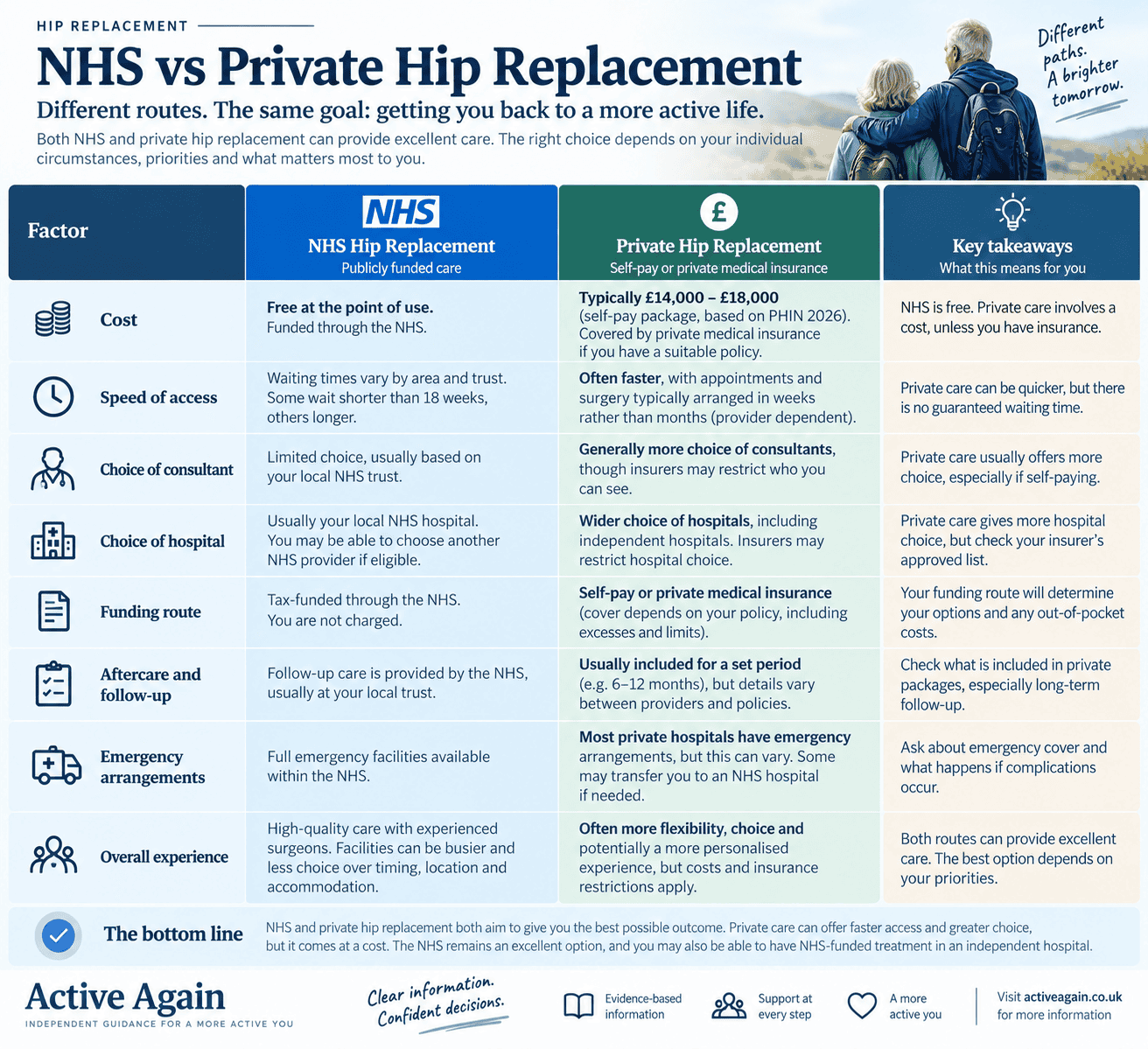
NHS vs private hip replacement: what is actually different?
The words NHS, private, hospital and patient can describe different parts of the same healthcare journey.
The most important distinction is between who funds the treatment and who provides it.
Four routes you may encounter
1. NHS-funded treatment in an NHS hospital
The NHS funds your care and an NHS hospital provides it.
2. NHS-funded treatment in an independent hospital
The NHS pays for the treatment but an independent hospital provides it.
This is still NHS treatment from the patient’s perspective.
3. Private medical insurance
Your insurer pays eligible treatment costs according to your policy.
You may have an excess, approved-provider restrictions or limits on consultant fees.
4. Self-pay
You pay the provider yourself.
This can give you considerable choice, but you become responsible for understanding the quotation and potential additional costs.
Important distinction: an independent hospital is not automatically treating a private patient. An NHS patient can receive NHS-funded treatment in an independent hospital.
The National Joint Registry records hip replacement procedures across the healthcare system, while PHIN’s private-market data concern privately funded hospital admissions. These datasets therefore should not be combined as though they measure the same thing.
How big is the UK hip replacement market?
Hip replacement is a major component of elective orthopaedic care in the UK.
The National Joint Registry recorded 116,901 hip procedures during calendar year 2024.
The NJR’s 2024 summary records an average age of approximately 69.5 years for primary hip replacement patients and shows osteoarthritis as the dominant indication.
But there is an important limitation if you are trying to answer:
How many of these were private hip replacements?
There is no single authoritative UK dataset that gives a complete annual total of privately funded hip replacement operations.
That is because the main datasets measure different things.
What we can measure
| Question | Best source |
|---|---|
| How many hip procedures are performed? | NJR |
| How many procedures are recorded by the registry? | NJR |
| How many private hospital admissions occur? | PHIN |
| How many private admissions are insured? | PHIN |
| How many are self-pay? | PHIN |
| How many privately funded hip replacements occur nationally? | No single complete national figure |
PHIN recorded 953,000 private hospital/clinic admissions in 2025, a record level and 1% higher than 2024. Of these, approximately 670,000 were insurance-funded and 283,000 were self-pay. The overall funding split remained about 70% insurance / 30% self-pay.
However, these are all private hospital admissions, not hip replacements.
Hip replacement is nevertheless particularly important to the self-pay market. PHIN identifies primary hip replacement as one of the three most popular self-pay admissions, alongside cataract surgery and primary knee replacement.
Why this matters
It would be misleading to say:
“X thousand people have private hip replacements every year”
unless the underlying dataset actually supports that calculation.
For patients, the more useful question is usually:
Who is funding my treatment, where will it take place and what exactly am I paying for?
How long do you wait for a hip replacement on the NHS?
Waiting time is one of the main reasons people consider private treatment.
But national NHS waiting-list statistics need to be understood correctly.
The NHS England Referral to Treatment (RTT) system measures elective treatment pathways. It does not represent a simple national queue containing only people waiting for hip replacement.
A patient’s pathway can involve:
Referral → specialist assessment → treatment decision → waiting for treatment
The time spent waiting for a hip replacement operation is therefore not necessarily the same as the headline NHS waiting-list figure.
What does the 18-week standard mean?
In England, patients have a right to start consultant-led treatment within 18 weeks of referral in the circumstances covered by the NHS rules.
If you have waited, or are expected to wait, longer than the maximum standard, you can in appropriate circumstances ask to be referred to another NHS provider that can start treatment sooner. There are exceptions.
This is important because going private is not necessarily your only alternative to waiting.
You may be able to remain NHS-funded while changing provider.
Can the NHS use a private hospital?
Yes.
An independent hospital can be commissioned to provide NHS-funded treatment.
This means:
NHS-funded + independent hospital
is different from:
privately funded + independent hospital.
That distinction is often missed when patients compare NHS and private care.
What should you do if you are waiting?
Ask your NHS provider:
- Where am I in the pathway?
- When am I expected to be assessed or treated?
- Am I approaching or beyond the relevant 18-week standard?
- Am I eligible to request another NHS provider?
- Could an NHS-funded independent provider offer treatment sooner?
The NHS Choice Framework explains the circumstances in which patients can request an alternative provider and the exceptions that apply.
How long does a private hip replacement take?
There is no single national UK private waiting time.
Private waiting times depend on:
- consultant availability
- hospital capacity
- diagnostic appointments
- pre-operative assessment
- insurance authorisation
- your clinical circumstances
- the timing of available theatre sessions.
This means that “private hip replacement waiting time” is best understood as a provider-specific question.
When speaking to a private provider, ask for two dates:
When is the earliest consultation?
and:
If surgery is recommended, when is the earliest realistic operation date?
Don’t assume that being able to see a consultant quickly means that surgery will automatically follow immediately.
How does private hip replacement work?
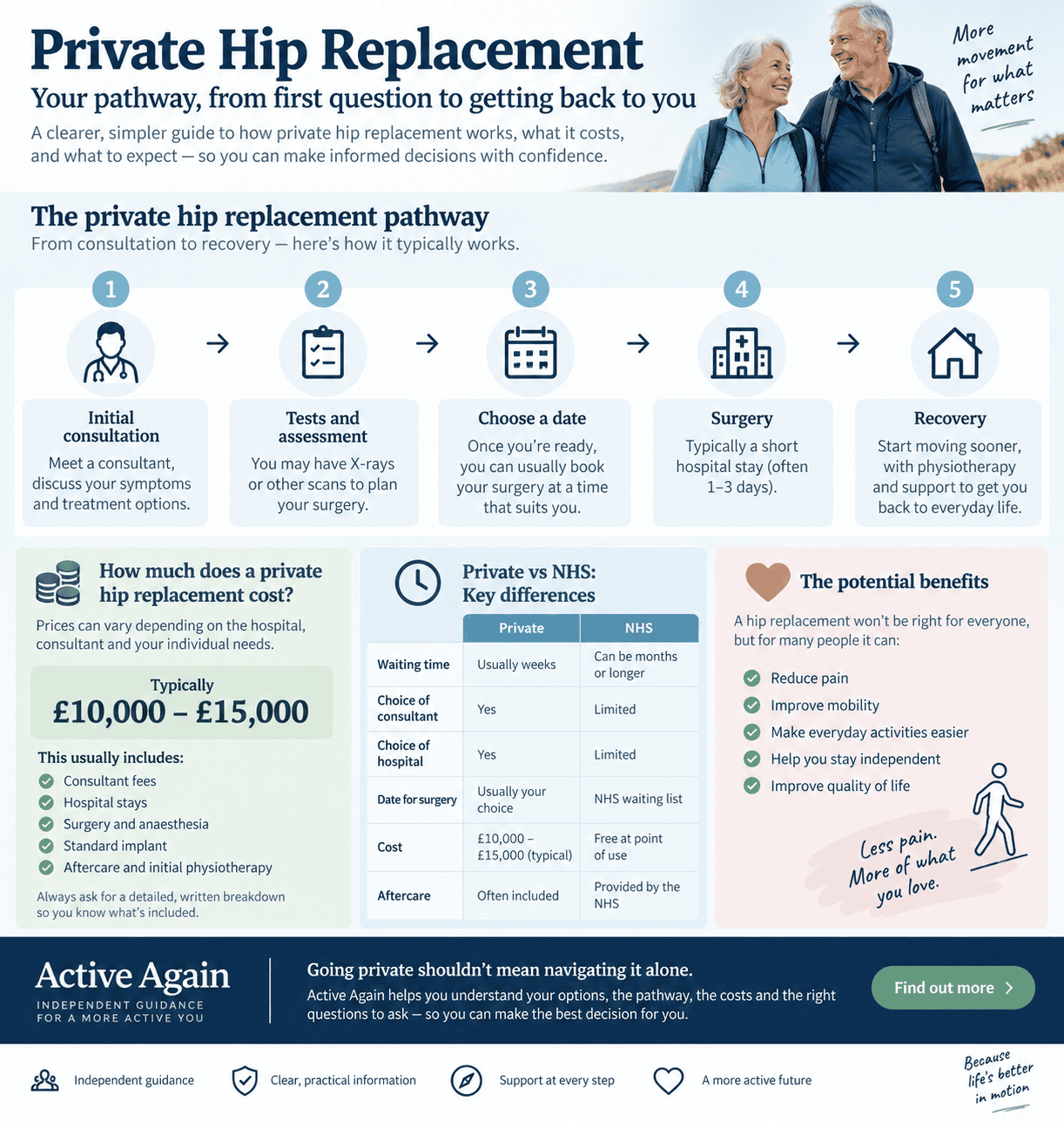
Although providers differ, the journey usually involves several stages.
1. Initial consultation
A consultant assesses your symptoms, medical history and previous treatment.
2. Diagnosis and imaging
Your consultant determines whether your symptoms and examination findings support the diagnosis and whether hip replacement is appropriate.
NICE recommends considering referral for joint replacement when symptoms substantially affect quality of life and non-surgical management is ineffective or unsuitable.
3. Discussing treatment options
Hip replacement is not automatically the correct treatment for every person with hip pain or osteoarthritis.
Your clinician should discuss appropriate alternatives and the potential benefits and risks.
4. Choosing how to fund treatment
You may use:
- NHS funding
- private medical insurance
- self-pay.
5. Choosing a consultant and hospital
Private care generally gives you more choice, although insurance arrangements can restrict the hospitals and consultants available to you.
6. Authorisation or quotation
If you are insured, your insurer may need to authorise treatment.
If you are self-paying, you should obtain a detailed written quotation.
7. Pre-operative assessment
You undergo the appropriate checks before surgery.
8. Surgery
Your hip replacement is performed in the chosen hospital.
9. Discharge and rehabilitation
Your recovery plan should include appropriate medication, mobility advice, follow-up and rehabilitation.
How much does a private hip operation cost in the UK?
For many people, this is the first practical question.
PHIN’s latest published figures use publicly available information collected in March 2026. They are average self-pay package prices by location and are intended as a guide. PHIN notes that prices can change and that individual circumstances affect what a patient pays.
Current PHIN average package prices
| Location | Average package price |
|---|---|
| Glasgow | £13,847 |
| Bristol | £14,295 |
| Sheffield | £14,354 |
| Carmarthen | £14,606 |
| Belfast | £14,682 |
| Aberdeen | £14,908 |
| Manchester | £15,083 |
| Birmingham | £15,090 |
| Cardiff | £15,237 |
| Leeds | £15,299 |
| Liverpool | £15,482 |
| Wrexham | £15,638 |
| London | £15,712 |
| Newcastle upon Tyne | £16,262 |
| Edinburgh | £16,535 |
| Norwich | £16,962 |
| Cambridge | £17,540 |
These figures cover the city centre and surrounding 25 miles and represent average package prices, not necessarily the final amount an individual patient will pay.
A useful planning figure
For a self-pay patient, £14,000–£18,000 is a reasonable current benchmark range based on PHIN’s published city averages.
But don’t treat £15,000 as a universal price.
Your quotation may be higher or lower.
Why can private hip replacement prices be so different?
A headline price can hide important differences.
PHIN says private package prices usually cover the main costs of treatment, including hospital, surgeon and anaesthetist fees, but the first consultation and some extras may be separate.
PHIN also notes that hospitals may charge separately for items such as:
- nursing
- accommodation
- meals
- tests
- medication
- dressings
- prosthesis
- X-rays
- scans
- physiotherapy
- take-home medication.
That means two apparently similar quotations may not actually be comparable.
How to compare two private hip replacement quotations
Imagine you receive two quotations.
Quotation A
£14,500
Quotation B
£16,000
At first glance, A looks cheaper.
But suppose A excludes:
- initial consultation
- imaging
- anaesthetist
- physiotherapy
- medication.
While B includes them.
The more useful question is not:
Which headline price is lower?
It is:
Which quotation represents the lower comparable total cost for the care I need?
Use this checklist
| Item | Quote A | Quote B |
|---|---|---|
| Initial consultation | ✓ / £ | ✓ / £ |
| Imaging | ✓ / £ | ✓ / £ |
| Pre-operative assessment | ✓ / £ | ✓ / £ |
| Surgeon | ✓ / £ | ✓ / £ |
| Anaesthetist | ✓ / £ | ✓ / £ |
| Hospital/theatre | ✓ / £ | ✓ / £ |
| Implant | ✓ / £ | ✓ / £ |
| Overnight stay | ✓ / £ | ✓ / £ |
| Medication | ✓ / £ | ✓ / £ |
| Physiotherapy | ✓ / £ | ✓ / £ |
| Follow-up | ✓ / £ | ✓ / £ |
| Additional nights | Check | Check |
| Complications | Check | Check |
| Revision surgery | Check | Check |
Best practice: ask the provider to confirm the complete price and exclusions in writing before you commit.
PHIN specifically recommends establishing what is included in a package before booking.
What is usually included in a private hip replacement package?
There is no universal package definition.
Hospital
May include:
- theatre
- accommodation
- nursing
- standard hospital care.
Surgeon
The consultant’s surgical fee may be included.
Check.
Anaesthetist
The anaesthetic fee may be included or charged separately.
Do not assume.
Implant
Ask whether the implant is included and discuss the proposed implant with your surgeon.
Diagnostics
Ask whether the package includes:
- X-rays
- blood tests
- other investigations.
Physiotherapy
Some packages include it.
Others charge separately.
Medication
Ask whether medication supplied when you leave hospital is included.
Follow-up
Ask how many follow-up appointments and investigations are included.
Additional hospital nights
This is an important question:
If I need to stay an extra night for medical reasons, what will I be charged?
Self-pay hip replacement
Self-pay means paying for your private treatment yourself.
You do not need to have private medical insurance to use private healthcare.
Self-pay has become an important part of the private market. PHIN recorded 282,625 self-pay admissions in 2025, almost unchanged from 2024 and only slightly below the 2023 record.
Hip replacement is one of the most popular self-pay private hospital procedures.
Why do people self-pay?
Reasons can include:
- concern about NHS waiting times
- wanting more control over timing
- wanting to choose a particular consultant
- wanting to choose a particular hospital
- not having private medical insurance.
But self-pay also means taking responsibility for understanding what you are buying.
Before paying, ask:
What is included?
What isn’t?
What happens if something goes wrong?
Who pays for additional treatment?
What happens if I need another operation?
Private medical insurance and hip replacement
If you already have private medical insurance, the process is different from self-pay.
Your insurer will normally need to confirm that the treatment is covered and may require pre-authorisation.
Depending on your policy, you may be restricted to:
- certain hospitals
- certain consultants
- certain fee arrangements.
You may also have an excess or a potential fee shortfall.
Ask your insurer:
- Is hip replacement covered?
- Is my diagnosis covered?
- Do I need pre-authorisation?
- Which consultants can I use?
- Which hospitals can I use?
- What excess applies?
- Are there consultant fee limits?
- Could I have to pay a shortfall?
- Are diagnostics covered?
- What happens if complications require additional treatment?
PHIN notes that private medical insurance policies differ substantially in their coverage, limits, excesses and treatment arrangements.
Is private hip replacement better than NHS treatment?
Not necessarily.
This is worth stating clearly because “private” is sometimes interpreted as meaning “better”.
The evidence does not support such a simple conclusion.
A population-based English study compared publicly funded elective hip and knee replacements delivered in NHS and private hospitals between 2016 and 2019. It included 75,891 hip replacements in private hospitals and 166,925 in NHS hospitals.
The researchers found apparent differences between the groups in some analyses.
But patients treated in private hospitals differed from those treated in NHS hospitals, and the researchers highlighted the importance of differences in patient characteristics and other potential confounding factors.
Using a more rigorous instrumental-variable approach, the study found no significant difference in most of the main outcomes examined, although hospital-associated infection was lower in private hospitals in that analysis.
The sensible conclusion is therefore:
There is no good evidence that simply paying privately makes a hip replacement clinically superior to an NHS-funded operation.
The more reliable differences are often around:
- access
- timing
- consultant choice
- hospital choice
- accommodation
- purchasing arrangements
- patient navigation.
What do NHS hip replacement outcomes tell us?
NHS Patient Reported Outcome Measures (PROMs) provide a useful picture of how patients report feeling after surgery.
For 2024/25, NHS England recorded approximately 90,000 hip replacement episodes, with approximately 60,000 pre-operative responses and 30,000 postoperative responses.
Among the relevant postoperative responses:
- 85.8% felt much better
- 9.4% felt a little better.
These figures relate to NHS-funded hip replacement episodes.
They should not be interpreted as a guarantee for an individual patient, and they should not be presented as a direct NHS-hospital-versus-private-hospital comparison.
How long does a hip replacement last?
There is no guaranteed lifespan for an artificial hip.
The National Joint Registry follows patients over many years and provides information about revision rates for different implant combinations.
The NJR’s long-term dataset contains more than 1.6 million primary hip procedures and tens of thousands of linked first revisions. Its analyses show that revision risk varies according to factors including implant combination, age and sex.
This is why a surgeon should be able to explain:
- which implant is being recommended
- why it is appropriate
- how it has performed in registry data
- what factors affect your individual risk of revision.
The NJR also allows patients to look up their proposed consultant and hospital, including the last three years of activity, and provides a patient decision-support tool.
How to choose a private hip replacement consultant
There is no reliable single league table of “the best” hip replacement surgeons.
Instead, look for evidence that helps you assess whether a consultant is appropriate for you.
Ask about experience
How many primary hip replacements do they perform?
Ask about their specialist practice
Do they regularly treat the type of hip condition you have?
Look at NJR information
The NJR provides consultant and hospital activity information for patients considering joint replacement.
Ask about implant choice
Ask:
Why are you recommending this implant for me?
What does the NJR show about its performance?
Ask about revision
A surgeon’s approach to complications and revision surgery can be as important as their routine primary surgery.
Ask where you would be treated if something went wrong
This leads to an important part of choosing a hospital.
How to choose a private hip replacement hospital
Price is only one part of the decision.
Check the hospital’s regulatory position
In England, the Care Quality Commission regulates independent healthcare services and assesses services against areas including whether they are safe, effective, caring, responsive and well-led.
A CQC rating is useful information about the regulated service.
But it should not be interpreted as a league table of hip replacement surgical outcomes.
Check hip replacement activity
Look at the hospital’s activity and available information rather than relying entirely on marketing statements.
Consider emergency arrangements
Ask:
- Is critical care available?
- What happens if I become medically unwell?
- Where would I be transferred?
- Who would manage me?
- What happens outside normal working hours?
Check aftercare
Ask:
- Who reviews me?
- How many follow-ups are included?
- Is physiotherapy included?
- Who do I contact if I have a problem?
What happens if something goes wrong?
Hip replacement is major surgery.
Although most patients do well, complications can occur.
Depending on the circumstances, these can include:
- infection
- blood clots
- bleeding
- dislocation
- fracture
- nerve injury
- readmission
- further surgery.
You do not need to assume that a complication will happen.
But if you are paying privately, you should understand what happens if it does.
Before booking, ask:
Who will manage complications?
Is emergency care available at the hospital?
If I need to be transferred, where will I go?
Who pays for additional nights?
Who pays for additional investigations?
What happens if I need revision surgery?
These questions can be just as important as the initial package price.
NHS or private hip replacement: which is right for you?
There is no universally correct choice.
Your decision may depend on your health, clinical needs, finances, priorities and how long you are prepared to wait.
| If your priority is… | You might consider… |
|---|---|
| Minimising personal cost | NHS |
| Avoiding a prolonged NHS wait | Private |
| Existing private medical insurance | Insured private care |
| No insurance but wanting private treatment | Self-pay |
| Greater consultant choice | Private |
| Greater hospital choice | Private |
| Remaining NHS-funded but changing provider | NHS patient choice |
| Unsure whether you actually need surgery | Clinical assessment first |
| Complex medical needs | Discuss the most appropriate setting with your clinician |
Private treatment may make sense if:
- access time is particularly important
- you want greater control over consultant choice
- you want greater hospital choice
- you have appropriate insurance
- self-pay is financially realistic.
NHS treatment may make sense if:
- minimising personal cost is important
- you are comfortable with the expected waiting time
- you do not need the additional choice associated with private treatment.
And there is another possibility
If you are waiting on the NHS, ask about your NHS patient-choice rights before assuming that paying privately is your only way to get treatment sooner.
Going private shouldn’t mean navigating it alone
Private healthcare can give you more choice.
But more choice also means more decisions.
You may need to understand:
Your options
→ NHS, insurance or self-pay
The pathway
→ consultation, diagnosis, authorisation and surgery
The costs
→ package price, exclusions and potential additional charges
The questions
→ consultant, hospital, implant, aftercare and complications
The decision
→ which route is appropriate for you.
That is where Active Again can help.
Active Again is a patient-information and navigation resource focused on helping people understand the decisions surrounding joint replacement. We do not provide medical treatment or replace advice from your own healthcare professional.
Start with our hip replacement guide if you want to understand the operation and your treatment options.
If cost is your main concern, see our hip replacement cost guide.
If you are thinking about what happens after surgery, see our hip replacement recovery guide.
Before you book: a private hip replacement checklist
Use this checklist before committing to treatment.
Your diagnosis
- Do I understand why hip replacement is being recommended?
- Have alternatives been discussed?
- Do I understand the expected benefits and risks?
Your consultant
- How often does the consultant perform hip replacements?
- What is their relevant specialist experience?
- Have I checked their available NJR information?
- Have I asked why they recommend the proposed implant?
Your hospital
- Have I checked the hospital’s regulatory information?
- How much relevant surgery does it perform?
- What emergency facilities are available?
- What happens if I need to be transferred?
Your price
- Is the consultant included?
- Is the anaesthetist included?
- Is the implant included?
- Are scans included?
- Is medication included?
- Is physiotherapy included?
- Is follow-up included?
- What happens if I need an extra night?
- What happens if I develop a complication?
Your funding
- Has my insurer authorised treatment?
- Do I know my excess?
- Is there any consultant fee shortfall?
- If self-paying, do I have a written quotation?
Frequently asked questions about private hip replacement
How much does a private hip replacement cost?
PHIN’s March 2026 data show average self-pay package prices ranging from £13,847 to £17,540 across the UK locations it publishes. These are guide prices, not guaranteed final costs.
Is private hip replacement better than NHS hip replacement?
Not necessarily. Private treatment may offer greater choice and potentially faster access, but there is no good evidence that simply paying privately makes the operation clinically superior.
How quickly can I have a private hip replacement?
There is no national UK private waiting time. It depends on consultant availability, hospital capacity, investigations, insurance authorisation and your individual circumstances.
Can I have a private hip replacement without insurance?
Yes. You can self-pay for private treatment.
Does private medical insurance cover hip replacement?
Many policies cover eligible hip replacement treatment, but coverage depends on your policy, diagnosis, exclusions, authorisation requirements and approved providers.
Can I choose my private hip replacement surgeon?
Usually private care provides more consultant choice than an NHS pathway, but your insurer may restrict which consultants you can use.
Can I choose my private hospital?
Usually, although insurance policies can restrict your hospital choices.
What is included in a private hip replacement package?
It varies. Hospital, surgeon and anaesthetist fees are often included, but consultation, diagnostics, physiotherapy and other costs may be separate. Always check the quotation.
Can I have an NHS-funded hip replacement in a private hospital?
Yes. The NHS can commission independent hospitals to provide NHS-funded treatment.
Can I choose another NHS provider if I have been waiting a long time?
In England, patients who have waited or expect to wait longer than the applicable 18-week maximum for non-urgent consultant-led treatment may, subject to exceptions, request an alternative NHS provider that can start treatment sooner.
How do I compare private hip replacement quotations?
Compare the complete cost rather than the headline package price. Check consultant, anaesthetist, hospital, implant, diagnostics, accommodation, medication, physiotherapy, follow-up, additional nights and complication arrangements.
How long does a hip replacement last?
There is no guaranteed lifespan. The NJR provides long-term revision information for different implant combinations and shows that revision risk varies according to several factors.
How successful is hip replacement?
In the NHS 2024/25 PROM data, 85.8% of responding hip replacement patients reported feeling much better after surgery and another 9.4% reported feeling a little better.
What happens if something goes wrong after private surgery?
Ask the hospital and consultant before treatment. Establish who manages complications, whether emergency care is available, where you would be transferred if necessary and who pays for additional treatment.
What to do next
If you have just been told that you may need a hip replacement, you do not necessarily need to make a decision immediately.
Start by understanding:
1. Do I actually need surgery?
2. What are my NHS options?
3. How long am I likely to wait?
4. Do I have private insurance?
5. If I self-pay, what is the true total cost?
6. Which consultant and hospital are appropriate?
7. What happens if something goes wrong?
Once you have answers to those questions, the choice between NHS, insured private care and self-pay becomes much easier to assess.
Going private shouldn’t mean navigating it alone.
Active Again is here to help you understand the journey before you make your decision.
Medical information
This article provides general information about hip replacement and NHS and private healthcare in the UK. It is not a substitute for an individual assessment or advice from a qualified healthcare professional. Whether hip replacement is appropriate for you, which treatment you receive and the risks involved depend on your individual circumstances and should be discussed with your clinician.
How we researched this guide
We prioritise UK primary and authoritative sources, including the National Joint Registry, NHS England, NHS, Private Healthcare Information Network, NICE, CQC and UK Government publications, together with peer-reviewed research where appropriate.
Where statistics measure different populations or definitions, we do not treat them as directly interchangeable. In particular, NHS-funded care, NHS hospital activity, independent-hospital activity, insured private care and self-pay care are different measures.
Written by:
Medically reviewed by: UK Consultant Orthopaedic Surgeon TBA
Medically reviewed: September 2026
Last updated: September 2026
External sources to cite
Primary sources
- National Joint Registry — activity, demographics, revision, consultant/hospital information.
- PHIN — private market, prices, insurance, self-pay and patient research.
- NHS England PROMs — patient-reported outcomes.
- GOV.UK NHS Choice Framework — NHS choice and 18-week rights.
- CQC — regulation and hospital information.
- NICE — clinical guidance.