Do you often feel short of breath, need to take a deep breath or sigh repeatedly, or feel as though you cannot get enough air? Perhaps you find yourself yawning frequently, breathing more quickly than usual, or feeling that you simply cannot take a satisfying deep breath.
These symptoms can sometimes be associated with breathing pattern disorder (BPD), also known as dysfunctional breathing. Breathing pattern disorder describes an altered way of breathing that can cause or contribute to breathlessness and a range of other symptoms. It can occur on its own or alongside conditions such as asthma and other respiratory problems.
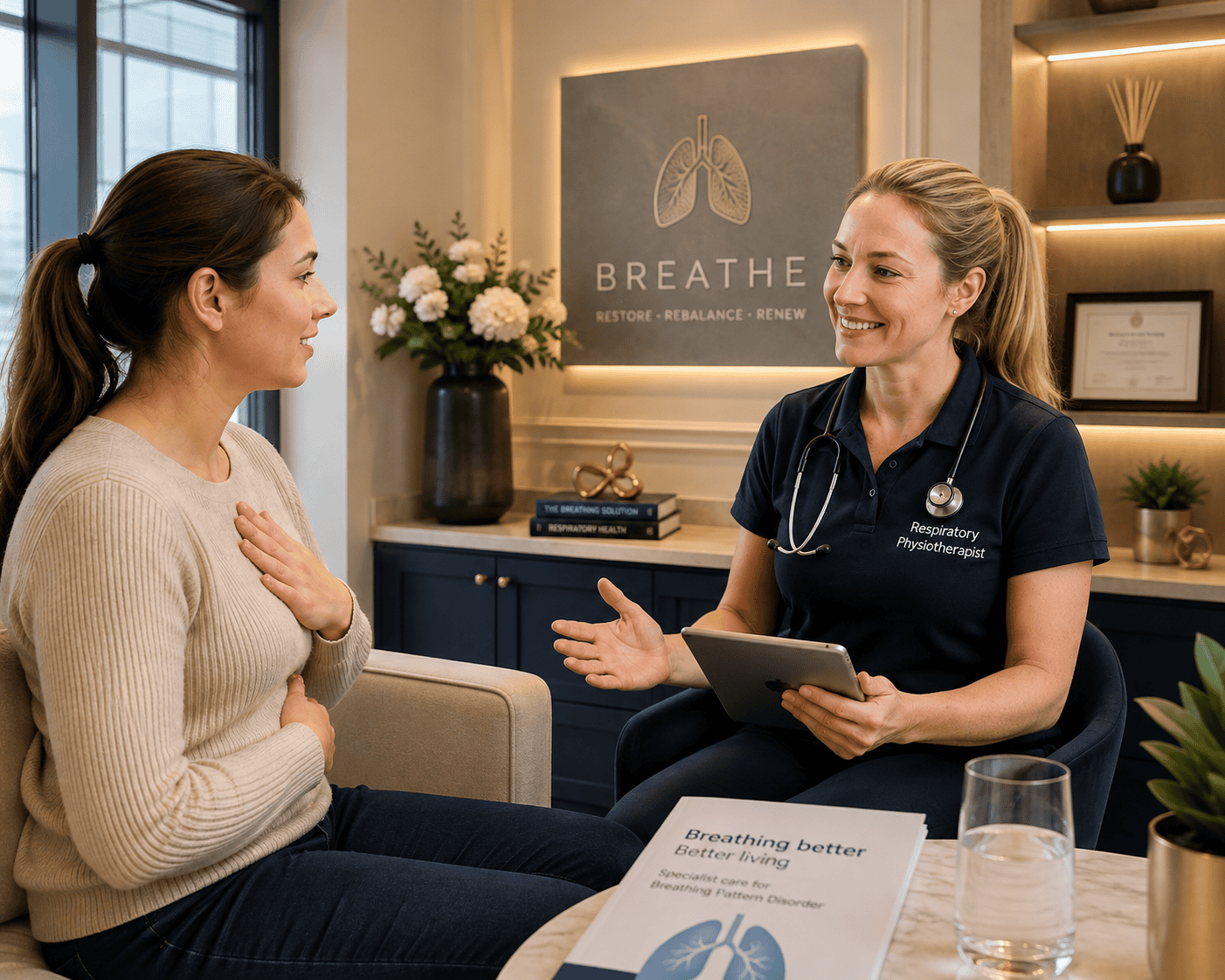
A specialist respiratory physiotherapist can assess your breathing pattern and, where appropriate, provide breathing retraining and other strategies to help you develop better control of your breathing.
Request a specialist breathing pattern disorder assessment
The active again team have teamed up with specialist highly qualified respiratory physiotherapists who solely deal with patients in the NHS and privately with breathing pattern disorders and dysfunctional breathing. A summary of this service is below:
- Remote/virtual assessment and treatment session(s) to anywhere in the world, not just UK based patients.
- Fully qualified, trained with 25 + year experience, specialist respiratory physiotherapists to assess and treat you
- Home visits, on site and international visits/assessment are available by prior discussion
- Unfortunately we do not accept medical insurance company remuneration. The fees that they offer for “physiotherapy treatments” do not represent the type of service that we offer in this complex area.
- Self pay patients only.
- Costs: Initial Assessment £150. Follow up consultation £75. Home visit £220 (location dependent). Others by negotiation.
What is breathing pattern disorder?
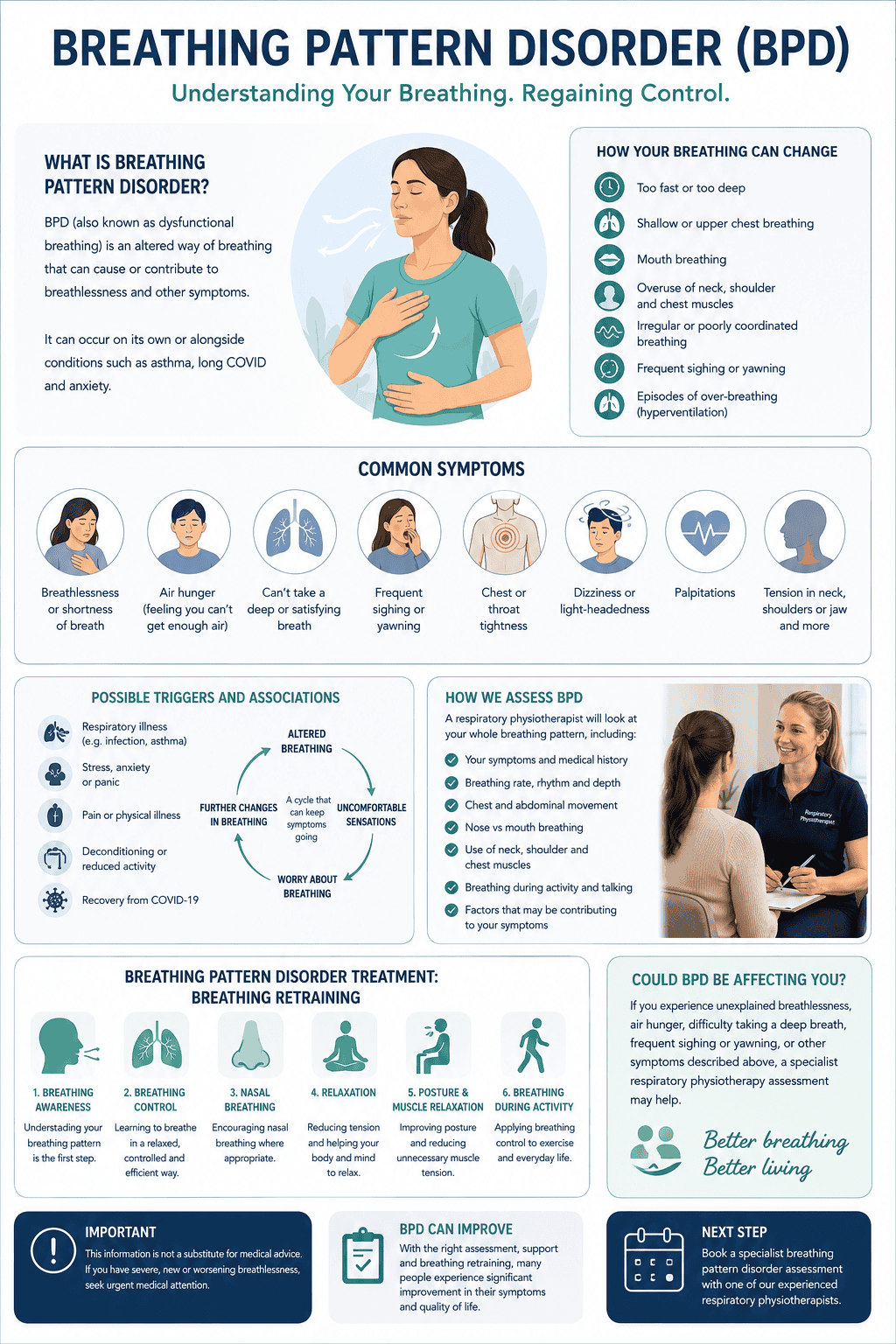
Breathing pattern disorder is an alteration in the way you breathe. Breathing normally happens automatically, without conscious thought. However, breathing can change in response to illness, stress, anxiety, pain, physical exertion or other triggers. In some people, an altered breathing pattern can continue after the original trigger has passed.
Breathing pattern disorder can take different forms. A person may:
- Breathe too quickly
- Take breaths that are larger than necessary
- Breathe predominantly from the upper chest
- Breathe through the mouth rather than the nose
- Use the muscles around the neck and shoulders more than necessary
- Develop an irregular or poorly coordinated breathing pattern
- Frequently sigh or yawn
- Experience episodes of over-breathing or hyperventilation
Not everyone with BPD will have all of these features. The condition is therefore not simply about breathing too quickly. It is a broader description of an altered breathing pattern that may contribute to symptoms such as breathlessness, chest tightness and the sensation of not getting enough air.
The Association of Chartered Physiotherapists in Respiratory Care (ACPRC) published a UK consensus position in 2025 supporting breathing pattern disorder as the preferred terminology and highlighting the role of physiotherapists in assessment and management.
What does breathing pattern disorder feel like?
Breathing pattern disorder can produce a wide range of symptoms, and the experience can be different from one person to another. You may experience:
- Breathlessness
- A feeling that you cannot get enough air
- Air hunger
- Feeling unable to take a deep or satisfying breath
- Frequent sighing
- Frequent yawning
- Chest tightness
- Throat tightness
- Rapid or shallow breathing
- Difficulty coordinating breathing with talking or eating
- Dizziness or light-headedness
- Headaches
- Palpitations or awareness of your heartbeat
- Pins and needles
- Coughing
- Frequent throat clearing
- Tension around the neck, shoulders or jaw
You do not need to have every symptom to have a breathing pattern disorder.
Air hunger and breathing pattern disorder
Air hunger describes the sensation that you cannot get enough air or that you need to take a deeper breath. You may find yourself repeatedly:
- Taking a large breath
- Sighing
- Yawning
- Trying to “fill” your lungs
- Changing your breathing in an attempt to make it feel more satisfying
Air hunger is described in NHS respiratory physiotherapy information as a possible feature of breathing pattern disorder. However, air hunger can have many causes. Experiencing it does not mean that you necessarily have BPD, particularly if your symptoms are new or have not been medically assessed.
Why can’t I take a deep breath?
One of the most common ways people describe altered breathing is:
“I can’t take a deep breath.”
You may feel that you can breathe in, but the breath does not feel satisfying. This can lead you to repeatedly try to take a bigger breath, sigh or yawn. This sensation is sometimes described as air hunger.
Breathing pattern disorder can contribute to this feeling because changes in the way you breathe can affect how breathing feels and how you respond to those sensations. However, difficulty taking a deep breath has many possible causes. It should not automatically be assumed to be a breathing pattern disorder.
If this is a new symptom, is worsening or has not previously been investigated, appropriate medical assessment is important.
Frequent yawning, sighing and shortness of breath
Frequent yawning or repeated sighing can sometimes occur alongside an altered breathing pattern.
Some people with BPD describe a persistent urge to take a deeper breath because their breathing does not feel satisfying. This can lead to a cycle of taking larger breaths, sighing or yawning and becoming increasingly aware of breathing. You may notice this particularly when:
- Sitting quietly
- Working at a desk
- Talking for long periods
- Feeling stressed
- Concentrating on your breathing
- Walking or exercising
- Recovering from an illness
Frequent yawning or sighing on its own does not mean that you have BPD. These symptoms can occur for many other reasons.
What causes breathing pattern disorder?
There is not always one identifiable cause.
Breathing can change in response to physical and psychological factors. In some people, the altered pattern persists even after the original trigger has gone. Possible triggers or associated factors include:
Respiratory illness
A respiratory infection or other illness can change the way you breathe. For some people, an altered breathing pattern can remain after recovery.
Asthma and other respiratory conditions
Breathing pattern disorder can occur alongside asthma and other respiratory conditions.
This is important because breathlessness does not necessarily have one single cause. An underlying respiratory condition and an altered breathing pattern may both contribute to symptoms.
Stress and anxiety
Stress, anxiety and panic can affect breathing.
A person may begin breathing faster or more deeply when they feel stressed or anxious. The physical sensations created by this change in breathing can then increase concern about breathing, creating a cycle of:
Altered breathing → uncomfortable sensations → concern about breathing → further changes in breathing
This does not mean that breathing pattern disorder is simply “caused by anxiety”.
BPD is a complex problem and can have physical, respiratory, behavioural and psychological factors.
Pain or physical illness
Pain, illness, reduced activity and changes in physical health can all influence breathing patterns.
Following COVID-19
Changes in breathing pattern have also been recognised in some people following COVID-19.
Persistent breathlessness after an illness can have several possible causes, and breathing pattern disorder is one potential contributor.
Breathing pattern disorder vs dysfunctional breathing
Breathing pattern disorder and dysfunctional breathing are closely related terms used to describe altered breathing patterns.
The terminology has historically varied between clinicians and researchers.
In 2025, the Association of Chartered Physiotherapists in Respiratory Care published a UK position statement supporting breathing pattern disorder as the preferred term.
However, dysfunctional breathing remains widely used, including in patient information and previous research.
If you have searched for:
- Dysfunctional breathing
- Dysfunctional breathing pattern
- Breathing pattern dysfunction
- Breathing pattern disorder
you are likely looking at closely related terminology.
Breathing pattern disorder and hyperventilation
Hyperventilation means breathing more than the body needs at a particular time.
It can occur for many reasons, including stress, anxiety, illness and other medical conditions.
Hyperventilation can be associated with breathing pattern disorders, but the terms are not necessarily interchangeable.
Some people with an altered breathing pattern may over-breathe or experience episodes of hyperventilation. Others may have a different type of breathing pattern disturbance without obvious hyperventilation.
For this reason, a specialist assessment looks at the whole breathing pattern, rather than simply asking whether someone breathes quickly.
How is breathing pattern disorder assessed?
Breathing pattern disorder is assessed clinically rather than diagnosed simply from a list of symptoms.
A respiratory physiotherapist may consider:
- Your symptoms
- When your symptoms occur
- What makes them better or worse
- Your medical and respiratory history
- Your breathing rate
- Your breathing rhythm
- How your chest and abdomen move
- Whether you predominantly breathe through your nose or mouth
- Whether you use your upper chest, neck or shoulder muscles excessively
- Your breathing pattern during movement or activity
- How breathing affects talking and everyday activities
- Other factors that may be contributing to your breathlessness
The 2025 ACPRC position statement recommends a more consistent approach to the assessment of breathing pattern disorder and specifically recognises the role of physiotherapists in assessing and managing the condition.
Do I need medical tests?
Sometimes further medical assessment or testing is appropriate.
Breathlessness can have many causes, including conditions affecting the lungs, heart and circulation.
A breathing pattern disorder should therefore not be assumed simply because you recognise some of the symptoms described on this page.
If your breathlessness is unexplained, new, persistent or worsening, you should seek appropriate medical assessment.
What happens during a breathing pattern disorder physiotherapy assessment?
A specialist breathing pattern disorder physiotherapy assessment will usually begin with a detailed discussion about your symptoms and medical history.
Your physiotherapist may ask:
- When did your symptoms begin?
- What does your breathing feel like?
- Do you experience air hunger?
- Do you frequently sigh or yawn?
- When do you become breathless?
- Does exercise affect your symptoms?
- Does stress affect your breathing?
- Have you already had medical investigations?
- Do you have asthma or another respiratory condition?
- Are there particular situations in which your breathing becomes difficult?
Your physiotherapist will then assess your breathing pattern.
This may involve observing your breathing at rest and, where appropriate, during movement or activity.
The purpose is not simply to tell you that you are “breathing incorrectly”.
Instead, the assessment aims to understand:
How are you breathing?
How does your breathing relate to your symptoms?
Could your breathing pattern be contributing to those symptoms?
Would breathing retraining be appropriate?
A first appointment may last around an hour, although appointment length varies between practitioners and services.
Breathing pattern disorder treatment
Breathing pattern disorder treatment is generally centred around breathing retraining.
The exact treatment will depend on your symptoms, assessment findings and any underlying conditions.
Treatment may include:
Breathing awareness
Understanding your own breathing pattern can be an important first step.
You may learn to recognise when your breathing becomes faster, deeper, more effortful or predominantly upper-chest based.
Breathing control
Breathing control techniques can help you practise a more comfortable and controlled breathing pattern.
The aim is not simply to take bigger or deeper breaths. In some circumstances, the goal may actually be to reduce unnecessary breathing effort and allow breathing to become quieter and more controlled.
Nasal breathing
Where appropriate, a physiotherapist may encourage nasal breathing at rest and during suitable activities.
Relaxation
Relaxation strategies can help reduce unnecessary tension and may help you gain greater awareness and control of your breathing.
Posture and muscle relaxation
Your physiotherapist may consider your posture and whether tension in the neck, shoulders, chest or jaw is contributing to your breathing pattern.
Breathing during activity
Once breathing control has improved at rest, techniques can be incorporated into walking, exercise and other everyday activities.
The exact approach should be individualised rather than relying on a single set of breathing exercises for everyone.
Can a respiratory physiotherapist help breathing pattern disorder?
Respiratory physiotherapists have an important role in the assessment and management of breathing pattern disorder.
Specialist respiratory physiotherapy services within the NHS use breathing pattern retraining as part of the management of breathlessness and altered breathing patterns.
The ACPRC’s current UK position statement also specifically recognises the role of physiotherapists in assessing and managing breathing pattern disorder.
A respiratory physiotherapist may help you understand:
- Whether your breathing pattern may be contributing to your symptoms
- What features of your breathing pattern may be relevant
- Whether breathing retraining is appropriate
- Which techniques may be suitable for you
- How to apply breathing control during everyday activities
- How to manage your breathing during exercise
Could your breathing pattern be contributing to your symptoms?
If you regularly experience breathlessness, air hunger, difficulty taking a satisfying breath, frequent sighing or yawning, or other symptoms associated with altered breathing, a specialist assessment may help you understand what is happening.
[Request a specialist BPD physiotherapy assessment]
Who might benefit from a BPD assessment?
A breathing pattern disorder assessment may be worth considering if you:
- Regularly feel short of breath without a clear explanation
- Feel unable to get enough air
- Experience air hunger
- Frequently need to take a deep breath
- Frequently sigh or yawn
- Feel unable to take a satisfying deep breath
- Experience chest or throat tightness
- Notice that your breathing becomes rapid or shallow
- Notice significant upper-chest movement when breathing
- Find that your breathing changes during stress
- Become breathless during relatively minor activity
- Have persistent breathlessness despite treatment of an underlying condition
- Have previously been told that you have dysfunctional breathing or a breathing pattern disorder
Recognising these symptoms does not mean that you have BPD.
The purpose of specialist assessment is to determine whether an altered breathing pattern may be contributing to your symptoms.
What if I have asthma or another respiratory condition?
Having asthma or another respiratory condition does not automatically rule out breathing pattern disorder.
BPD can coexist with respiratory conditions, and breathlessness can have more than one contributing factor.
For example, someone with asthma may experience genuine airway symptoms while also developing an altered breathing pattern that contributes to breathlessness.
A specialist respiratory physiotherapist can consider the wider picture and work alongside your existing healthcare team where appropriate.
You should continue any prescribed medication or treatment for an existing medical condition unless your doctor or another appropriate healthcare professional advises otherwise.
When should breathlessness be medically assessed?
Breathlessness should not automatically be attributed to breathing pattern disorder.
There are many possible causes of shortness of breath, including conditions affecting the lungs, heart and circulation.
If your breathlessness is new, unexplained, persistent or getting worse, seek appropriate medical assessment.
Seek urgent medical attention if you experience:
- Severe or rapidly worsening difficulty breathing
- Severe or persistent chest pain
- Fainting or collapse
- Coughing up blood
- Blue or grey lips or skin
- Severe confusion
- Or symptoms that feel like a medical emergency
A breathing pattern disorder assessment is not a substitute for investigating unexplained or potentially serious breathlessness.
Frequently asked questions
What is breathing pattern disorder?
Breathing pattern disorder is an altered pattern of breathing that can contribute to breathlessness and other symptoms. It may involve changes in breathing rate, depth, rhythm, muscle use or the way breathing is coordinated.
Is breathing pattern disorder the same as dysfunctional breathing?
The terms are closely related and have historically been used interchangeably in some settings. Current UK respiratory physiotherapy consensus supports breathing pattern disorder as the preferred terminology, although dysfunctional breathing remains widely used.
What does breathing pattern disorder feel like?
Symptoms vary between people but can include breathlessness, air hunger, difficulty taking a satisfying deep breath, frequent sighing or yawning, chest tightness, dizziness, palpitations and other sensations associated with altered breathing.
Can breathing pattern disorder cause air hunger?
Air hunger is a commonly described symptom associated with altered breathing patterns. It is the sensation that you cannot get enough air or need to take a deeper breath. However, air hunger can have many possible causes and should not automatically be attributed to BPD.
Why can’t I take a deep breath?
There are many possible reasons for feeling unable to take a deep breath. Breathing pattern disorder can contribute to this sensation in some people, particularly when associated with air hunger and repeated sighing or yawning. New or unexplained symptoms should be appropriately assessed.
Can breathing pattern disorder cause frequent yawning?
Frequent yawning and sighing can occur alongside an altered breathing pattern. Some people experience an urge to yawn or sigh because their breathing does not feel satisfying. However, frequent yawning has many possible causes.
Can anxiety cause dysfunctional breathing?
Stress and anxiety can affect breathing and may contribute to an altered breathing pattern. However, dysfunctional breathing should not simply be regarded as “anxiety”. Physical, respiratory, behavioural and psychological factors can all be relevant.
Can a respiratory physiotherapist treat breathing pattern disorder?
Respiratory physiotherapists play an important role in the assessment and management of breathing pattern disorder. Treatment may include breathing retraining, breathing control, education, relaxation, posture and strategies for applying breathing control during activity.
Can breathing pattern disorder occur with asthma?
Yes. Breathing pattern disorder can coexist with asthma and other respiratory conditions. A person’s breathlessness may have more than one contributing factor, which is why individual assessment is important.
How long does breathing pattern disorder treatment take?
There is no standard treatment duration that applies to everyone. The number and frequency of appointments will depend on your symptoms, assessment findings, underlying conditions and progress with breathing retraining.
Could your breathing pattern be contributing to your symptoms?
If you experience unexplained breathlessness, air hunger, difficulty taking a satisfying breath, frequent sighing or yawning, or other symptoms associated with an altered breathing pattern, specialist respiratory physiotherapy may be worth considering.
A respiratory physiotherapist can assess your breathing pattern and help determine whether breathing retraining or other physiotherapy strategies may be appropriate for you.
About this information
This information is intended for patients and is not a substitute for individual medical assessment or advice. Active Again recommends that new or unexplained breathlessness is appropriately medically assessed before assuming that a breathing pattern disorder is the cause.
Medical review
This page has been medically reviewed by a senior Respiratory Physiotherapist with 25 in the NHS and private practice.
Professionally qualified which include HCPC registration
Last reviewed: 18th august 2026
Next review: 17th August 2027
Sources and further information
This page has been informed by UK NHS respiratory physiotherapy patient information and professional guidance, including material from University College London Hospitals, Cambridge University Hospitals, North Bristol NHS Trust and the Association of Chartered Physiotherapists in Respiratory Care.
Request a specialist assessment