
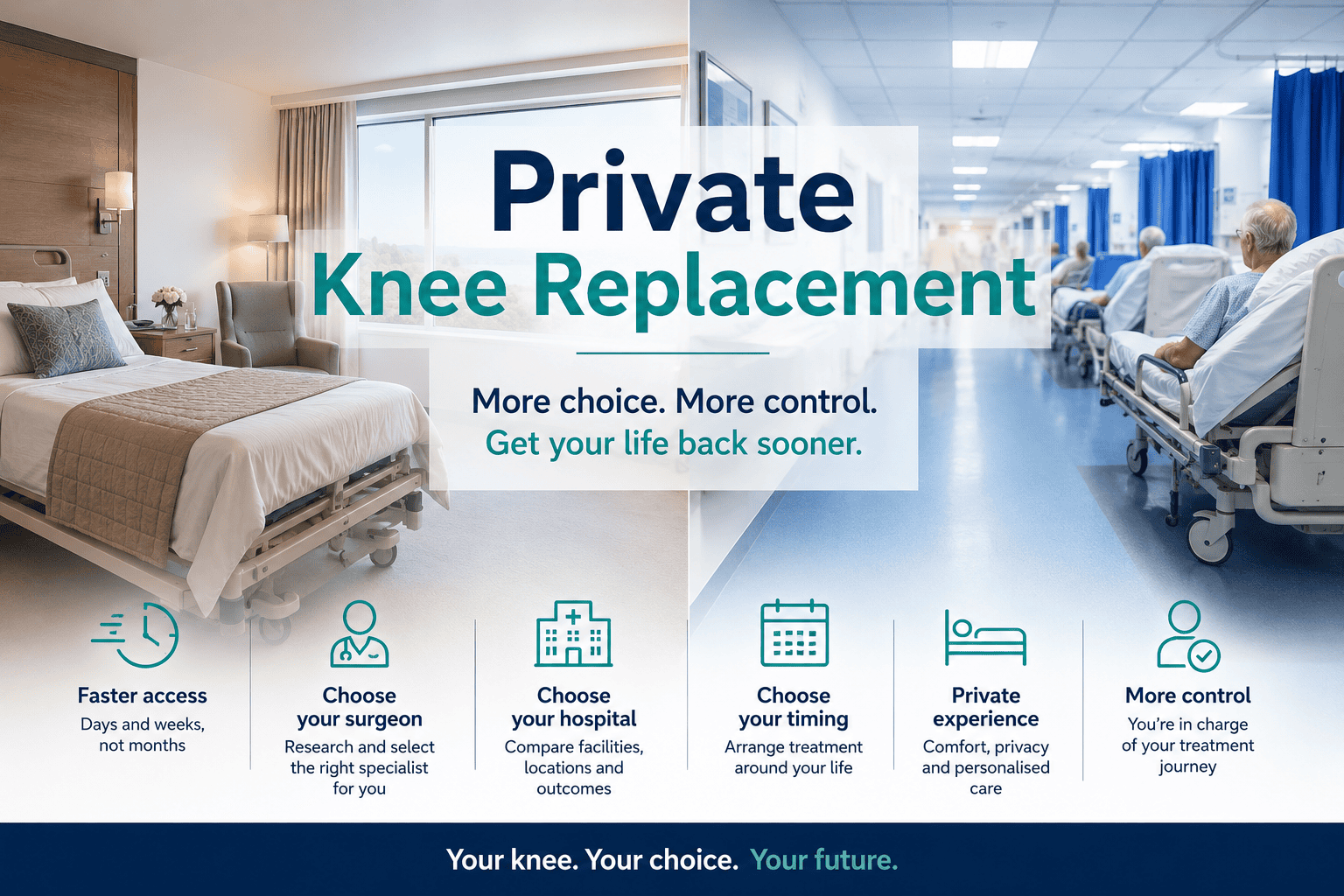
If you have reached the point where knee arthritis is affecting your everyday life, you may not want to spend months waiting for treatment.
Choosing private knee replacement gives you something that many patients value enormously: greater control over when, where and by whom you are treated.
You can research your surgeon, compare hospitals, ask about available surgical dates and arrange treatment around your work, family and lifestyle.
For many patients, that combination of speed, choice, convenience and control is the reason to go private.
Private knee replacement does cost money, and it is not automatically a guarantee of a better surgical result. But if your knee is significantly affecting your quality of life, the ability to take control of your treatment can be worth a great deal.
This guide explains the benefits of private knee replacement, what it costs, how it compares with NHS treatment, and how to choose your surgeon and hospital.
Private knee replacement: the quick answer
Why do patients choose private knee replacement?
⚡ Faster access
Private elective treatment is generally arranged in days and weeks rather than through an NHS-style waiting list, although actual availability varies. (Phin)
👨⚕️ Choose your surgeon
You can research individual knee specialists and decide who you want to see.
🏥 Choose your hospital
You can compare hospitals, facilities, locations and available information about outcomes.
📅 Choose when
Subject to availability, treatment can often be arranged around your work, family and other commitments.
🛏️ Greater privacy
Private hospitals generally provide individual rooms and a more private inpatient environment.
📞 More control
You can take a much more active role in deciding how, where and when your treatment takes place.
💷 But you pay for it
Private knee replacement is a substantial financial investment, so understanding exactly what you are buying is important.
The biggest benefit of going private may be choice
Private healthcare isn’t simply about paying to get through the door of a hospital.
For many patients, the attraction is being able to make choices about their treatment.
Research by the Private Healthcare Information Network (PHIN) found that 89% of people surveyed wanted either limited or complete choice about their private treatment. Greater flexibility, better facilities and different treatment options were also important reasons people gave for choosing private care. (Phin)
For knee replacement, that can mean researching:
- which surgeon you want to see;
- where they operate;
- how much knee surgery they perform;
- what type of knee replacement they specialise in;
- which hospital you prefer;
- when you want treatment;
- and how much the treatment will cost.
For a major operation such as knee replacement, that ability to make an informed choice can be extremely valuable.
Going private gives you the opportunity to choose — use it.
Why choose private knee replacement?
1. Faster access to treatment
For many patients, waiting is the biggest problem.
Severe knee arthritis can affect almost every aspect of life:
- walking;
- sleep;
- work;
- exercise;
- holidays;
- social activities;
- and independence.
Waiting months for treatment can mean spending months living with those limitations.
Private treatment allows you to approach consultants and hospitals directly and ask about available appointments and surgical dates.
PHIN says private elective procedures such as hip and knee replacement are generally measured in days and weeks, although the actual wait depends on the consultant, hospital, procedure and availability. (Phin)
Why does speed matter?
Because time has value.
If your knee is stopping you from:
- working normally;
- exercising;
- travelling;
- looking after your family;
- or enjoying everyday life,
getting treatment sooner may be worth considerably more to you than the financial cost of the operation.
What is happening with NHS waiting times?
The NHS is working hard to reduce waiting times, and performance has been improving.
In March 2026:
- 65.3% of NHS referral-to-treatment pathways had been waiting less than 18 weeks;
- the overall waiting list was 7.11 million pathways;
- and the number waiting more than 18 weeks had fallen substantially compared with the previous year. (NHS England)
The NHS 18-week standard is an important benchmark, but it does not mean every patient will have their knee replacement within 18 weeks.
For someone who doesn’t want to wait, private treatment provides an alternative route.
2. Choose your surgeon
This is one of the biggest advantages of private knee replacement.
You don’t simply have to accept the first available consultant.
You can research individual surgeons and investigate:
- qualifications;
- specialist interests;
- experience;
- number of knee replacements performed;
- particular surgical techniques;
- hospitals;
- patient feedback;
- and available outcome information.
You can then decide who you want to see.
That is particularly important because surgeons are not interchangeable.
A surgeon specialising in routine primary knee replacement may have a different expertise from one whose practice focuses on:
- partial knee replacement;
- robotic knee replacement;
- complex deformity;
- revision knee replacement;
- or infected knee replacements.
The right surgeon isn’t necessarily the surgeon who performs the most operations.
It is the surgeon whose expertise best matches your particular problem.
3. Choose your hospital
Going private also gives you the opportunity to compare hospitals.
Consider:
- location;
- CQC rating;
- orthopaedic activity;
- facilities;
- nursing;
- physiotherapy;
- accommodation;
- postoperative care;
- emergency arrangements;
- and what happens if a complication occurs.
You can decide which environment suits your needs.
4. Choose when you have treatment
Private treatment can give you greater flexibility over scheduling.
That can be particularly valuable if you are:
- working;
- running a business;
- caring for family;
- planning a holiday;
- or coordinating your recovery around other commitments.
Instead of waiting for a date to become available through an NHS pathway, you can ask your chosen consultant:
“When could I have my operation?”
You can then decide whether the available date works for you.
Private healthcare is about control
This is perhaps the simplest way of understanding the difference.
NHS pathway
Referral → provider → waiting list → appointments → surgery
Private pathway
Research → choose surgeon → choose hospital → discuss timing → surgery
The NHS pathway is changing, and patients in England have important rights to choose providers for eligible elective care. NHS England is also increasing the use of independent hospitals for NHS-funded treatment. (NHS England)
But private treatment gives you the ability to approach the market directly.
You can say:
“This is the surgeon I want to see.”
“This is the hospital I prefer.”
“These are the dates that work for me.”
For many patients, that control is the principal reason for going private.
5. A more private hospital experience
A private bedroom isn’t the main reason to spend thousands of pounds on knee replacement.
But it is a genuine advantage for many patients.
Private hospitals commonly offer:
- individual bedrooms;
- en-suite facilities;
- greater privacy;
- quieter surroundings;
- and a more personalised inpatient environment.
The exact facilities vary between hospitals.
The room is the visible benefit. The control is the important one.
Private knee replacement isn’t just about a nicer room
If you’re paying for surgery, the real value of private healthcare is much broader.
Access
Get treatment without relying solely on NHS waiting-list capacity.
Choice
Select your surgeon and hospital.
Time
Arrange treatment around your life.
Convenience
Coordinate consultations, investigations and surgery more flexibly.
Privacy
Enjoy a more private hospital environment.
Control
Take an active role in decisions about your care.
Is private knee replacement medically better?
This is an important question — but it doesn’t need to dominate the decision.
The short answer is:
Private payment does not automatically produce a better knee replacement.
The quality of your outcome depends on factors including:
- whether knee replacement is appropriate for you;
- your general health;
- the surgeon;
- the hospital;
- the implant;
- surgical technique;
- rehabilitation;
- and management of complications.
There is nevertheless evidence that independent hospitals can be highly effective at delivering planned elective surgery.
A large English study of more than 430,000 publicly funded hip and knee replacements found that, after adjustment for observable patient differences, treatment in private hospitals was associated with lower rates of several adverse outcomes and shorter postoperative stays. However, when the researchers used an instrumental-variable approach to account for unobserved differences between patients, most of those apparent advantages disappeared. (PubMed Central (PMC))
A separate study of 3.8 million publicly funded patients undergoing 133 planned procedures also found fewer emergency readmissions in private hospitals before more sophisticated adjustment. After accounting for differences in patient selection, the apparent ownership effect became statistically insignificant. (ScienceDirect)
What should patients take from this?
Not that private treatment isn’t worthwhile.
Rather:
The strongest reasons to choose private knee replacement are speed, choice, convenience and control — rather than assuming that paying privately automatically produces a superior clinical result.
That is why choosing the right surgeon and hospital is so important.
Private knee replacement: what does it cost?
Private knee replacement is a substantial investment, and prices vary considerably.
PHIN’s latest published self-pay package data, based on prices collected in March 2026, shows the following average knee replacement package prices:
| Location | Average package price |
|---|---|
| Glasgow | £14,341 |
| Bristol | £14,931 |
| Birmingham | £15,147 |
| Aberdeen | £15,400 |
| London | £15,689 |
| Manchester | £15,773 |
| Edinburgh | £15,874 |
| Liverpool | £15,845 |
| Cambridge | £18,236 |
Across the locations PHIN publishes, the average prices range from £14,341 to £18,236 per knee. These are guides rather than guaranteed prices, and individual circumstances can change the amount you pay. (Phin)
What does a package normally include?
Private hospitals often offer fixed packages covering the main costs of treatment, including hospital, surgeon and anaesthetist fees.
But not everything is necessarily included.
PHIN specifically advises patients to confirm the contents of a package in writing. Consultation fees and extras such as physiotherapy may be charged separately. (Phin)
Additional costs can potentially include:
- initial consultation;
- investigations;
- additional hospital nights;
- medication;
- physiotherapy;
- additional imaging;
- take-home medication;
- or treatment arising from complications.
Don’t compare headline prices. Compare what you actually get.
Private medical insurance or self-pay?
There are two main routes to private knee replacement.
Private medical insurance
Your insurer pays eligible costs according to your policy.
You may have restrictions concerning:
- consultant;
- hospital;
- implant;
- treatment;
- excess;
- or pre-existing conditions.
Always obtain authorisation from your insurer before proceeding.
Self-pay
You pay for the operation yourself.
This can provide considerable freedom over your choice of surgeon and hospital, but you carry the financial cost yourself.
For many people, self-pay knee replacement is a substantial investment.
That makes researching your surgeon before spending the money particularly important.
Private knee replacement is a major and growing part of UK healthcare
Private treatment is no longer a niche alternative to NHS care.
PHIN recorded 16,730 primary knee replacements in private hospitals in 2025, including:
- 8,580 insurance-funded procedures
- 8,150 self-pay procedures. (Phin)
Primary knee replacement is therefore one of the major procedures undertaken in the UK private healthcare sector.
And private hospitals don’t only treat private patients.
Independent providers also perform large amounts of NHS-funded elective surgery.
This means there is considerable overlap between the NHS and private sectors.
You can sometimes have NHS treatment in a private hospital
This is worth understanding.
There are actually three different routes:
NHS-funded NHS treatment
NHS pays → NHS hospital
NHS-funded independent treatment
NHS pays → private/independent hospital
Private treatment
Patient or insurer pays → private hospital
NHS England has increasingly used independent-sector capacity to expand elective treatment and reduce waiting times. (NHS England)
So:
A private hospital doesn’t necessarily mean privately funded treatment.
And:
NHS-funded treatment doesn’t necessarily mean treatment in an NHS hospital.
Understanding this distinction gives you more options.
Look beyond the hospital brochure
One of the advantages of going private is that you can research your options before committing your money.
You shouldn’t choose a hospital simply because it has:
- attractive photographs;
- impressive marketing;
- a convenient location;
- or a low headline price.
There is increasingly useful information available to patients.
PHIN publishes information on:
- private hospitals;
- consultants;
- fees;
- patient experience;
- and patient-reported outcomes.
It now publishes Patient Reported Outcome Measures (PROMs) for private knee replacement. These show how patients report changes in pain, mobility and day-to-day activities following surgery. (Phin)
That means patients can look beyond the hospital brochure and ask:
What do patients actually report after their knee replacement?
This is exactly the kind of information we believe should form part of your decision.
Who is most likely to value private knee replacement?
Private treatment may be particularly attractive if:
Your knee is severely affecting your life
You don’t want to spend another year living with significant pain and restricted mobility.
You are working
You may want to organise surgery and recovery around your employment.
You have an active lifestyle
You may value getting back to walking, golf, cycling, travelling or other activities sooner.
You have family commitments
You may want to choose when rehabilitation takes place.
You have a particular surgeon in mind
You may want to see a consultant whose expertise matches your needs.
You value privacy and convenience
You may prefer a private hospital environment.
You want to take control
You want to research the alternatives and make your own decision.
Choosing your private knee replacement surgeon
This is where going private becomes particularly powerful.
You have paid for the ability to choose.
Use it.
Don’t choose your surgeon simply because:
- they appear high in Google;
- their hospital has impressive photographs;
- they describe themselves as a “leading surgeon”;
- or their package is cheap.
Instead, investigate them.
How much knee replacement surgery do they perform?
Ask:
- How many knee replacements do you perform each year?
- How much of your practice is knee surgery?
- How long have you specialised in knee replacement?
- How often do you perform the specific procedure I need?
What are their outcomes?
Where available, investigate:
- patient-reported outcomes;
- revision rates;
- complications;
- National Joint Registry information;
- and patient feedback.
Do they treat your particular problem?
A surgeon who performs a large number of straightforward primary knee replacements may have different expertise from someone specialising in:
- partial knee replacement;
- robotic knee replacement;
- complex deformity;
- revision knee replacement;
- or infected knee replacements.
The right surgeon is not necessarily the surgeon who performs the most operations.
It is the surgeon whose expertise best matches your problem.
Choosing your private hospital
The hospital matters too.
Look at:
- CQC rating;
- knee replacement activity;
- infection prevention;
- physiotherapy;
- nursing;
- postoperative care;
- emergency arrangements;
- critical-care facilities;
- and arrangements for dealing with complications.
Ask:
“If something unexpected happens after my knee replacement, what happens next?”
The hospital should be appropriate for your individual level of risk, not simply look impressive.
What happens if something goes wrong?
This is one of the questions you should ask before booking private surgery.
Find out:
- Is there overnight medical cover?
- What happens if I need urgent treatment?
- Is there critical-care support?
- What happens if I need another operation?
- Is there access to emergency imaging?
- Where would I be transferred if the hospital could not manage my complication?
- Who pays for additional treatment?
Private hospitals vary in their facilities.
For straightforward elective knee replacement in an otherwise healthy patient, this may be less important than for someone with complex medical problems.
Private knee replacement: what are you actually paying for?
You are not necessarily paying for a “better knee replacement”.
You are paying for the opportunity to have greater control over how you access and experience elective treatment.
Access
Potentially faster treatment.
Choice
Your surgeon and hospital.
Time
Treatment arranged around your life.
Convenience
More flexible appointments and scheduling.
Privacy
A private inpatient environment.
Information
The ability to research before committing.
Control
A much more active role in your treatment decisions.
For many patients, those things are worth paying for.
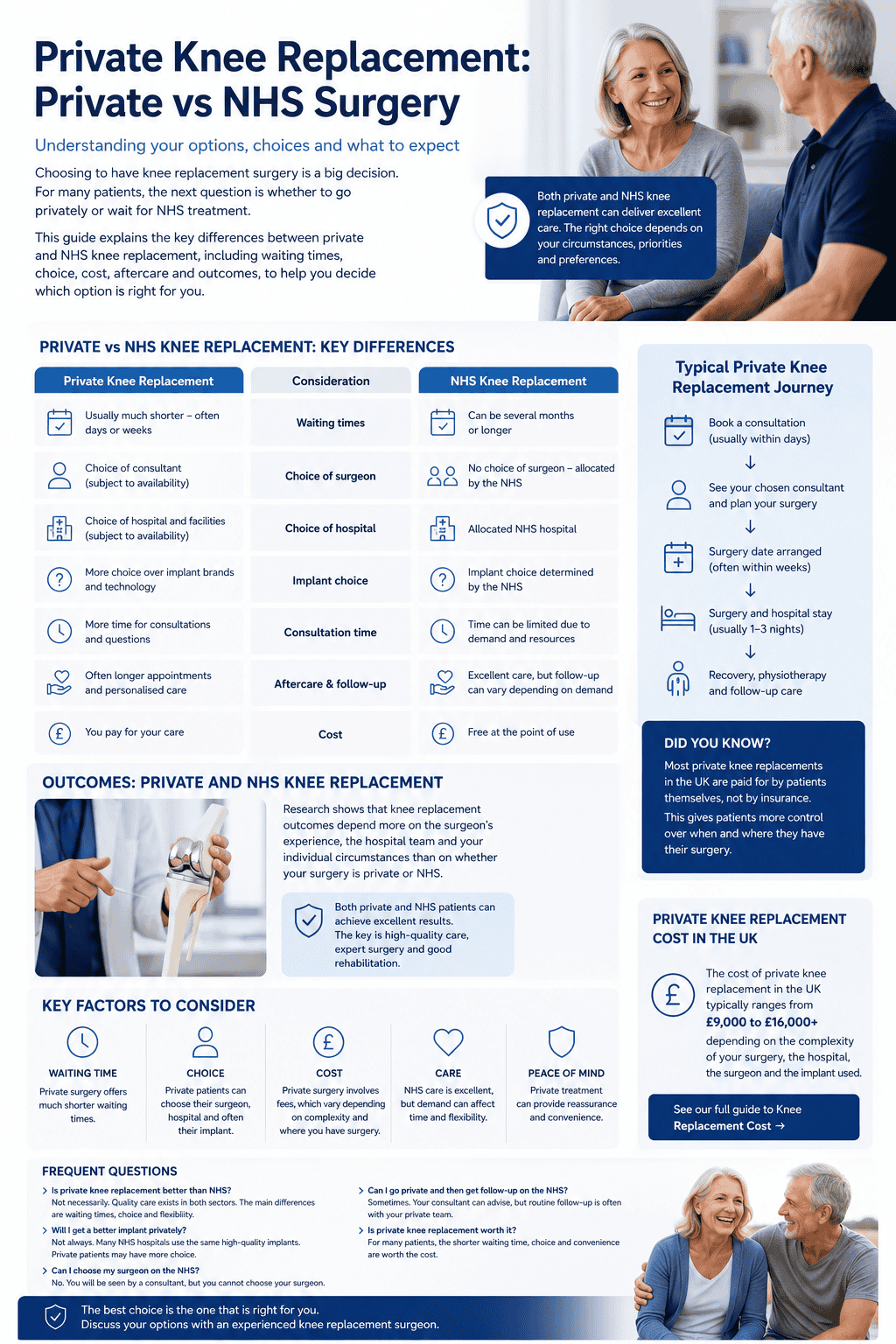
Private vs NHS knee replacement
| Private knee replacement | NHS knee replacement | |
|---|---|---|
| Direct treatment cost | Patient or insurer pays | NHS funded |
| Access | Generally quicker for elective treatment | Dependent on NHS waiting times and capacity |
| Consultant choice | Strong ability to research and select | Important choice rights exist in England |
| Hospital choice | Strong ability to research and select | Choice exists within the NHS pathway |
| Timing | Greater flexibility | Dependent on provider capacity |
| Accommodation | Usually private room | Varies |
| Patient information | PHIN, CQC and provider information available | NHS, CQC and provider information available |
| Emergency support | Depends on individual hospital | Broad NHS emergency and specialist network |
| Clinical quality | Can be excellent | Can be excellent |
| Main attraction | Speed, choice and control | No direct treatment cost |
The choice isn’t necessarily about which system is “better”.
It is about which route best suits your circumstances and priorities.
Is private knee replacement worth paying for?
For many patients, it can be.
If your knee is significantly affecting your quality of life, the cost of waiting can be substantial.
Going private can give you the opportunity to:
Choose your surgeon.
Choose your hospital.
Choose when you have treatment.
Research your options.
Plan your recovery.
And take control of your treatment journey.
Private treatment does not guarantee a better knee replacement.
But it can give you something that many patients value enormously:
The ability to take control of the process.
The most important thing is to use that choice wisely.
Don’t just choose private. Choose well.
Research the operation.
Research the surgeon.
Research the hospital.
Understand the cost.
Understand your alternatives.
Then decide whether private knee replacement is right for you.
Frequently asked questions
Is private knee replacement better than NHS knee replacement?
There is no strong evidence that simply paying privately guarantees a better clinical outcome. The strongest advantages of private care are generally access, choice, convenience, privacy and control. Large English studies have found differences between sectors, but patient selection makes direct comparisons of clinical quality difficult. (PubMed Central (PMC))
Is private knee replacement faster?
It can be. Private elective treatment is generally arranged in days and weeks rather than through an NHS-style waiting list, although the actual wait depends on the consultant, hospital, procedure and availability. (Phin)
How much does private knee replacement cost?
PHIN’s March 2026 data shows average package prices ranging from approximately £14,341 to £18,236 across the UK locations it publishes. Individual prices vary and packages do not necessarily include every cost.
Can I choose my private knee surgeon?
Yes. One of the major advantages of private treatment is being able to research and select your consultant.
Can I choose my private hospital?
Yes, subject to the surgeon’s practising privileges and hospital availability.
Can I have NHS treatment in a private hospital?
Yes. Independent hospitals provide NHS-funded elective treatment as part of the NHS’s use of independent-sector capacity. (NHS England)
Does private medical insurance cover knee replacement?
It can, but policies vary. Check your policy and obtain authorisation before treatment.
Is self-pay knee replacement worth it?
For some patients, the value of faster access, choice and convenience can justify the cost. For others, NHS treatment may be preferable.
Does private treatment guarantee a better result?
No. The surgeon, hospital, patient, operation and rehabilitation remain important determinants of outcome.
Can I research the outcomes of private knee replacement?
Yes. PHIN publishes patient-reported outcome information for private knee replacement, including changes in pain, mobility and day-to-day activities. (
Our approach at Active Again
A knee replacement is a major decision.
We don’t think patients should simply be told:
“Go private.”
We think you should understand why going private might be worthwhile — and how to make a good private healthcare decision.
That means helping you research:
- knee replacement options;
- the evidence;
- private versus NHS treatment;
- costs;
- hospitals;
- surgeons;
- implants;
- robotic surgery;
- recovery;
- and potential complications.
Because once you’ve decided to pay for knee replacement, the next decision may be even more important: who should perform it?