

Hip Replacement Cost in the UK
How much does private hip replacement surgery cost, what is normally included, and what might you pay extra?
Quick answer: how much does a private hip replacement cost?
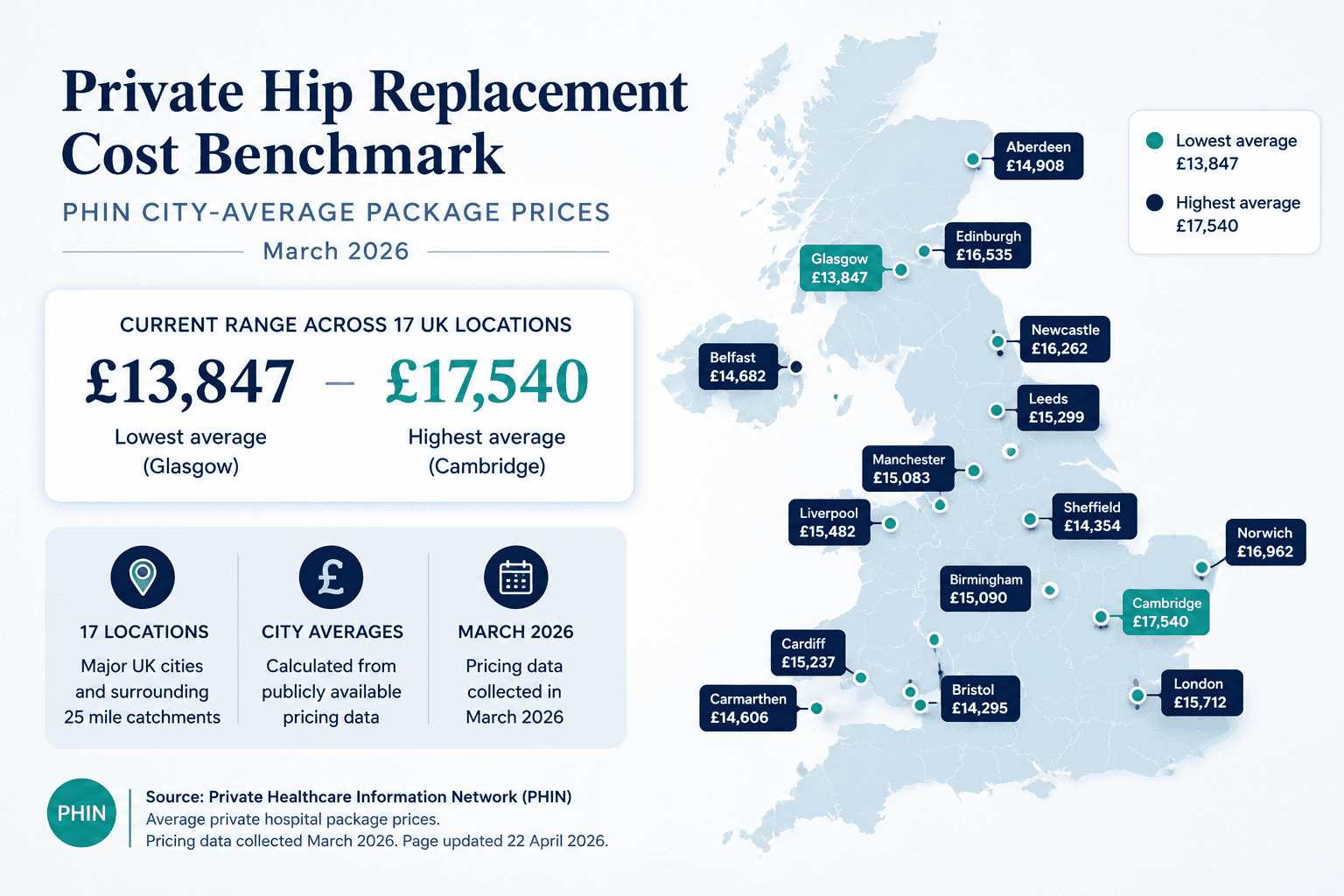
Current PHIN city-average private hip replacement package prices range from £13,847 to £17,540 per hip.
These figures come from the Private Healthcare Information Network (PHIN), using publicly available pricing data collected in March 2026 across 17 UK locations. The figures cover each city centre and the surrounding 25 miles.
They are average package prices, not guaranteed quotations. The price you are offered can be higher or lower depending on where you have treatment, the provider and consultant, your circumstances, and exactly what the package includes.
What does that mean in practice?
There is no single standard UK private price for hip replacement.
The current PHIN city averages sit broadly in the mid-£10,000s, but that does not mean you should expect to pay the same amount.
Your own quotation needs to be assessed against both the relevant price benchmark and what you are actually getting for the quoted amount.
Current PHIN city-average package prices
| Location | Average package price |
|---|---|
| Aberdeen | £14,908 |
| Belfast | £14,682 |
| Birmingham | £15,090 |
| Bristol | £14,295 |
| Cambridge | £17,540 |
| Cardiff | £15,237 |
| Carmarthen | £14,606 |
| Edinburgh | £16,535 |
| Glasgow | £13,847 |
| Leeds | £15,299 |
| Liverpool | £15,482 |
| London | £15,712 |
| Manchester | £15,083 |
| Newcastle upon Tyne | £16,262 |
| Norwich | £16,962 |
| Sheffield | £14,354 |
| Wrexham | £15,638 |
Source: PHIN, Average private hospital package prices. Pricing data collected March 2026; page updated 22 April 2026. These are city-level averages and should be treated as a guide rather than a personal quotation.
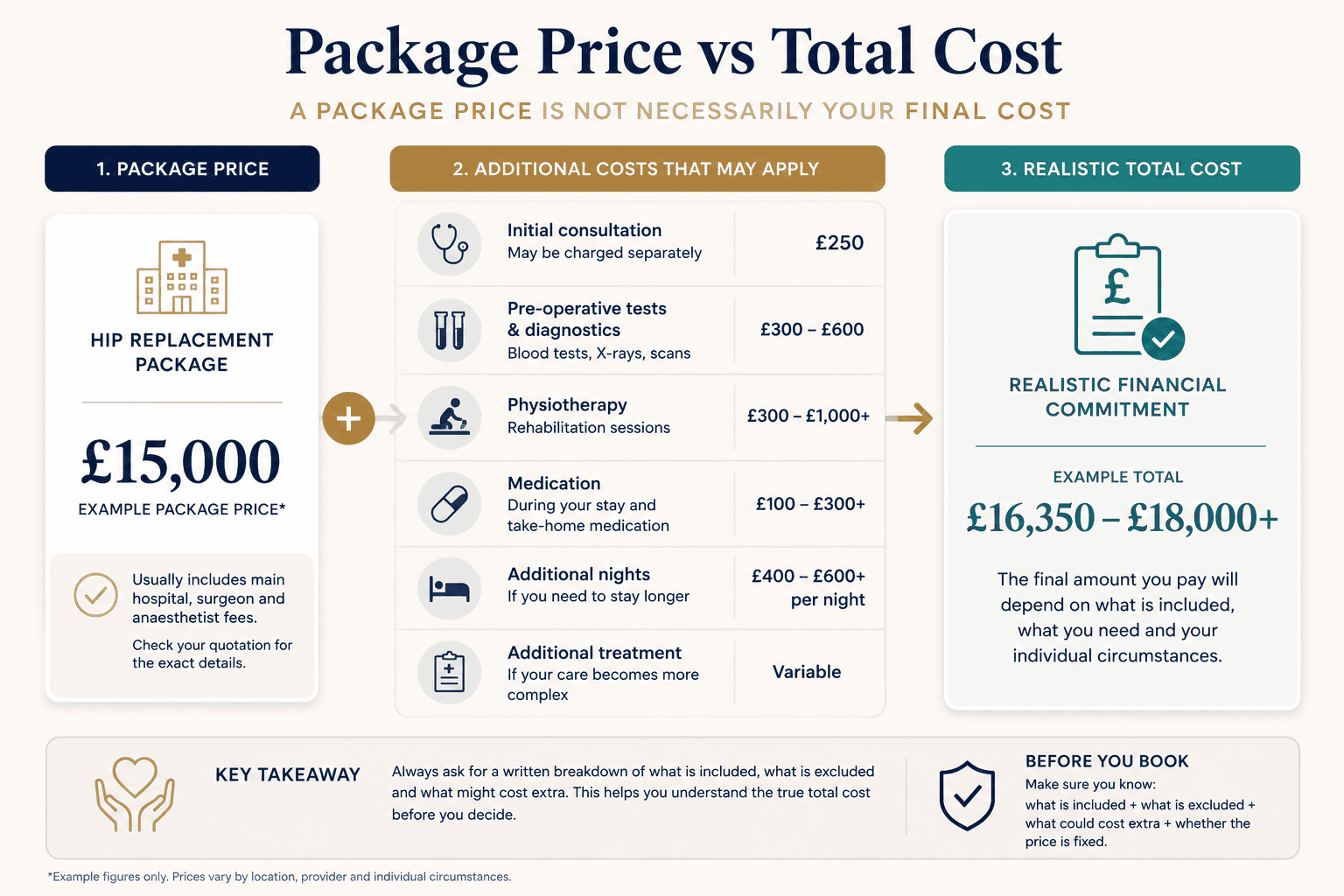
IMPORTANT: A HEADLINE PACKAGE PRICE IS NOT NECESSARILY YOUR FINAL COST
Private hospitals often offer package prices covering the main costs of treatment, but a package does not necessarily include every cost. Your initial consultation, some diagnostic investigations, physiotherapy, medication, additional hospital nights or other services may be outside the quoted amount. Ask for a written breakdown before you commit.
At a glance
CURRENT BENCHMARK
£13,847–£17,540 per hip across the UK locations currently covered by PHIN.
CHECK WHAT’S INCLUDED
A package commonly covers the main hospital, surgeon and anaesthetist costs, but exclusions vary.
COMPARE THE TOTAL
A lower headline price is not necessarily a lower overall cost.
What is included in a private hip replacement price?
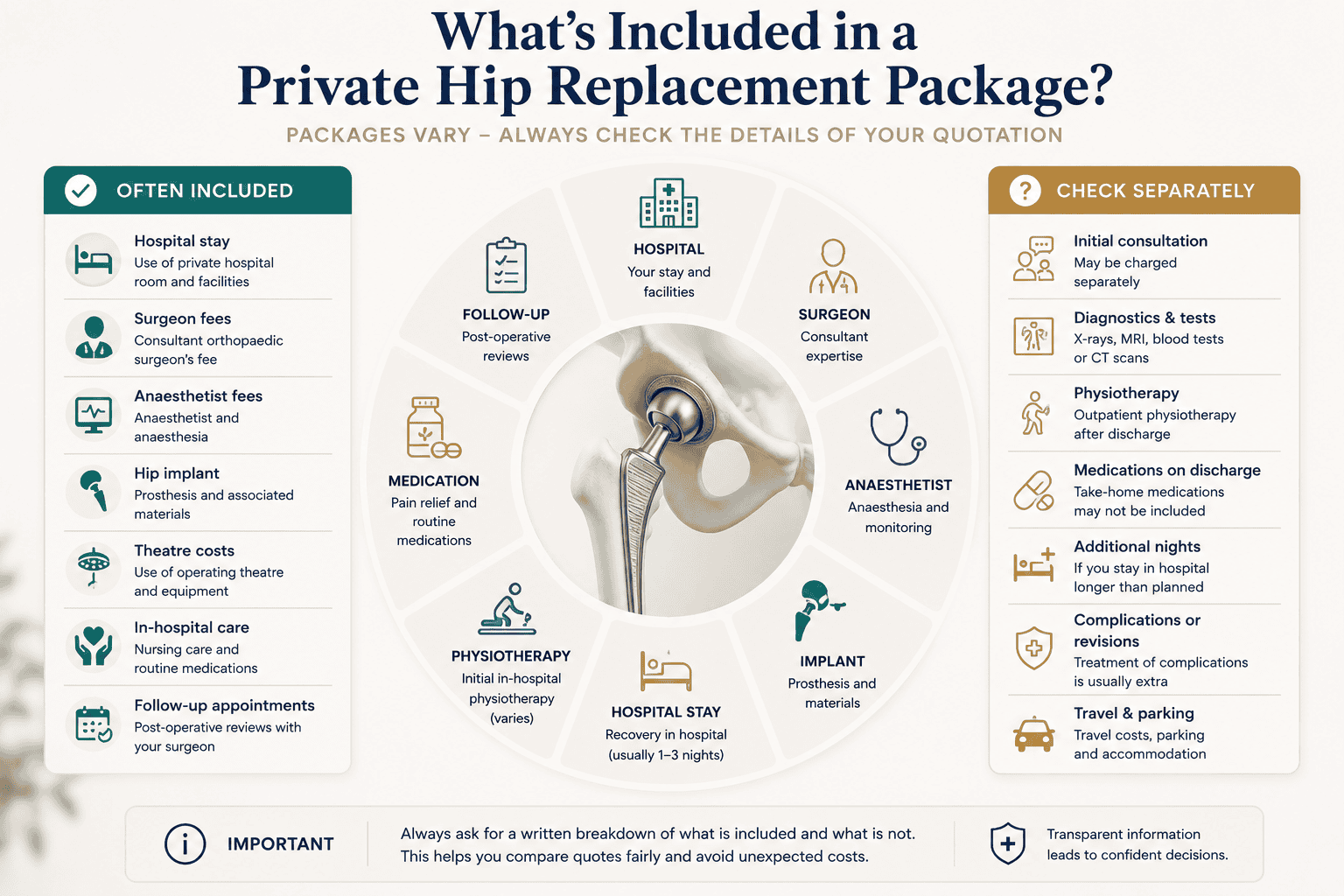
There is no universal private hip replacement package. The only reliable way to know what you will pay is to check the written inclusions and exclusions in your own quotation.
PHIN says a package usually covers the main costs of care, including the surgeon, anaesthetist and hospital fees. However, it does not always include the first consultation, and services such as physiotherapy may be charged separately.
| Cost or service | May be included | What you should check |
|---|---|---|
| Hospital treatment | Often | What length of stay is covered? |
| Surgeon | Often | Is the consultant’s full fee included? |
| Anaesthetist | Often | Is the anaesthetic fee included? |
| Implant/prosthesis | Varies | Is it included and what implant is proposed? |
| Initial consultation | Not always | Is this charged separately? |
| Pre-operative assessment | Varies | Is it included? |
| Blood tests | Varies | Are required investigations covered? |
| X-rays/scans | Varies | Are diagnostic investigations included? |
| Physiotherapy | Varies | How much rehabilitation is included? |
| Medication | Varies | Are medicines during and after treatment covered? |
| Follow-up appointments | Varies | How many are included? |
| Additional hospital nights | Varies | What happens if you need to stay longer? |
Hospital and surgical costs
A package may combine the hospital costs and professional fees associated with your operation.
However, you should establish whether the advertised amount represents the complete planned treatment cost or only certain elements.
A particularly important distinction is whether the consultant’s and anaesthetist’s professional fees are included.
Surgeon and anaesthetist fees
Anaesthetist fees are separate professional fees, although they may be included within a hospital package. The exact arrangement should be confirmed with the hospital.
Ask:
- Is the surgeon’s fee included?
- Is the anaesthetist’s fee included?
- Is either fee estimated rather than fixed?
- Could either fee change?
Depending on the pricing arrangement, you may receive separate charges for different professional services.
Implant and prosthesis
A hip replacement replaces damaged parts of the hip joint with an artificial joint, or prosthesis. The most suitable implant depends on your individual circumstances and should be discussed with your surgeon.
From a cost perspective, the important question is whether the prosthesis is included in your quotation.
Ask:
“Is the implant or prosthesis included in this price, and what implant is being proposed for me?”
The purpose of asking is to understand your treatment and quotation, not to choose an implant simply because it is cheaper or more expensive. Implant choice should be considered in the context of your individual circumstances, the proposed procedure and the available clinical evidence.
Hospital stay and aftercare
Your package may include the expected hospital stay and some follow-up care.
However, establish what happens if you need to remain in hospital longer than expected.
Additional nights may not be included in an original package, particularly where unexpected circumstances or complications arise.
Aftercare also needs checking. Ask whether follow-up appointments, physiotherapy and other rehabilitation are included and, if so, for how long.
What extra costs might you have to pay?
The advertised price is only useful if you understand what sits behind it.
PHIN advises patients to obtain a written quotation and check exactly what it includes. It highlights consultations, diagnostics, take-home medication, additional nights and aftercare as areas that can fall outside a package.
Common costs to check before booking
- Initial consultation
- Pre-operative assessment
- Blood tests
- X-rays or other scans
- Surgeon fee
- Anaesthetist fee
- Implant/prosthesis
- Hospital accommodation
- Additional nights
- Physiotherapy
- Medication during your stay
- Take-home medication
- Follow-up appointments
- Additional treatment if your care becomes more complex
PHIN notes that hospitals may charge for items such as nursing, accommodation, meals, tests, medication, dressings, prostheses, X-rays, scans, physiotherapy and take-home medication. PHIN does not currently collect national pricing data for these individual additional costs.
What happens if you need additional treatment or a longer stay?
Ask this before your operation:
“If I need additional treatment or have to stay in hospital longer than expected, who pays for it?”
Needing additional treatment does not automatically mean you will have to pay more. Your financial responsibility depends on the terms of the package, your insurance arrangements and the circumstances.
The important point is to understand those terms before treatment.
Can the price change after you’ve booked?
It can.
A price described as a guide price, starting price or estimate should not automatically be treated as a final fixed cost.
Ask:
“Is this a fixed price for my treatment, and under what circumstances could it change?”
If it is not fixed, ask which elements remain uncertain.
Package price vs paying separate fees
Private treatment can be priced in different ways.
Package pricing
A package combines a number of treatment costs into one quoted amount.
This can make budgeting easier because several costs are brought together.
However, package does not necessarily mean completely all-inclusive.
PHIN specifically advises patients to check what is and is not covered.
Fee-per-service pricing
Under a fee-per-service arrangement, individual components may be charged separately.
Depending on the arrangement, you may encounter separate charges associated with:
Hospital + surgeon + anaesthetist + investigations + other services
Private patients can therefore receive separate invoices for different parts of their treatment.
Why this matters when comparing quotations
Imagine two quotations both appear to be £15,000.
If one includes the surgeon, anaesthetist, implant, hospital stay and follow-up while the other excludes several of these, £15,000 is not really the same price.
The comparison needs to be made on a like-for-like basis.
KEY TAKEAWAY: COMPARE LIKE WITH LIKE
Don’t ask only, “Which quotation is cheaper?”
Ask, “What is the likely total cost of each option, and what exactly is included?”
Why do private hip replacement prices vary?
There are several legitimate reasons why private hip replacement prices differ.
Location
PHIN’s March 2026 data demonstrate substantial geographical variation.
The city averages currently range from £13,847 in Glasgow to £17,540 in Cambridge, while London’s average is £15,712.
These are averages, not fixed regional prices.
Hospital
Private hospitals have different costs and pricing structures.
They may also present their prices differently. One provider may combine several costs into a package while another separates some services.
This is why the contents of the quotation matter as much as the headline number.
Consultant and anaesthetist fees
Professional fees can form part of the overall cost.
Depending on the pricing model, they may be incorporated into the package or billed separately.
Implant and procedure
The procedure and implant selected should be based on your clinical circumstances and discussed with your surgeon.
NICE recommends shared decision-making around joint replacement, including discussion of the potential benefits and risks, implant choice, anaesthesia and what to expect before and after surgery.
The most expensive option should not automatically be assumed to be the most appropriate.
Length of stay and additional care
A planned admission has an expected length of stay.
If additional care is required, however, the financial position may change depending on the provider’s terms.
Ask specifically what happens if you need an additional night.
Primary versus revision surgery
A primary hip replacement is the initial replacement of a hip joint.
A revision procedure is surgery to revise, replace or otherwise address one or more components of an existing hip replacement.
Revision procedures can be more complex than primary replacement and should not be compared directly with the price of a routine primary hip replacement.
If you are considering revision surgery, ask for a quotation specifically for the procedure you require rather than using a primary hip replacement benchmark.
How do I know whether my hip replacement quote is reasonable?
There is no single price at which a private hip replacement becomes “reasonable”.
A quotation needs to be considered in context.
The PHIN benchmark can tell you how a headline price compares with current city-level averages, but it cannot tell you whether a particular treatment is appropriate for you or whether every important cost has been included.
Five checks before judging a quote
1. Compare the headline price with the relevant PHIN benchmark
Find the closest PHIN location to where you are considering treatment.
Remember that PHIN’s figures are city-level averages, not target prices.
A quotation above the benchmark is not automatically excessive, and one below it is not automatically better value.
2. Check exactly what is included
Look at the quotation line by line.
Check:
- hospital
- surgeon
- anaesthetist
- implant
- consultation
- investigations
- hospital stay
- physiotherapy
- medication
- follow-up
3. Add known additional costs
If the consultation, diagnostic tests or other services are excluded, establish their prices.
Don’t leave known costs out simply because they aren’t part of the headline package.
4. Identify potential or uncapped costs
Ask what happens if:
- you need an additional night
- additional investigations are required
- treatment changes
- complications occur
You are not trying to predict whether these things will happen.
You are establishing what the financial arrangements would be if they did.
5. Consider the clinical and practical proposition
Price is only one part of the decision.
You should also consider whether the proposed treatment is appropriate, the information available about the surgeon and hospital, the arrangements for aftercare and the practicalities of travelling for treatment.
So, is a £16,000 quote expensive?
The number alone cannot answer that question.
You need to know what the £16,000 includes.
A £16,000 quotation that includes substantially more than a £15,000 quotation may represent a different financial proposition.
This is why quote completeness is often more useful than simply asking whether the price is high or low.
BEFORE BOOKING
Make sure you know:
what is included + what is excluded + what could cost extra + whether the price is fixed
How to compare two private hip replacement quotations
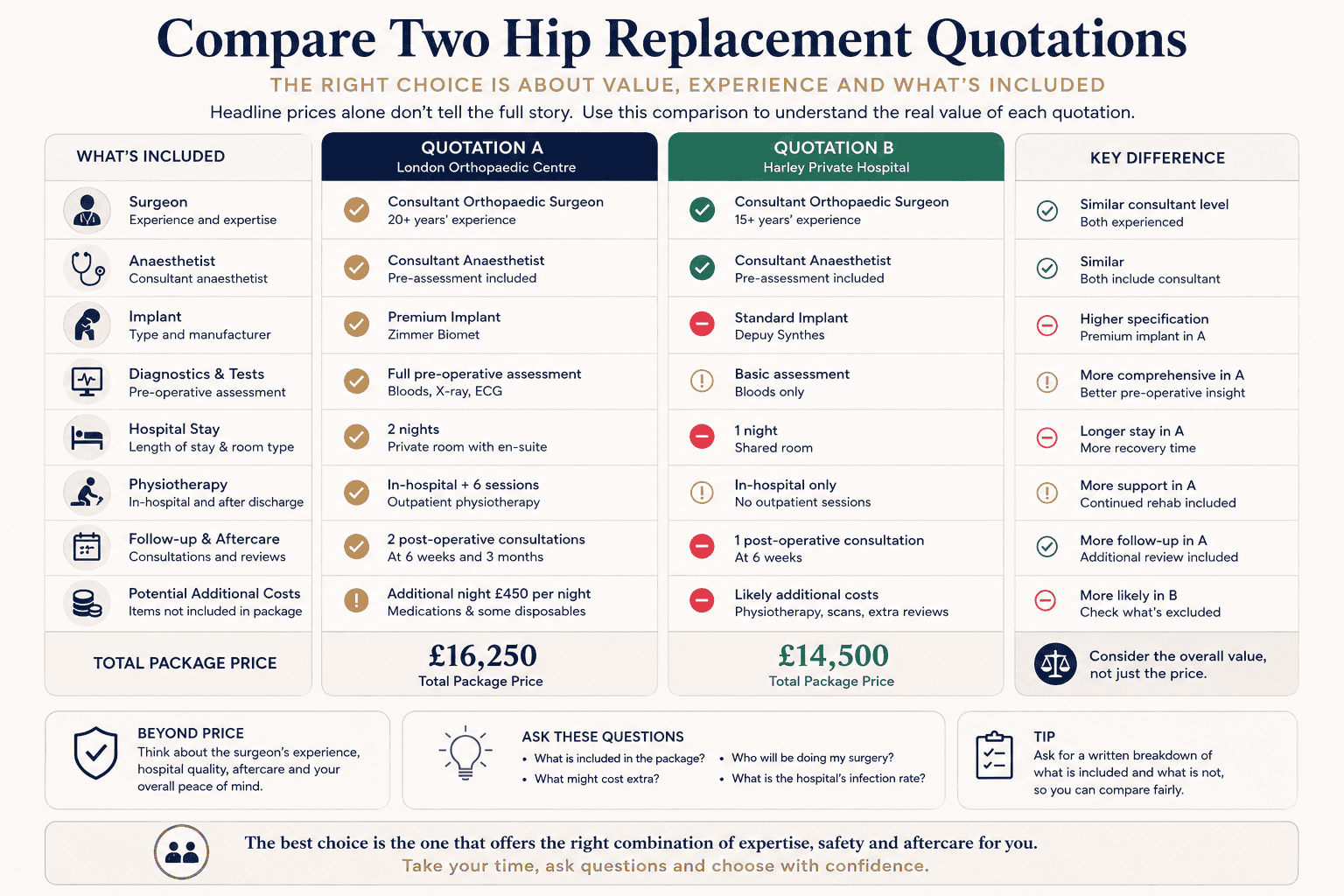
If you have quotations from two providers, don’t simply put the two headline figures side by side.
Compare what each quotation actually contains.
Quote comparison checklist
| Cost or service | Quote A | Quote B |
|---|---|---|
| Hospital package | £ | £ |
| Surgeon | Included / £ | Included / £ |
| Anaesthetist | Included / £ | Included / £ |
| Implant | Included / £ / unclear | Included / £ / unclear |
| Initial consultation | £ | £ |
| Pre-assessment | Included / £ | Included / £ |
| Blood tests | Included / £ | Included / £ |
| Imaging | Included / £ | Included / £ |
| Hospital stay | Number of nights | Number of nights |
| Physiotherapy | Included / £ / unclear | Included / £ / unclear |
| Medication | Included / £ / unclear | Included / £ / unclear |
| Follow-up | Included / £ / unclear | Included / £ / unclear |
| Additional nights | Terms | Terms |
| Additional treatment | Terms | Terms |
| Known total | £ | £ |
| Unknown/potential costs | List | List |
What makes two quotations genuinely comparable?
Two quotations are comparable only when you understand:
- what both include
- what both exclude
- which costs are fixed
- which costs could change
- what happens if additional treatment is required
A lower headline price can become more expensive once excluded costs are added.
A higher headline price may include services that another provider charges separately.
That is why the objective is not to find the lowest headline price.
It is to understand the most comparable total cost.
A useful way to think about your quotation
Headline package price
↓
+ known excluded costs
↓
+ potential costs you need to understand
↓
Realistic financial commitment
You may not be able to predict every possible cost before treatment. But you should be able to identify what is known, what is included and what remains uncertain.
What should I consider besides price?
Cost matters, especially if you are paying yourself.
But hip replacement is not simply a product that can be compared by price.
NICE recommends shared decision-making for joint replacement, including discussion of potential benefits and risks, implant choice, anaesthesia and what to expect before, during and after surgery.
Clinical suitability
Before comparing prices, establish whether hip replacement is appropriate for you.
NICE recommends considering referral for joint replacement when symptoms substantially affect quality of life and non-surgical management has been ineffective or is unsuitable.
Surgeon and hospital information
Understand who will perform your surgery and where it will take place.
The National Joint Registry (NJR) collects data on joint replacement procedures and provides information on implants, hospitals and surgical outcomes. It also provides patient decision-support information to help people understand questions and risks relevant to their circumstances.
NJR information should be considered alongside your clinical discussion rather than treated as a simple league table for choosing a surgeon.
Outcomes and patient experience
Price alone does not tell you what outcome you will have.
Consider the information available about the treatment, surgeon and hospital, together with the arrangements for aftercare.
Convenience and aftercare
Think beyond the operation itself.
Ask:
- Where will follow-up appointments take place?
- How is physiotherapy arranged?
- Who do you contact if you have a problem after going home?
- Is travelling to the hospital practical for you?
For a broader explanation of the clinical decision, operation, recovery and risks, see the complete Hip Replacement Guide.
What should I ask the hospital or private provider?
The hospital or private provider should be able to explain the financial and practical terms of your treatment.
About the quotation
- Is this a fixed price or a guide price?
- Exactly what is included?
- What is excluded?
- When will the final price be confirmed?
- Could the price change after my consultation or investigations?
About the treatment package
- Is the surgeon’s fee included?
- Is the anaesthetist’s fee included?
- Is the implant included?
- How many hospital nights are included?
- Are pre-operative tests included?
- Are scans included?
- Is physiotherapy included?
- Are medication and take-home medicines included?
- How many follow-up appointments are included?
About unexpected costs
- What happens if I need another night in hospital?
- What happens if I need additional treatment?
- What happens if a complication changes the planned treatment?
- Who would tell me if additional costs were going to arise?
Ask for the answers in writing wherever possible. PHIN recommends obtaining a written quotation and checking what it includes before agreeing to treatment.
What should I ask the surgeon?
The surgeon’s role is different from the hospital’s role.
The surgeon should help you understand the clinical decision, rather than simply the price.
Useful questions include:
- Why do you recommend hip replacement for me?
- Are there reasonable alternatives?
- What operation are you recommending?
- What implant or prosthesis do you propose, and why is it suitable for me?
- What are the important risks in my circumstances?
- What outcome should I realistically expect?
- What will recovery involve?
- What happens if I develop a problem after surgery?
The choice of implant should be discussed in the context of your individual circumstances, the proposed operation and the available evidence.
The financial decision and the clinical decision should inform each other, but they are not the same decision.
Is a more expensive hip replacement necessarily better?
No.
A higher price does not automatically mean better treatment.
Equally, a lower price does not automatically mean poorer treatment.
Prices can differ because of location, hospital costs, professional fees, package structure, included services and other factors.
The right question is therefore not:
“Which option costs the most?”
or:
“Which option is cheapest?”
It is:
“Which treatment is clinically appropriate for me, and what exactly am I paying for?”
Can I afford a private hip replacement?
If you are paying for treatment yourself, work out the likely total financial commitment, rather than budgeting around the headline package price alone.
Start with:
Quoted treatment price
- known excluded costs
- known additional consultations/tests
- potential costs you need to understand
= realistic budget
You should also establish whether the price is fixed or indicative and what would happen if your treatment changes.
Self-pay versus private medical insurance
With self-pay, you pay for your private treatment yourself.
With private medical insurance, your insurer may contribute towards eligible treatment according to the terms of your policy.
Insurance arrangements vary.
Before proceeding, check:
- whether your treatment has been authorised
- whether your consultant is covered
- whether you have an excess
- whether there are exclusions or limits
- whether the consultant’s fees fall within your insurer’s approved arrangements.
PHIN warns that a consultant’s fee can exceed the amount recognised by an insurer, potentially leaving the patient responsible for the difference.
Do not assume that having private medical insurance means every cost associated with hip replacement will automatically be covered.
What about finance?
Some private healthcare providers offer finance or payment plans for self-pay treatment.
Availability, interest rates, eligibility and repayment terms vary.
If you consider finance, look at the total amount repayable, not just the monthly payment, and make sure the repayments are affordable.
Finance should help you understand how you would pay for treatment; it should not determine which treatment you choose.
Frequently asked questions about hip replacement cost
How much does a private hip replacement cost in the UK?
Current PHIN city-average package prices range from £13,847 to £17,540 per hip across the 17 UK locations covered by its March 2026 pricing dataset. These are average package prices rather than guaranteed individual quotations.
What is the average cost of a hip replacement in the UK?
There is no single PHIN national average that should be treated as the definitive UK price. PHIN currently publishes city-level average package prices, ranging from £13,847 to £17,540 across its covered locations.
What is a normal private hip replacement price?
Current PHIN city averages are broadly in the mid-£10,000s, but there is no single normal UK price. The exact amount depends on location, provider, your circumstances and what the package includes.
What does a private hip replacement package include?
PHIN says a package usually covers the main costs of care, including hospital, surgeon and anaesthetist fees. However, packages vary and may not include the initial consultation or services such as physiotherapy.
Is the surgeon included in a private hip replacement price?
Often, a surgeon’s fee forms part of a private treatment package. However, pricing arrangements vary, so check whether the consultant’s full fee is included in your quotation.
Is the anaesthetist included?
An anaesthetist’s fee may be included within a package or charged separately. PHIN advises patients to check the arrangement for their particular treatment.
Is the hip implant included in the price?
Not necessarily. Implant arrangements vary between providers and packages. Ask whether the prosthesis is included in your quotation and what implant is being proposed for you.
Are scans and diagnostic tests included?
Not necessarily. Diagnostic investigations can be charged separately depending on the provider and package. Ask which tests are included before treatment.
Is physiotherapy included after hip replacement?
It depends on the package. Physiotherapy may be included or charged separately. Rehabilitation is an important part of recovery, so ask exactly what postoperative physiotherapy is provided and for how long.
What happens if I need another night in hospital?
An additional hospital stay may result in extra costs if it falls outside the agreed package. Ask the provider what their terms are for additional nights before your operation.
Can the price of a private hip replacement change?
Yes. A guide or indicative price may change if your treatment plan changes or additional care is required. Ask when the final quotation will be confirmed and what circumstances could change it.
What is the difference between a package price and the total cost?
A package price combines some or many costs into one quoted amount. The total cost is the amount you ultimately have to pay after considering anything excluded from the package and any additional costs that arise. A package is therefore not automatically the same as your final bill.
How do I know whether my hip replacement quote is reasonable?
Compare it with the relevant PHIN city benchmark, then check what is included, what is excluded, which costs are fixed and what could lead to additional charges. Price alone cannot determine whether a quotation is appropriate for you.
How should I compare two hip replacement quotations?
Compare the total known cost and the inclusions, rather than just the advertised price. Check the surgeon, anaesthetist, implant, hospital stay, investigations, physiotherapy, medication, follow-up and arrangements for additional nights or treatment.
Is a more expensive hip replacement better?
Not necessarily. Price is affected by many factors and is not, by itself, a measure of clinical quality. Consider clinical suitability, the available information about the surgeon and hospital, aftercare and the total cost.
How much does a hip replacement cost in London?
PHIN’s current London city-average package price is £15,712, based on publicly available pricing data collected in March 2026. This is an average package price rather than a guaranteed London price for an individual patient.
Is private hip replacement cheaper in some parts of the UK?
PHIN’s current city data show variation between locations. Its March 2026 averages range from £13,847 in Glasgow to £17,540 in Cambridge. These figures should not be interpreted as fixed regional prices because individual quotations and package contents vary.
Does private medical insurance cover hip replacement?
It may, depending on your policy and circumstances. Check authorisation, your excess, exclusions or limits and whether the consultant’s fees are covered before arranging treatment. PHIN also advises patients to check whether a consultant’s fee exceeds their insurer’s approved amount.
Can I pay for a private hip replacement using finance?
Some private providers offer finance or payment plans. Terms, interest rates and eligibility vary. If you consider finance, check the total amount repayable and whether the repayments are affordable.
What should I do next?
Still deciding whether hip replacement is right for you?
Start with the complete Hip Replacement Guide.
It covers the clinical side of the decision, including what hip replacement involves, recovery, risks and the questions you may want to discuss with your surgeon.
Already have a private quotation?
Your next question is different:
What does the quotation actually mean?
Work through the price, inclusions, exclusions, potential additional costs and terms before deciding.
Comparing quotations?
Use the checklist above to make sure you are comparing like with like.
The aim is not to find the cheapest hip replacement.
It is to understand what you are paying for, what you might still have to pay, and what you need to know before you say yes.
Sources and evidence
Pricing information in this guide is based primarily on the Private Healthcare Information Network (PHIN), including its current city-level average package-price data and guidance on private treatment pricing and self-funding.
Clinical information and recommendations are supported by NICE and the NHS, with the National Joint Registry (NJR) providing information on joint-replacement monitoring, implant information and outcomes.
Pricing information is time-sensitive. The PHIN city figures quoted above were collected in March 2026 and the relevant PHIN pricing page was updated on 22 April 2026. Individual providers may subsequently change their prices.
Last reviewed for pricing and evidence: September 2026.
| External source | What it was reviewed for | Clean link |
|---|---|---|
| NICE — National Institute for Health and Care Excellence | Osteoarthritis, referral for joint replacement and shared decision-making | NICE — Osteoarthritis in over 16s (NG226) |
| NICE — National Institute for Health and Care Excellence | Primary hip replacement, including benefits, risks, implants, anaesthesia and recovery | NICE — Joint replacement: primary hip, knee and shoulder (NG157) |
| NHS | What a hip replacement involves and general patient information | NHS — What is a hip replacement? |
| National Joint Registry (NJR) | Hip replacement, implant choices, risks and shared decision-making | NJR — Hip replacement |
| National Joint Registry (NJR) | Personalised decision support for hip and knee replacement | NJR — Patient Decision Support Tool |
| National Joint Registry (NJR) | Surgeon and hospital information and outcomes | NJR — Surgeon and Hospital Profile |
About this guide
Written by: Active Again Medical Team
Medically reviewed by:
Published: September 2026
Last medically reviewed: September 2026
Next review due: September 2027
This guide has been prepared using current UK healthcare information and guidance from recognised organisations, including NICE, the NHS and the National Joint Registry. Pricing information is based on the latest available data and is clearly dated because private healthcare prices can change.
The information is intended to help patients understand the potential cost of private hip replacement and the questions they should ask when comparing treatment options and quotations. It is general information and should not be used as a substitute for advice from your GP, orthopaedic surgeon or other qualified healthcare professional.
External sources reviewed (Links in the table above)
For transparency, we provide links to the principal external sources reviewed when preparing this guide:
- NICE — Osteoarthritis in over 16s (NG226)
- NICE — Joint replacement: primary hip, knee and shoulder (NG157)
- NHS — Hip replacement
- National Joint Registry — Hip replacement
- National Joint Registry — Patient Decision Support Tool
- National Joint Registry — Surgeon and Hospital Profile
Information and recommendations can change over time. We review our medical content periodically and update it when significant changes to clinical guidance, evidence or pricing information occur.
Active Again is an independent patient-information website. It is not a hospital or clinic and does not provide medical treatment.